
Abstract:Through the deployment of 450 SRESKY Atlas SSL-36M all-in-one solar street lights, this case study successfully addressed challenges in the Indonesian village of Sukamaju—including a long rainy season, tree canopy shading, high humidity and temperatures, and a lack of professional maintenance—achieving stable off-grid lighting and low-cost, long-term operation and maintenance in an extreme tropical environment.
Project Background
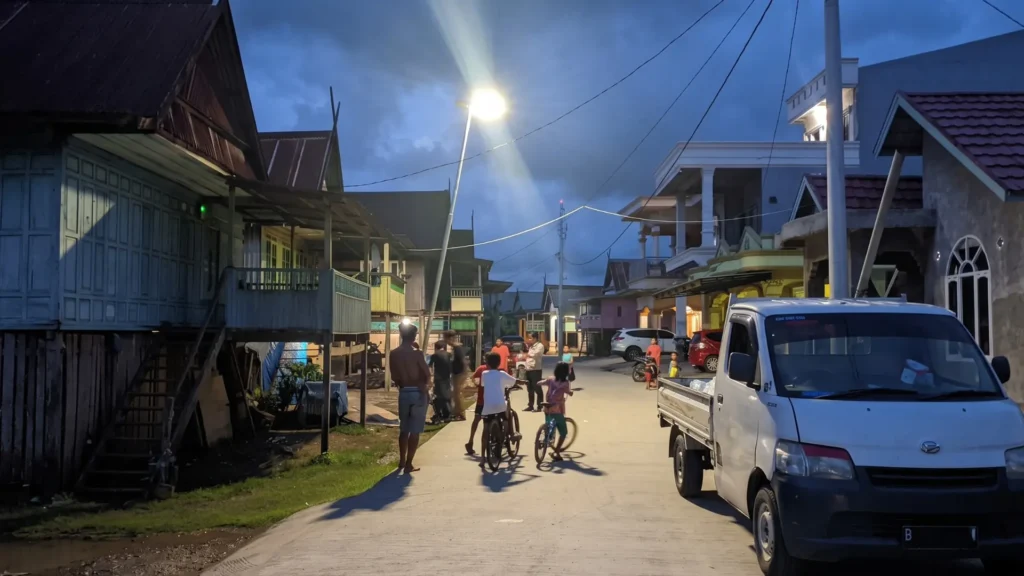
By 6:00 p.m., the main road in Sukamaju Village, West Java, is already plunged into darkness. Women heading to evening prayers, students returning from tutoring sessions, and vendors closing their shops have, for years, relied solely on motorcycle headlights to illuminate their way.
The village is located far from the nearest substation, and grid extension has never been a budget priority. Meanwhile, dense tropical tree canopy along both sides of the road causes most traditional solar streetlights to fail within the first rainy season.
In late 2025, the local Village Self-Governance Council (BPD) commissioned the contractor CV. Cahaya Nusantara to identify a rural lighting solution capable of withstanding Indonesia’s long rainy season, heavy canopy shading, and minimal maintenance requirements. After evaluating multiple suppliers, the project deployed 450 SRESKY Atlas SSL-36M all-in-one solar street lights along the village’s main road, school playground, and community center.
Project Snapshot
| Project Parameter | Details |
|---|---|
| Project Name | “Smart Village” Lighting Upgrade in Sukamaju Village, West Java, Indonesia |
| Installation Locations | Unpaved rural main roads, public elementary school, community activity center |
| Responsible Agency | Village Self-Governance Committee (BPD), implemented by CV. Cahaya Nusantara |
| Selected Product | SRESKY Atlas SSL-36M All-in-One Solar Street Lights |
| Project Scale | 450 units covering approximately 21 km of roads and key public nodes |
The Threefold Challenge of Tropical Rural Lighting and the Solution
In Sukamaju Village, the challenge is not simply a lack of electricity, but the combination of extreme climate, complex biological conditions, and zero-maintenance constraints—factors that render most conventional solutions ineffective.
Challenge 1: Insufficient Power Generation Due to Prolonged Low Sunlight and Canopy Shading
Located in the tropical rainforest belt, Sukamaju Village experiences significant fluctuations in solar resources:
- Prolonged overcast conditions during the rainy season
- Uneven sunlight due to dense tree canopy shading
- Reduced charging efficiency in conventional systems
Common issues include:
- Insufficient battery charge after long rainy periods, leading to reduced lighting duration
- Lower efficiency in split-system configurations under shaded conditions
- High grid connection costs, making deployment uneconomical
SRESKY’s solution—maximizing limited solar energy utilization:
- ALS 2.2 Smart Battery Management System: Dynamically allocates power when battery levels are low, prioritizing essential lighting duration.
- PIR Motion Sensor (120° / 8 m): Automatically switches to low-brightness mode when no motion is detected and returns to full brightness upon detection, improving energy efficiency.
- BMS Battery Management: Improves charging efficiency by over 30%, enabling faster recovery during brief sunlight windows.
- High-efficiency monocrystalline solar panels (>23%): Ensures effective energy harvesting even in low-light conditions.
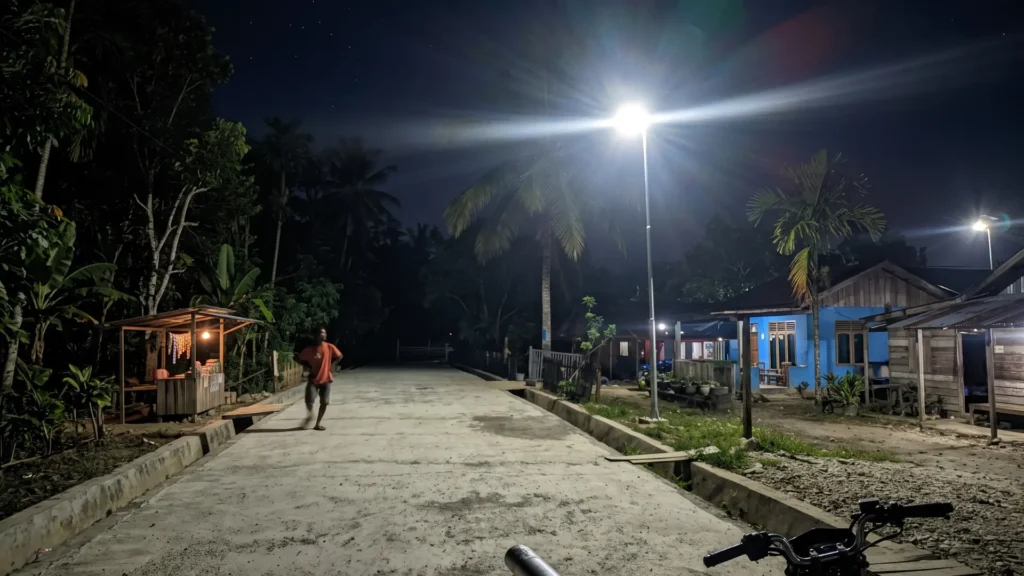
Field results: Stable lighting for over 10 days of continuous rainy weather without grid connection or excavation work, significantly reducing installation time.
Challenge 2: High Humidity and Insect-Prone Environments Increase Equipment Failure Risk
Local temperatures exceed 30°C year-round, creating harsh conditions for outdoor electronics:
- Persistent high temperatures
- Day–night temperature swings causing internal condensation
- Insects and dust entering lamp housings
Common failure modes:
- Corrosion or short circuits at wiring terminals
- Accelerated battery degradation
- Water ingress in split-structure systems
SRESKY’s solution—fully sealed integrated design:
- IP65 integrated structure with IK08 impact resistance: All components (solar panel, battery, controller, LEDs) are integrated into a sealed aluminum housing, preventing moisture, dust, and insect intrusion.
- TCS intelligent thermal protection: Automatically regulates current and stops charging when temperatures approach safety thresholds.
- Automotive-grade lithium battery: Over 1,500 charge cycles, supporting a service life exceeding 10 years under local usage conditions.
Challenge 3: Lack of Sustainable Maintenance Capacity in Remote Areas
Sukamaju Village has no full-time electricians, leading to:
- Absence of local technical personnel
- Slow response to equipment failures
- Dependence on external contractors
- High and unpredictable maintenance costs
SRESKY’s solution—modular, user-friendly maintenance design:
- Modular quick-change structure: Components can be replaced directly on the pole without rewiring, enabling quick repairs by non-professionals.
- Independent off-grid operation per unit: Failure of a single light does not affect the rest of the system, ensuring system-wide reliability and controllable O&M costs.
Project Results
Based on operational feedback during typical tropical rainy-season conditions:
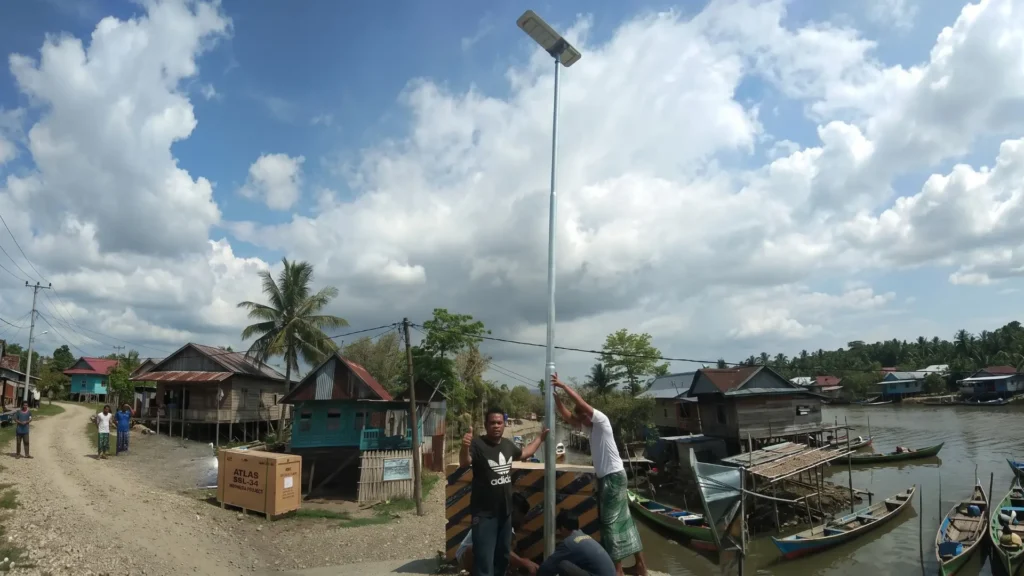
- All 450 units are operating normally across 21 km of roads and key public areas
- No large-scale outages occurred during the first rainy season
- Lighting duration increased by over 30% under low-battery conditions compared to fixed-output systems
- System maintained high availability even under extreme weather conditions
- No grid connection required, significantly reducing infrastructure costs
Contractor Evaluation
“We’ve tried other suppliers before—they looked good on paper, but they failed once the rainy season actually hit. With this project, the roads never went dark, even during the worst of the rainy season. Installation was fast, with no road excavation or wiring required, which was crucial for our budget.”
— Hendra Gunawan, Project Manager, CV. Cahaya Nusantara
Frequently Asked Questions (FAQ)
Q: Are rural roads with heavy tree shading suitable for solar streetlights?
A: Yes, but only with adaptive systems. Shading reduces solar input significantly, which standard systems cannot compensate for. Adaptive energy management systems such as SRESKY ALS 2.2 dynamically adjust output based on remaining energy, enabling continued operation in low-light conditions.
Q: What type of solar streetlights are suitable for humid tropical environments?
A: All-in-one sealed systems are preferred. Split-type systems introduce more connection points, increasing the risk of water ingress and insect damage. IP65 or higher fully sealed designs are more reliable in such environments.
Q: What should be considered in large-scale rural lighting projects?
A: Total cost of ownership (TCO) is more important than unit price. Maintenance frequency, battery lifespan, and failure rates have greater long-term impact than initial procurement cost, especially in remote areas without service infrastructure.
Conclusion
The Sukamaju Village project demonstrates that the core challenge of tropical rural solar lighting is not brightness alone, but long-term reliability under extreme environmental stress and minimal maintenance capacity.
By combining adaptive energy management, a fully sealed integrated structure, and modular maintenance design, the SRESKY Atlas SSL-36M transforms rural lighting from a short-term installation into a long-term public infrastructure asset.
For municipal planners and rural infrastructure developers, this case provides a practical reference: in off-grid environments, system design and lifecycle reliability matter more than initial equipment cost.