
Table of Contents
Marinas after dusk differ significantly from ordinary road environments.
Vehicles need to enter and exit, staff must conduct patrols, and boats require nighttime maintenance. At the same time, the area is exposed to coastal salt fog, intense sunlight, highly reflective boat hulls, and complex operational conditions.
Simply increasing the brightness of solar street lights may not solve the underlying challenges. High temperatures can shorten battery lifespan, excessive lighting may cause glare, and large open areas may still experience insufficient illumination.
Therefore, this project required a solar street lighting solution capable of withstanding coastal environments and high temperatures while ensuring long-term, stable operation.
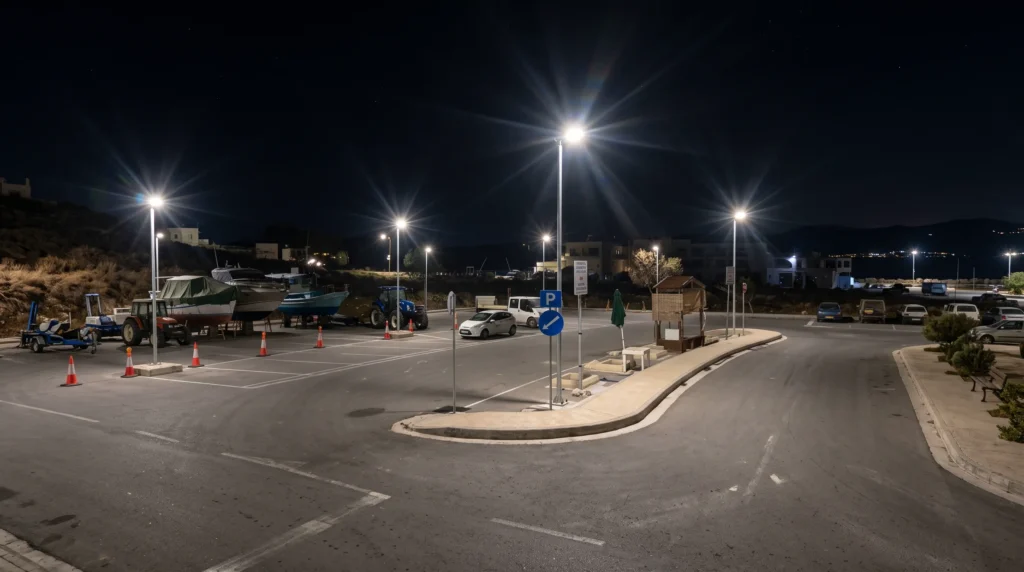
Located in a coastal marina in Cyprus, this project deployed 80 sets of Sresky Atlas Series solar street lights along marina roads, parking areas, and vessel operation zones to provide reliable off-grid lighting.
Project Information
Project Type: Solar Street Lights for Marina/Port Areas
Project Location: Coastal Marina, Cyprus
Key Areas: Marina roads, parking areas, and boat operation zones
Solution Series: Customized Sresky Atlas Solar Street Lights
Number of Fixtures: 80 sets
Challenge 1: High-Temperature Environments Affect the Stability of Solar Street Lights
Cyprus experiences extremely high temperatures during summer. The black asphalt, concrete surfaces, and metal boat hulls in the marina continuously release heat, causing the internal temperature of solar street lights to exceed that of typical road environments.
For off-grid lighting systems, long-term reliability depends not only on short-term brightness but also on whether the battery can maintain stable performance over an extended period.
Key risks include:
- High temperatures reducing battery efficiency;
- BMS protection being triggered, affecting nighttime lighting duration;
- Long-term thermal stress accelerating battery degradation;
- Increased maintenance costs over the system’s lifespan.
Therefore, this project focused on addressing the thermal management challenges of solar street lights operating in high-temperature environments.
Solution: Optimizing Heat Dissipation Structure to Enhance Reliability in High-Temperature Environments
Rather than simply increasing battery capacity, the project optimized the lighting system from a thermal management perspective.
The Atlas Series solar street light adopts a layered structure that separates the photovoltaic panel from the battery compartment. This design reduces direct heat transfer from the solar panel while using airflow to lower internal temperatures.
Additionally, the TCS intelligent temperature control system automatically adjusts charging and discharging strategies according to environmental changes, helping reduce the risk of system shutdowns during extreme heat conditions.
Under intense sunlight, the layered structure and intelligent temperature control design significantly reduce the temperature of the Atlas Series battery compartment compared with traditional compact integrated solar street lights, thereby improving operational stability in high-temperature environments.
For coastal regions with high temperatures, such as Cyprus, stable operational performance is one of the most important factors when selecting solar street lighting solutions.
Challenge 2: Port Areas Require Uniform Lighting While Minimizing Glare from Ship Hulls
Port area lighting must not only illuminate roadways but also meet the operational requirements of parking areas, trailer traffic, and vessel activities.
The large number of white boat hulls, metal equipment surfaces, and reflective signs at the site can amplify light reflection. Simply increasing luminaire power may result in excessive brightness directly beneath the lights and strong glare from vessel surfaces, while areas between light poles may still experience insufficient illumination.
Key issues include:
- Visual discomfort caused by highly reflective surfaces;
- Reduced operational comfort during nighttime activities;
- Uneven illumination in areas with widely spaced light poles;
- Increased energy consumption without effectively improving lighting efficiency.
Therefore, precise light distribution was required instead of simply increasing brightness.
Solution: Combining Lighting Simulation with Precise Light Distribution to Improve Port Area Lighting Efficiency
The project team conducted IES/DIALux lighting simulations based on the actual road layout, pole spacing, and functional zones to optimize the solar street light installation plan.
After evaluation, the Sresky Atlas SSL-316 model was selected, providing a luminous flux of 10,000 lm. Combined with Type II road-type light distribution, the solution delivers focused illumination for roads and operational areas while reducing unnecessary light spill.
Additionally, through PIR motion sensing (120° detection range, up to 8 meters) and time-based dimming strategies:
- Brightness is reduced during low-activity periods at night;
- Lighting automatically increases when people or vehicles enter the area;
- Unnecessary energy consumption is reduced.
This solution ensures safe and efficient lighting while minimizing glare issues in port environments, making it particularly suitable for complex applications such as boat docks and industrial areas.
Project Outcomes
Following a customized design approach, 80 Sresky Atlas Series solar street lights were installed to illuminate the port area’s roads, parking lots, and vessel operation zones.
Key Outcomes:
- Stable Operation in High-Temperature Conditions:
The lights maintained stable operation during summer temperatures of approximately 42°C, with no power interruptions caused by high-temperature BMS protection activation. - Enhanced Nighttime Safety:
Optimized light distribution reduced dark areas and improved safety for vehicles and pedestrians. - Reduced Maintenance Requirements:
The absence of underground battery compartments minimizes the impact of coastal humidity and corrosion, reducing long-term maintenance needs. - Smart Energy Savings:
PIR sensors and intelligent dimming strategies reduce energy consumption during low-demand periods.
Previously, Sresky completed the deployment of 233 Atlas Series solar street lights along the southwest coast of Cyprus, between Paphos and Limassol. This project was exposed to high salt fog, strong winds, and complex coastal conditions for an extended period, providing valuable practical experience for the current marina lighting project.
Customer Feedback
“Our main concerns were whether the lights could operate continuously and reliably under high summer temperatures, and whether the lighting system would create excessive glare in the port area. The Atlas Series performed well in both aspects and successfully met our operational requirements.”
— Terminal Facilities Operations Manager
FAQ: Common Questions About Solar Street Lights in Port Areas
1. Are solar street lights suitable for installation in coastal port areas?
Yes. However, it is essential to select a solar street lighting solution specifically optimized for coastal environments.
Key factors to consider include:
- Salt fog resistance;
- Battery heat dissipation design;
- High-temperature protection systems;
- Long-term maintenance costs.
A suitable solution should be designed to withstand corrosion, temperature fluctuations, and continuous outdoor exposure.
2. How should solar street lights be selected for high-temperature regions?
When selecting solar street lights for high-temperature areas, the following factors should be carefully evaluated:
- Battery thermal management capabilities;
- BMS protection strategies;
- Lamp housing heat dissipation structure;
- Adaptability to actual environmental conditions.
Brightness parameters alone should not be the only selection criteria. Long-term operational stability and system reliability are more important for harsh environments.
3. How can glare be avoided when using solar street lights in port areas?
Glare can be effectively reduced through several methods:
- Using road-type light distribution;
- Conducting IES/DIALux lighting simulations before installation;
- Controlling the direction and angle of light projection;
- Applying intelligent dimming strategies based on actual usage schedules.
These approaches help achieve sufficient illumination while improving visual comfort for workers, drivers, and vessel operators.
Conclusion: Reliable Solar Street Lights Are Becoming a Key Choice for Off-Grid Infrastructure
As green infrastructure development continues to expand across ports, islands, municipal roads, and remote areas worldwide, solar street lights are evolving from simple lighting devices into smarter, more reliable off-grid energy solutions.
For high-temperature, coastal, and off-grid environments, an excellent solar street lighting solution must provide more than sufficient brightness. It should also deliver:
- Stable energy storage performance;
- Advanced thermal management design;
- Precise lighting control;
- Long-term, low-maintenance operation.
This Cyprus marina project provides a valuable reference for:
- Municipal authorities: Supporting green lighting planning for roads and public areas;
- Engineering contractors: Assisting project design for ports, industrial zones, and parking facilities;
- Urban planners: Helping select suitable solar street lighting solutions for high-temperature coastal environments.
In the future, solar street lighting solutions that balance reliability, energy efficiency, and maintenance costs will become an important trend in outdoor infrastructure development.