
When selecting solar street lights for extreme climates, the priority is not simply to increase power output or battery capacity, but to ensure that the system configuration is suited to local environmental conditions. In high-temperature regions, focus on battery thermal management; in rainy regions, prioritize energy balance; in dusty regions, consider solar panel cleaning and maintenance; and in typhoon-prone regions, emphasize wind load calculations and overall structural safety.
For government road projects, EPC projects, industrial parks, and infrastructure developments, the selection process should comprehensively assess power generation, energy storage, lighting performance, protective measures, structural integrity, and maintenance costs. Suppliers should be required to provide relevant technical documentation and project validation evidence.
I. How Should Solar Street Lights Be Selected for Four Types of Extreme Weather Conditions?
| Environment | Major Risks | Selection Priorities |
|---|---|---|
| High Temperatures | Battery performance degradation and increased thermal loads on electronic components | TCS temperature management, BMS protection, battery compartment design, and heat dissipation |
| Heavy Rain and Prolonged Overcast Conditions | Water ingress, insufficient PV power generation, and nighttime lighting interruptions | Waterproof sealing, ALS intelligent energy management, and appropriately matched PV and battery capacities |
| Dust Storms | Dust accumulation on PV panels, reduced power generation efficiency, and increased maintenance costs | Auto-Clean automatic cleaning, panel mounting angle, dust protection, and maintenance planning |
| Strong Winds and Typhoons | Significant wind loads on PV panels, mounting brackets, light poles, and foundations | Design wind speed, structural calculations, light pole and foundation design, and corrosion protection |
These four environmental conditions do not necessarily occur in isolation. For example, tropical coastal regions may experience high temperatures, heavy rainfall, strong winds, and salt spray simultaneously. Therefore, projects should be designed around the actual combination of environmental conditions rather than assessed according to a single product parameter.
II. High-Temperature Environments: How to Select Heat-Resistant Solar Street Lights
Selection Conclusion: Prioritize battery temperature management, BMS protection, and high-temperature test data. Also confirm that the PV power generation and energy storage configuration can meet local lighting requirements. Do not rely solely on the maximum operating temperature stated on the product label.
High temperatures increase the thermal loads on batteries and electronic components and may accelerate battery performance degradation. In hot regions, component temperatures can exceed ambient temperatures when luminaires are exposed to direct sunlight. During procurement, it is therefore essential to understand the battery compartment structure, temperature monitoring methods, overheating protection strategies, and charging and discharging limits under high-temperature conditions.
Focus on the following three key areas:
- TCS Temperature Control System: Understand how the system responds to abnormally high temperatures and whether it limits charging under specific temperature conditions to reduce the risk of thermal damage.
- BMS (Battery Management System): Confirm whether the system protects against overcharging, over-discharging, and abnormal temperatures. Request the relevant battery specifications and test data.
- Battery Compartment and Heat Dissipation Design: Review the layout of the battery and controller, the thermal management solution, and the conditions under which high-temperature operational tests were conducted.
TCS and BMS serve different purposes. TCS focuses on temperature management, while BMS monitors battery status and provides battery protection. The specific functions of each system should be verified against the product’s technical documentation.
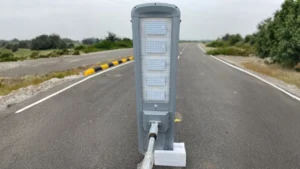
Indian Road Projects: Addressing High Temperatures and Dust Accumulation Together
In suburban road projects in India, high temperatures, road dust, and unstable power supplies present multiple challenges to the long-term operation of solar street lights. Hot weather increases the thermal management demands on batteries, while prolonged dust accumulation on PV panels can reduce power generation.
To address these challenges, the project adopted Sresky THERMOS solar street lights. This series features a TCS temperature control system and an Auto-Clean device that periodically removes dust from the PV panels. Its ALS intelligent lighting system adjusts lighting output according to battery status and operating conditions.
A key advantage of this solution is that it addresses both the impact of high temperatures on batteries and the effect of dust accumulation on PV power generation, rather than simply increasing battery capacity. This integrated approach is particularly worth considering for projects in hot, dusty environments where access for routine maintenance is limited.
III. Rainy Season Conditions: How Can Solar Street Lights Maintain Reliable Lighting During Prolonged Rainfall?
Selection Conclusion: Solar streetlight projects in rainy climates must address both waterproofing and energy shortages. In addition to checking the IP protection rating, the system’s energy balance during prolonged rainy periods should be calculated using local solar irradiance, lighting duration, PV capacity, battery capacity, and dimming strategies.
Protection ratings such as IP65 are important reference points, but they cannot replace a comprehensive assessment of the entire luminaire’s sealing, electrical compartments, connectors, and cables. Furthermore, even if a luminaire is adequately waterproof, its battery may not provide sufficient energy for the expected nighttime lighting if continuous rainfall prevents adequate charging.
Therefore, solar streetlight selection for rainy climates should focus on the following factors:
- ALS Intelligent Energy Management: Understand how the system adjusts brightness according to battery charge levels and environmental conditions, including its operating strategies during periods of low battery charge.
- PV Modules: Evaluate power generation capacity based on local solar irradiance, seasonal overcast and rainy conditions, installation angles, and shading.
- Battery Capacity: Calculate the required capacity based on daily lighting energy consumption and the designed number of days of energy autonomy, rather than evaluating battery capacity in isolation.
- Waterproof Construction: Verify the protection ratings, applicable test standards, and sealing design of the complete luminaire and its key electrical components.
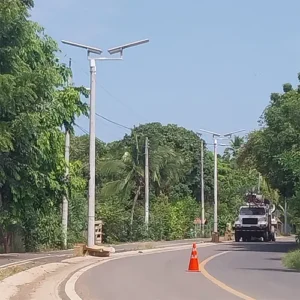
Panama Road Project: Selecting Solar Streetlights for the Rainy Season—Matching Power Generation, Energy Storage, and Lighting
Panama has a tropical climate, and overcast skies and persistent rainfall during the rainy season can reduce the solar radiation received by PV modules. For roads without a stable grid supply, the key consideration extends beyond whether the luminaires are waterproof. The system must also provide sufficient stored energy to maintain nighttime lighting during prolonged periods of low solar irradiance.
In Sresky’s Atlas road lighting project in Panama, the solution was tailored to local rainy-season conditions by incorporating ALS intelligent energy management, TCS temperature control, and an IP65-rated design. ALS adjusts lighting output according to battery status and operating conditions, helping the system allocate available energy more efficiently when power generation is limited.
Sresky’s project description sets a target of maintaining basic lighting for more than 10 consecutive days of overcast or rainy weather. This figure should not be applied directly to projects in other regions. Energy calculations must be adjusted according to local solar irradiance, PV output, battery capacity, and daily lighting duration.
The practical lesson from this project is that solar streetlights for rainy climates require an integrated design that treats PV power generation, battery storage, and smart dimming as parts of a unified system. Suitability cannot be determined solely by waterproof ratings or battery capacity.
For EPC projects, a more reliable approach is to require suppliers to submit energy balance calculations that clearly specify the solar irradiance data used, daily lighting duration, designed energy autonomy, and dimming strategies for low-battery conditions.
IV. Dust-Prone Environments: How Can Power Generation Losses Caused by Dust Accumulation on PV Panels Be Reduced?
Selection Conclusion: In dust-prone areas, buyers should assess not only the dust resistance of the complete luminaire but also PV power generation losses caused by dust accumulation, cleaning frequency, and maintenance costs. For remote, heavily dust-prone areas where regular maintenance is difficult, the Auto-Clean automatic cleaning solution is worth evaluating.
Dust accumulation on PV panels reduces the amount of light reaching the solar cells, thereby decreasing power generation. For off-grid solar streetlights, insufficient power generation can subsequently affect nighttime lighting:
Dust accumulation on PV panels → Reduced power generation → Insufficient battery charging → Lower available stored energy → Reduced lighting reliability.
Key evaluation criteria during procurement include:
- Whether the solar panel mounting angle is appropriate for the local environment.
- The rate of dust and sand accumulation.
- The frequency, labor costs, and difficulty of manual cleaning.
- The operating principles, maintenance requirements, and reliability of automatic cleaning systems.
- The dust protection design of the luminaire housing and electrical components.
The Value of Auto-Clean: Reducing Dependence on Manual Cleaning
The Sresky THERMOS project documentation from India describes an Auto-Clean design featuring built-in side brushes that periodically clean the solar panels to reduce the accumulation of dust and debris. This solution is particularly worth evaluating for projects along remote roads, in areas prone to frequent dust storms, and at sites where manual maintenance is expensive.
However, automatic cleaning does not eliminate the need for maintenance. Buyers should still verify the cleaning mechanism’s wear resistance, power supply method, replacement intervals for consumable components, troubleshooting procedures, and availability of local after-sales support.
If a project can be cleaned manually at regular intervals and at a low cost, automatic cleaning may not be essential. However, where cleaning is difficult or dust accumulation is severe, automatic cleaning may reduce long-term operation and maintenance (O&M) demands.
Therefore, effective selection for dusty environments involves more than ensuring that the equipment is dust-resistant. It also requires maintaining the long-term serviceability and power generation performance of the PV system despite ongoing dust accumulation.
V. Typhoon Conditions: How Should the Wind Resistance of Solar Street Lights Be Evaluated?
Selection Conclusion: Rather than simply asking how much wind a luminaire can withstand, evaluate the entire structure—including PV modules, mounting brackets, lamp arms, light poles, connectors, and foundations—against the local design wind speed. Require suppliers to provide structural calculation data applicable to the actual project conditions.
Strong winds place substantial loads on PV panels and light pole systems. PV module area, installation angle, pole height, mounting bracket design, and foundation conditions all affect the overall distribution of structural stress. Therefore, the wind resistance specifications of an individual luminaire are insufficient to demonstrate that the complete system is suitable for typhoon-prone areas.
EPC projects should focus on verifying the following:
- Design Wind Speed: Establish the design basis according to the applicable codes for the project location rather than relying solely on promotional claims such as “withstands a Category 12 typhoon.”
- Solar Modules and Mounting Structures: Verify the wind-exposed area, installation angle, connection methods, and structural strength.
- Light Poles and Arms: Review the design specifications for materials, wall thickness, connection joints, and critical load-bearing components.
- Foundations and Geological Conditions: Determine the foundation design according to pole height, wind loads, and on-site soil conditions.
- Coastal Corrosion Protection: For island and coastal projects, also evaluate salt spray exposure, humidity, fastener materials, and surface protection.
Bohol Island, Philippines Project: Typhoons and Salt Spray Increase the Demands on Structural Design
In coastal communities on Bohol Island in the Philippines, solar streetlights must withstand seasonal typhoons and strong winds while enduring high humidity and salt spray over the long term. Such environments require more than waterproofing. They also demand secure PV module mounting, reliable lamp arm connections, adequate light pole load-bearing capacity, and corrosion-resistant metal components.
The Sresky ATLAS solar streetlight project on Bohol Island incorporated structural optimization and wind load considerations for key connection points to suit the project environment. The design also included corrosion protection measures, such as 316L stainless steel fasteners, hot-dip galvanizing, and powder coating, to address the corrosion risks associated with coastal conditions.
This project illustrates a key principle for selecting solar streetlights in typhoon-prone regions: luminaires, PV panels, mounting brackets, light poles, and foundations must be evaluated as an integrated structural system.
For new engineering projects, structural calculations should still be based on local design wind speeds, pole heights, the wind-exposed area of the PV modules, and soil conditions. Decisions should not be based solely on wind resistance claims in product promotional materials.
VI. EPC Procurement Verification Checklist: What Should Be Requested from Manufacturers?
Product brochures can support preliminary screening, but they should not replace engineering validation. Different technical documents are required for projects in different climates, and the model numbers, configurations, and test conditions specified in those documents must be verified.
| Environment | Recommended Documents to Request from Manufacturers | Key Verification Points |
|---|---|---|
| High Temperatures | Cell specifications, BMS/TCS functional specifications, and high-temperature test reports | Test temperature, charging and discharging limits, protection mechanisms, and test duration |
| Rainy Season and Overcast Conditions | PV module and battery specifications, energy balance calculations, ALS control specifications, and IP test reports | Local irradiance assumptions, daily energy consumption, designed energy autonomy, and waterproofing test items |
| Dust and Sand | PV module documentation, dust accumulation or cleaning test data, and Auto-Clean maintenance instructions | Cleaning cycle, cleaning mechanism service life, maintenance requirements, and assumptions about power generation losses |
| Typhoons and Strong Winds | Wind load calculation reports, light pole and mounting bracket drawings, material specifications, and foundation design data | Design wind speed, structural assumptions, connection details, geological conditions, and foundation dimensions |
| Combined Coastal Conditions | Salt spray test data, fastener material certificates, and surface treatment specifications | Test standards, test duration, coating systems, and material suitability |
| All Projects | Product specifications, installation manuals, warranty terms, spare parts information, and after-sales service plans | Consistency of model numbers across documents, scope of liability, maintenance intervals, and response procedures |
During procurement, it is also necessary to verify whether test reports were issued by accredited laboratories, which standards were applied, whether the test samples match the products to be purchased, and whether the results are applicable to the project’s actual environmental conditions.
If a manufacturer provides only general claims such as “high-temperature resistant,” “typhoon resistant,” or “capable of providing lighting during continuous rain” without specifying the test conditions or design basis, supplementary written technical documentation should be requested.
VII. FAQs on Selecting Solar Street Lights for Extreme Weather Conditions
1. For Solar Streetlights in High-Temperature Regions, Is a Larger Battery Capacity Always Better?
Not necessarily. A larger battery can increase energy storage capacity, but it cannot, by itself, resolve inadequate battery thermal management, insufficient PV power generation, or ineffective control strategies.
A comprehensive assessment should consider battery type, BMS/TCS functions, temperature conditions, lighting energy consumption, and PV configuration.
2. Can IP65 Solar Streetlights Be Used in Areas Prone to Heavy Rainfall?
IP65 provides a reference for dust and water ingress protection. However, suitability for a specific project depends on the applicable test criteria, sealing structure, installation conditions, and long-term maintenance requirements of the complete luminaire and its key components.
In addition, projects in rainy climates must verify that sufficient energy reserves are available to maintain lighting during prolonged periods of low solar irradiance.
3. Can Solar Streetlights Really Provide Continuous Lighting for 10 Days During Overcast or Rainy Weather?
Some products or project solutions may specify this as a design target, but it should not be regarded as a universal capability across all models.
Actual operating time depends on local solar irradiance, PV module capacity, battery capacity, luminaire power consumption, lighting duration, and dimming strategies. Suppliers should be asked to provide calculation sheets and test conditions for the specific system configuration.
4. What Are the Most Important Parameters When Selecting Solar Streetlights for Typhoon-Prone Regions?
The primary considerations are the design wind speed and wind loads specified by the applicable project codes. Other critical factors include PV panel area, installation angle, pole height, mounting brackets, connectors, and foundation design.
The safety of the complete system cannot be determined solely from the wind resistance claims of the luminaire itself.
5. When Purchasing Solar Streetlights, Which Is More Important: Manufacturer Case Studies or Test Reports?
Both are important, but they serve different purposes. Case studies help buyers understand a product’s application experience in similar environments, while test reports, technical specifications, and engineering calculations help verify performance and design assumptions.
For high-risk projects, buyers should review relevant case studies, test data for the specific model, and system-level and structural calculations tailored to the project.
Conclusion
When selecting solar streetlights for extreme weather conditions, follow three principles: environmental compatibility, system calculations, and technical validation.
- High temperatures: Prioritize thermal management.
- Rainy seasons: Evaluate the energy balance.
- Dust and sand: Prioritize PV panel cleaning and maintenance.
- Typhoons: Assess the complete structure and foundation.
Clearly define the project’s environmental conditions before procurement and require manufacturers to provide the corresponding technical documentation. This approach helps minimize selection risks and improve long-term operational reliability.