
Table of Contents
In the plains of northern and central India, outdoor lighting designs for high-end institutional courtyards, diplomatic residences, and similar properties must balance landscape aesthetics, nighttime accessibility, and security requirements.
These sites typically feature mature trees, lawns, and carefully designed landscaping. Although they appear lush and inviting during the day, tree canopies can obstruct sunlight reaching solar panels. Winter smog can reduce solar irradiance, while high summer temperatures increase the demands on battery thermal management.
This case study examines the Sresky Atlas SSL-315 solar street light, with 25 units installed to illuminate the courtyard of a high-end institution in India. The project has been completed, and the system has operated through the transition from winter to summer, providing practical engineering insights into the performance of solar street lights in environments characterized by tree shade, winter haze, and high summer temperatures.
I. Project Overview: Solar Street Lighting for an Institutional Courtyard in India
| Project Parameter | Details |
|---|---|
| Project Area | Plains of northern or central India; the specific location is confidential |
| Application Scenarios | Courtyards of high-end institutions, managed properties, and landscaped walkways |
| Number of Units Installed | 25 |
| Luminaire Model | Sresky Atlas SSL-315 |
| Project Status | Installation completed; the system has operated through seasonal changes from winter to summer |
| Major Environmental Challenges | Tree shade, winter smog, seasonal reductions in sunlight, and high summer temperatures |
| Engineering Focus Areas | Nighttime operating duration, photovoltaic power generation, battery management, and ease of maintenance |
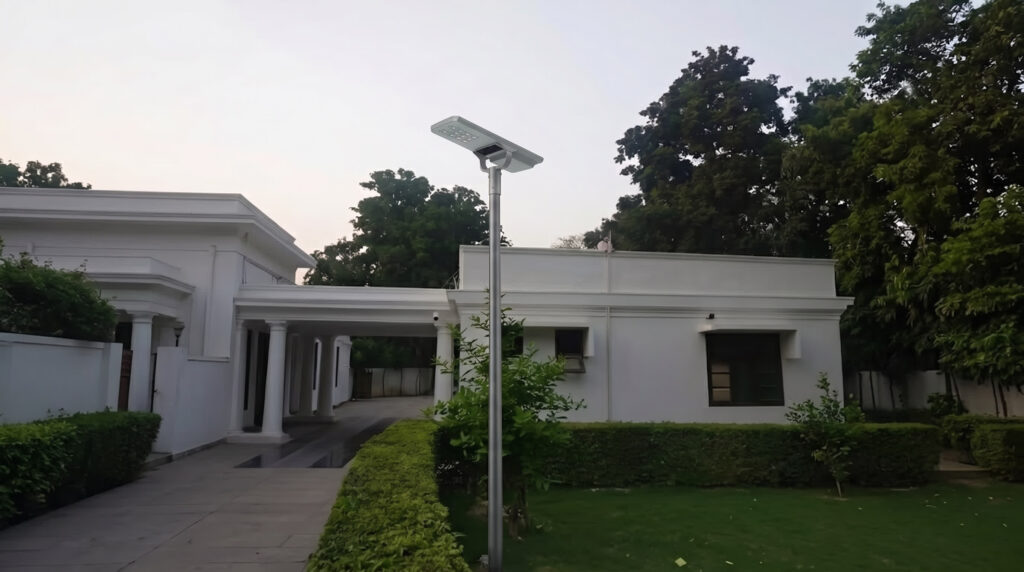
II. Engineering Challenge 1: How Do Tree Shade and Dust Accumulation Affect Solar Street Light Charging?
1. Project Challenge: Tree Canopies Can Reduce the Power Generation of Photovoltaic Modules
Challenge: Localized shading may lead to sustained power generation losses.
The shadows cast by mature trees in courtyards shift with the sun’s position throughout the day and across seasons. Photovoltaic panels are particularly susceptible to shading in the early morning, late afternoon, and winter months, when the sun is lower in the sky. Contaminants such as fallen leaves, pollen, and bird droppings can further reduce power generation efficiency.
For solar street lights, these conditions may result in the following issues:
- Reduced charging capacity: Tree shade can reduce photovoltaic output, with the extent of the impact depending on the location of the shading and the electrical design of the panels.
- Shorter nighttime operating duration: Insufficient daytime charging can leave the battery with inadequate stored energy, increasing the risk of insufficient lighting during the latter part of the night, particularly after consecutive overcast days.
- Higher maintenance costs: Tree growth and dust accumulation on the panels increase the need for inspections, cleaning, and work at height.
2. Sresky Solution: Combining Smart Controls, Lighting Modes, and On-Site Maintenance Management
This project uses the Sresky Atlas SSL-315, selected to meet the lighting requirements of a landscaped courtyard, with particular attention to solar exposure, nighttime energy management, and long-term maintenance.
The Sresky Atlas SSL-315 features ALS 2.4 smart control technology, which adjusts lighting output according to battery levels when charging conditions are unfavorable. This helps manage limited energy reserves and supports continued lighting operation when available solar energy is insufficient.
The SSL-315 offers three preset lighting modes—M1, M2, and M3—and supports PIR motion sensing.
For courtyards with mature trees, installation locations with minimal canopy shading should be prioritized whenever possible. The orientation and tilt angle of the solar panels should also be optimized during installation to improve solar exposure.
Engineering Insights: For solar street lighting projects in shaded environments, shading assessments, smart control systems, and long-term maintenance strategies must be integrated into the overall design. Simply increasing battery capacity is not sufficient to resolve every issue caused by inadequate solar charging.
III. Engineering Challenge 2: How Do Winter Smog and Summer Heat Affect Solar Street Lights?
1. Project Challenge: Annual Average Sunshine Duration Does Not Reflect the Most Adverse Operating Conditions
In northern India, winter days are shorter, and smog and air pollution can further reduce the solar radiation reaching photovoltaic panels. In summer, high ambient temperatures can affect battery service life and charging and discharging performance when batteries are exposed to unfavorable thermal conditions for extended periods.
If solar street lights are selected solely on the basis of annual average sunshine duration, several problems may arise:
- Insufficient winter power generation: Prolonged periods of limited sunlight reduce daily charging capacity.
- Inadequate energy reserves: Batteries may be unable to compensate for power generation shortfalls over several consecutive days, increasing the risk of lights switching off prematurely at night.
- Accelerated battery aging: Prolonged exposure to high temperatures may shorten battery service life.
- Unstable lighting performance: Operating at a fixed power level can place additional strain on stored energy during seasons with limited sunlight.
2. Sresky Solution: Prioritizing Seasonal Energy Balance and Battery Temperature Management
Verify energy storage capacity against low-sunlight winter conditions and combine it with adaptive dimming.
- Rather than relying on annual average sunshine data, use site-specific solar irradiance data from the winter months with the least sunlight. Account for reductions associated with smog and recalculate the expected nighttime operating duration of the 44 W LED module used in the SSL-315.
- Verify the autonomy of the 384 Wh LiFePO4 battery under scenarios involving several consecutive days of low solar irradiance, rather than estimating operating duration based on ideal sunny conditions.
- Evaluate temperature management and thermal protection measures, including appropriate charging protection at high and low temperatures, to mitigate the effects of high summer temperatures on battery performance.
- Use ALS 2.4, together with the preset M1, M2, and M3 lighting modes and PIR motion sensing, to reduce output when pedestrian activity is low. This can help reduce energy consumption compared with operating at full power throughout the night.
Engineering Insights: In regions where low winter solar irradiance and high summer temperatures occur in the same year, solar street light selection must account for power generation, battery capacity, temperature management, and nighttime energy consumption. Comparing luminaire brightness alone is insufficient to determine whether a system is suitable for the site.
IV. Project Results
A total of 25 Sresky Atlas SSL-315 solar street lights were installed for this project. Installation has been completed, and the system has operated through seasonal changes spanning winter and summer.
- All-Weather Security Coverage: According to the project report, all 25 luminaires operated throughout the night without unexpected outages during two consecutive weeks of heavy winter fog.
- Luminous Efficacy and Lighting Uniformity: The measured luminous efficacy of the LED modules was 230 lm/W. Fixed-distribution lenses provided uniform illumination along the main roads and landscaped walkways, meeting the project’s stated requirements for clear, flicker-free security camera imaging.
- Reduced Maintenance Frequency: According to the project report, a nano-based anti-fouling coating and a long-pole cleaning protocol extended the interval between elevated cleaning operations from monthly to quarterly.
V. Project Lessons Learned: Best Practices for Other Solar Street Lighting Projects
The primary lesson from this project is that tree shade, seasonal variations in solar irradiance, and maintenance conditions must all be incorporated into the engineering assessment of solar street lighting systems.
For similar applications, the following practices are particularly valuable.
First, Assess Shading Before Installation and Continue Monitoring Afterward
The shadows cast by mature trees change with the seasons and as the trees grow. Completing installation does not guarantee that photovoltaic panels will continue to receive the same amount of sunlight over time. Follow-up inspections and periodic shading assessments remain essential.
Second, Use the Least Favorable Season as a Key Reference for Energy Budgeting
Low winter solar irradiance may determine the system’s actual energy limitations. Design calculations and operational assessments should account for prolonged periods of limited sunlight rather than evaluating battery autonomy solely on the basis of performance during sunny weather.
Third, Use Smart Controls Effectively to Manage Nighttime Energy Consumption
Lighting modes and motion sensors can help balance lighting requirements with available battery energy. However, settings should be tailored to actual site conditions to avoid reducing essential baseline illumination below acceptable levels.
Fourth, Match Product Specifications to On-Site Lighting Requirements
LED luminous efficacy, luminous flux, photovoltaic panel power, and battery capacity represent different technical characteristics. Determining whether a configuration is suitable for a specific project requires an integrated assessment of light distribution, installation layout, solar exposure, and nighttime energy demand.
Fifth, Incorporate Landscape Protection into the Operation and Maintenance Plan
In high-end courtyards and institutional properties, cleaning and inspection activities should minimize disruption to lawns, trees, and existing landscaping. Well-planned maintenance routes and work schedules can improve the long-term management of the lighting system while protecting the surrounding environment.
This article has been partially anonymized to protect project location details, client identities, and internal operational data. The experiences described above illustrate engineering considerations for similar environments and should not be interpreted as a universal performance guarantee for all regions, climatic conditions, or installation scenarios.
VI. Customer Feedback
“Initially, we were particularly concerned about the system’s performance when tree shade coincided with winter smog. After experiencing different seasons, we found that the interaction between shading from surrounding trees, nighttime energy consumption, and routine maintenance remains an important consideration for ongoing system management.”
— Project Property Technical Manager (Anonymous)
VII. FAQ: Common Questions About Selecting Solar Street Lights in India
1. Does winter smog in northern India affect solar street lights?
Yes. Smog can reduce the solar radiation reaching photovoltaic modules. The extent of the impact depends on local meteorological conditions and pollution levels.
Key considerations include:
- Use site-specific winter solar irradiance data.
- Evaluate energy storage requirements during prolonged periods of limited sunlight.
- Verify nighttime operating duration using actual operational records whenever available.
2. How Can the Charging Efficiency of Solar Street Lights Be Improved in Shaded Areas?
One key strategy is to minimize shading rather than relying solely on increasing battery capacity.
Recommended measures include:
- Conduct shading assessments at different times of day and during different seasons before installation.
- Optimize luminaire placement, photovoltaic panel orientation, and tilt angle.
- Regularly remove fallen leaves, bird droppings, and dust from photovoltaic panels.
3. How Can the Battery Life of Solar Street Lights Be Extended in India’s High-Temperature Environment?
Battery longevity depends in part on temperature management, charging and discharging protection, and maintenance practices.
Recommended measures include:
- Verify the battery’s specified operating temperature range.
- Ensure that the controller provides appropriate temperature protection.
- Periodically inspect battery condition, electrical connections, and charging performance.
Conclusion: Solar Street Light Design Must Account for Adverse Operating Conditions and Validate Long-Term Performance Through Actual Operation
Solar street lighting projects for residential and institutional properties in India must account for several environmental challenges simultaneously, including tree canopy shading, winter haze, summer heat, and dust accumulation on photovoltaic panels. Comparing luminaire brightness or initial purchase price alone is insufficient to determine whether a system can operate reliably over the long term.
The Sresky Atlas SSL-315 has a nominal configuration comprising 8,000 lm of luminous flux, a 71 W photovoltaic panel, and 384 Wh of battery storage. These specifications provide a starting point for product selection, but the final system configuration must be validated against local solar irradiance, lighting requirements, and actual installation conditions.
For municipal authorities, engineering contractors, lighting planners, and property developers, we recommend completing the following three tasks before procurement:
- Site Survey: Identify tree shading, building obstructions, and any constraints affecting cleaning and maintenance operations.
- Energy Budgeting: Calculate power generation, energy storage requirements, and nighttime consumption using data from the winter months with the least sunlight.
- Operational Validation: Assess battery performance, lighting quality, and maintenance costs through seasonal monitoring.
Practical Recommendation: Verify the site’s most challenging operating conditions before finalizing the luminaire configuration and procurement quantities. A data-driven approach to solar street lighting design helps manage project risks and improve long-term operational reliability.