
Project Overview
Project Information
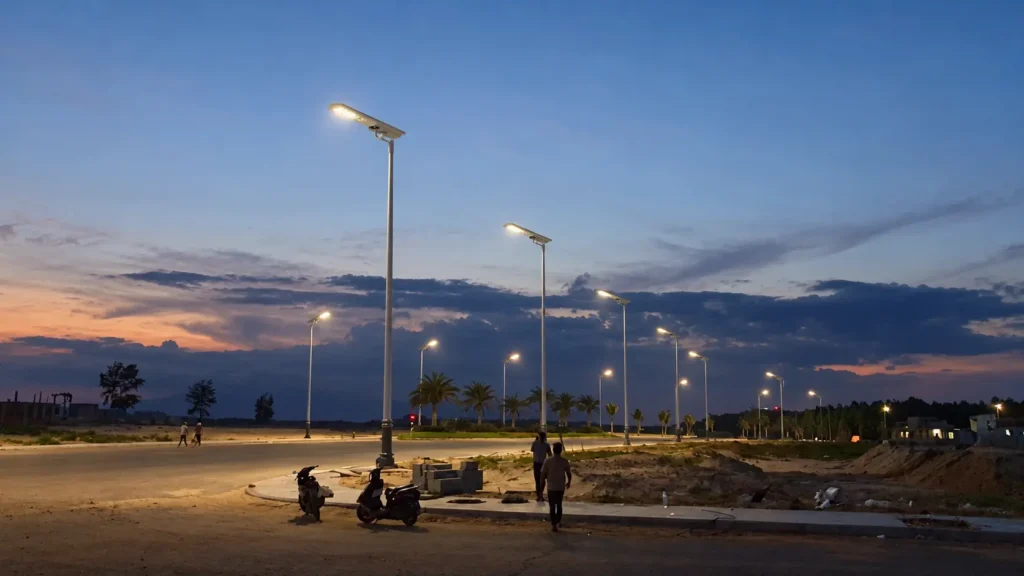
- Project Type: Solar lighting for the main thoroughfare of a coastal cultural and tourism complex
- Location: Central-southern coast of Vietnam (Da Nang to Khanh Hoa)
- Client: Provincial and municipal transportation authorities and project management units
- Project Scale: Approximately 600 units, delivered in phases
- Product Series: Sresky Atlas Series SSL-320
Engineering Challenge 1: How Can the Structural Integrity of Solar Streetlights Be Ensured in Typhoon-Prone Coastal Regions?
Vietnam’s central coastal region is frequently exposed to tropical cyclones. Solar streetlights must withstand not only the wind loads acting on the poles themselves but also the wind pressure, uplift forces, and torque generated by the photovoltaic panels.
For a municipal lighting project involving approximately 600 units, sourcing poles, photovoltaic panels, and lamp heads from different suppliers can create gaps in structural responsibility and make it difficult to verify the safety of the complete luminaire assembly.
Key Challenges
- Typhoon-Related Wind Load Risks: The connections between photovoltaic panels and light poles may be subjected to significant wind pressure and torque.
- Insufficient Structural Verification: Individual components meeting their respective specifications does not necessarily mean that the complete luminaire and foundation assembly meets the project’s structural requirements.
- Coastal Foundation Risks: Improper backfilling, insufficient foundation bearing capacity, and inadequate anchor bolt design can increase the risk of pole tilting and structural failure.
Solution: Sresky Atlas SSL-320 — Reducing Coastal Project Risks Through Whole-Luminaire Wind Resistance Verification
Key Advantage: The solution focuses not only on the light pole but also on the structural integrity of the entire luminaire assembly.
Integrated Design: The photovoltaic panel and lamp head are integrated into a single unit, creating a relatively compact structure that facilitates unified calculations of wind-exposed area and structural loads during verification.
Whole-Luminaire Structural Verification: The pole, photovoltaic panel, connectors, flanges, and anchor bolts are evaluated as an integrated system in accordance with the applicable Vietnamese wind load standards and project requirements.
Foundation Coordination: Foundation designs are determined based on geotechnical survey data to minimize the risks of pole tilting and structural failure caused by unsuitable ground conditions.
Core Value: By coordinating the design of the entire luminaire structure with its foundation interface, the solution makes the wind resistance of solar streetlights verifiable rather than relying solely on the specifications of individual components.
Engineering Challenge 2: How Can Solar Streetlights Meet Road Lighting Requirements on Roads with Complex Widths and Central Medians?
In road lighting design, higher brightness does not necessarily translate into better lighting performance. Central medians, roadside trees, and sidewalks can all affect light distribution.
If the luminaire’s optical distribution is not properly matched to the road width, mounting height, and spacing between luminaires, problems such as excessive brightness directly beneath the fixtures, dark areas between fixtures, and insufficient illumination along road edges may occur.
For municipal projects, the priority should be the results of road lighting simulations and compliance with applicable lighting standards, rather than simply focusing on the luminaire’s lumen output.
Key Challenges
- Uneven Illumination: Excessive brightness directly beneath the luminaires and insufficient illumination between them can compromise visual continuity along the road.
- Insufficient Edge Coverage: Poorly optimized light distribution may leave dark spots along sidewalks and road edges.
- Design and Acceptance Risks: Without accurate photometric data, engineering design teams may struggle to conduct reliable lighting simulations and verify compliance with project requirements.
Solution: Sresky Atlas SSL-320 TYPE-II M — Improving Road Lighting Performance Through Targeted Optical Distribution
Key Advantage: Rather than simply increasing brightness, this solution optimizes light distribution to ensure that illumination reaches the areas where it is needed most.
Targeted Light Distribution: The TYPE-II M optical configuration is designed to optimize light distribution according to the road cross-section and lighting layout.
Simulation-Based Verification: Lighting simulations based on road width, mounting height, and luminaire spacing help identify potential problems, including uneven illumination and insufficient edge coverage, before installation.
Core Value: By combining actual photometric data with road lighting simulations, the solution helps projects achieve a balance between lighting performance, energy consumption, and acceptance requirements.
Project Deliverables
Structural and Wind Resistance Design: Technical support was provided for whole-luminaire structural verification, taking into account the project’s wind load requirements and foundation conditions.
Road Lighting Distribution: The SSL-320 TYPE-II M optical configuration was adopted. Road lighting simulation diagrams and IES/LDT photometric files were provided to support lighting design and distribution verification.
Coastal Environmental Adaptability: With IP66 and IK08 protection ratings and stainless steel brackets, the product is designed to withstand demanding outdoor coastal environments.
Energy Management: Equipped with TCS thermal management technology and N-type TOPCon photovoltaic modules, the system supports effective temperature management and solar power generation.
Customer Feedback
“We focus not only on luminaire specifications but also on whether the wind resistance of the complete luminaire assembly can be verified, whether road lighting distribution can be accurately simulated, and whether bulk deliveries can be managed according to clearly defined acceptance criteria.”
— Head of Design Review, Client
FAQ: Common Questions About Selecting Solar Streetlights for Vietnam’s Coastal Regions
What Key Factors Should Be Considered When Installing Solar Streetlights in Vietnam’s Coastal Regions?
Wind Resistance Design: Calculate wind loads for the complete luminaire assembly, including the pole, flange, anchor bolts, and foundation.
Corrosion Protection: Assess the effects of salt fog, high temperatures, and humidity on metal fasteners, structural components, and enclosures.
System Runtime: Configure photovoltaic panels and batteries according to local solar irradiation levels, consecutive rainy days, and nighttime power consumption requirements.
What Structural Verifications Are Required for Solar Streetlight Poles in Typhoon-Prone Areas?
- Determine the design wind load in accordance with the applicable project wind load standards.
- Verify the structural stresses on the light pole, photovoltaic panels, mounting brackets, flanges, and anchor bolts.
- Evaluate the foundation’s bearing capacity and resistance to overturning based on geotechnical survey data.
- Ensure that the structural calculation documents for the complete luminaire assembly correspond to the actual supplied product configuration.
Is a Smaller Wind-Exposed Area for Solar Streetlight Panels Always Better?
Not necessarily. Wind-exposed area is only one of several factors that must be considered in structural design.
Structural Considerations: Wind pressure, uplift forces, torque, and connection methods must all be evaluated.
Power Generation Considerations: The photovoltaic module’s power output, installation angle, and local solar irradiation conditions must be balanced.
Engineering Considerations: The final configuration should be determined through a combination of power generation simulations and structural verification, rather than simply minimizing the panel area.
Conclusion: From Individual Luminaire Procurement to Verifiable Solar Road Lighting Solutions
With the continued growth of coastal tourism, road construction, and demand for off-grid infrastructure, the evaluation criteria for solar streetlight projects are evolving. Instead of focusing solely on power output and purchase price, project stakeholders are paying increasing attention to structural safety, road lighting distribution, energy management, and long-term operational reliability.
For municipal authorities, engineering contractors, and road planners evaluating solar streetlight projects involving approximately 600 units or more, we recommend prioritizing the verification of three key documents:
- Whole-Luminaire Wind Load Calculation Report: Clearly defines the design conditions, structural boundaries, and foundation interfaces.
- Road Lighting Simulation Documentation: Confirms the actual luminaire models, installation parameters, layout, and applicable lighting performance criteria.
- Phased Delivery and Acceptance Plan: Establishes standardized procedures and criteria for initial product verification, on-site testing, and subsequent batch deliveries.
The value of selecting the Sresky Atlas SSL-320 for this project lies in its verifiable structural documentation, accurate photometric data, and clearly defined acceptance criteria.
For coastal municipal road lighting and off-grid lighting projects, verifying product performance and structural compliance before proceeding with bulk deliveries is a practical and effective way to manage project risks and control procurement costs.