
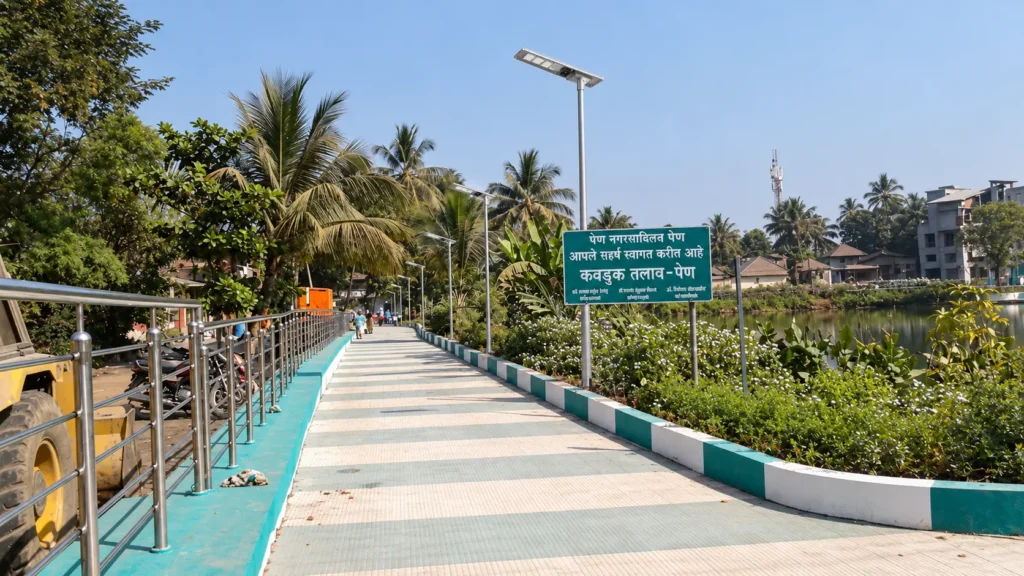
To address these challenges, Sresky supplied 30 units of its Raptor SSL-204M Series solar streetlights for a public lakeside promenade in western China. Through intelligent energy management, a high-protection structural design, and optical configurations tailored to walkway lighting, the system addresses power supply and illumination challenges in demanding outdoor environments.
This case study outlines the project’s key engineering challenges, technical solutions, and implementation results.
Project Overview
Project Details
- Project Type: Public lakeside promenade lighting retrofit
- Project Location: A public lakeside area in western China
- Implementation Model: Procurement by municipal authorities, with on-site installation carried out by a construction contractor
- Project Scale: Approximately 30 units for the current phase, with approximately 60 additional units planned for supporting infrastructure and similar projects
- Product Series: Sresky Raptor SSL-204M Series Solar Streetlights
Engineering Challenge 1: How Can Solar Streetlights Maintain Reliable Illumination During Prolonged Rainy Weather and Under Dense Tree Canopies?
The lakeside promenade is surrounded by dense trees. During the monsoon season, several consecutive days of cloudy and rainy weather are common. These conditions reduce the effective sunlight exposure time of photovoltaic modules, making it difficult for solar streetlights to maintain sufficient battery reserves.
With conventional configurations, several problems could arise:
- Insufficient battery charging during prolonged cloudy and rainy periods, resulting in premature interruptions to nighttime lighting.
- Reduced photovoltaic charging efficiency due to tree canopy shading, causing actual operating time to fall short of design expectations.
- Excessive battery capacity increases the weight of the luminaires, structural loads on the poles, and overall procurement costs.
- Long-term operation under insufficient charging conditions accelerates battery degradation and increases future maintenance expenses.
Sresky Solution: Intelligent Energy Management + ALS Adaptive Dimming
Taking into account local solar resources, seasonal variations in sunlight, and actual on-site shading conditions, Sresky optimizes the matching of photovoltaic module output and lithium iron phosphate battery capacity, avoiding an approach that relies solely on adding more hardware.
Key technologies include:
ALS Intelligent Adaptive Lighting System: When prolonged rainy weather causes the battery’s State of Charge (SOC) to decrease, the system automatically activates a multi-level power reduction strategy. This reduces overall nighttime energy consumption and extends lighting duration during extended periods of insufficient sunlight.
Extended Runtime During Prolonged Rainy Weather: Through optimized energy allocation and intelligent dimming, the system improves power supply reliability during extended rainy periods.
BMS Battery Management System: The system manages and protects battery charging and discharging, helping minimize the impact of abnormal charging and discharging conditions on battery service life.
Core Value: Rather than relying exclusively on increasing battery capacity, the system coordinates photovoltaic panels, batteries, and ALS intelligent dimming to provide more reliable nighttime illumination for solar streetlights operating in low-sunlight environments.
Engineering Challenge 2: How Can Water Ingress and Corrosion Risks Be Minimized in High-Humidity Lakeside Environments?
Lakeside environments are characterized by persistently high humidity. Outdoor lighting fixtures must withstand continuous exposure to rainfall, temperature fluctuations, and airborne pollutants.
For public walkway lighting projects, luminaires must not only meet initial acceptance requirements but also deliver reliable long-term performance while helping control maintenance costs.
Common risks include:
- Corrosion of the luminaire housing and metal components caused by prolonged environmental exposure.
- Deterioration of sealing materials, allowing rainwater or condensation to enter the electrical compartment.
- Internal pressure fluctuations caused by temperature differences between the inside and outside of the luminaire, placing additional stress on sealing structures.
- Electrical failures that increase maintenance frequency and compromise the continuity of public lighting.
Sresky Solution: High-Protection Structural Design + Corrosion Resistance + Professional Optical Distribution
The Raptor SSL-204M Series is designed for demanding outdoor environments and features a multi-layer structural protection system.
Corrosion-Resistant Materials and Surface Treatments: The luminaire housing is made of aluminum alloy, while the stainless steel mounting bracket undergoes an EP treatment and outdoor-grade powder coating to improve overall corrosion and weather resistance.
IP65 Protection Rating: The luminaire features an IP65-rated protection design, with particular attention to sealing the electrical components to reduce the risk of rainwater and external moisture entering the housing.
TYPE-II M Light Distribution: The optical design is optimized for narrow pathways and boardwalks, balancing illumination coverage with visual comfort for pedestrians.
Core Value: Solar streetlights must do more than meet IP protection requirements. Their materials, surface treatments, sealing structures, and optical designs must also be adapted to the specific environmental conditions of high-humidity lakeside locations.
Project Results
30 Units Installed: The first phase of the lakeside promenade solar streetlight installation was completed and delivered, covering 30 units.
Completed 3 Days Ahead of Schedule: On-site delivery and lighting commissioning were completed three days ahead of the contractual deadline.
Stable Operation: Subsequent operational monitoring indicated consistent overall system performance.
Improved Power Supply Reliability During Prolonged Rainy Periods: Optimized energy allocation and ALS intelligent dimming improved the system’s power supply reliability during extended periods of rainy weather.
No Customer Complaints About Power Outages Caused by Insufficient Battery Charge: During the subsequent monitoring period, no customer complaints were received regarding lighting interruptions caused by insufficient battery charge.
Customer Feedback
“This rainy season, we didn’t experience the lights going out after the third consecutive week of rain as we had in the past. Even when the lights dimmed, the illumination along the walkway remained sufficient for pedestrian traffic.”
— Project Manager, Construction Contractor (translated from the original)
FAQ: Frequently Asked Questions About Procuring Solar Streetlights for Lakeside Walkways
1. How Many Days Can Solar Streetlights Remain Operational During Continuous Rainy Weather?
This depends on several factors, including photovoltaic module output, battery capacity, local sunlight conditions, and the lighting control strategy.
When procuring solar streetlights, it is recommended to pay particular attention to:
- The system’s designed operating duration during consecutive rainy days.
- Whether the system incorporates an ALS (Adaptive Lighting System) intelligent dimming function.
- Whether the battery capacity is appropriately matched to local solar resources.
In this project, optimized energy configuration and ALS intelligent dimming were implemented to improve power supply reliability during prolonged rainy periods.
2. What IP Protection Rating Is Suitable for Solar Streetlights in High-Humidity Lakeside Environments?
For lakeside environments, priority should be given to the luminaire’s waterproof performance, corrosion resistance, and electrical compartment sealing.
Key considerations include:
- Selecting an appropriate IP protection rating based on actual site exposure conditions.
- Prioritizing housing materials and surface treatments with proven corrosion resistance.
- Inspecting the sealing design of the battery compartment, control compartment, and electrical connections.
The luminaires used in this project feature an IP65 protection rating and incorporate corrosion-resistant materials and surface treatments to withstand high-humidity outdoor environments.
3. How Should Solar Streetlights Be Selected for Public Walkways?
Selecting solar streetlights should involve more than simply comparing their power output. Actual lighting requirements and site conditions must also be considered comprehensively.
Key evaluation factors include:
- Walkway width and pole mounting height.
- Pole spacing and illumination uniformity.
- Optical distribution and glare control requirements.
- Shading from surrounding trees and local solar resource availability.
- Battery runtime and long-term maintenance costs.
A site survey is recommended before procurement. Product configurations should then be determined based on the lighting layout and, where necessary, photometric simulations.
Conclusion: Solar Streetlights Are Becoming an Important Choice for Public Outdoor Lighting
With the growing emphasis on green municipal infrastructure, energy-efficient public space renovations, and off-grid lighting solutions, solar streetlights are evolving beyond simple alternatives to grid-connected lighting. Increasingly, they are becoming comprehensive engineering solutions that prioritize energy management, environmental adaptability, and total life-cycle costs.
The installation of 30 Sresky Raptor SSL-204M solar streetlights along the lakeside promenade demonstrates how combining solar resource assessments, battery storage, ALS intelligent dimming, and protective luminaire design can improve the long-term operational reliability of outdoor lighting systems, even under challenging conditions such as prolonged rainfall, tree canopy shading, and high humidity.
For municipal procurement authorities, EPC contractors, and infrastructure distributors considering similar projects, the most practical starting point is to evaluate local solar resources, shading conditions, lighting requirements, and long-term maintenance expectations based on actual site conditions.
Reliable solar streetlights must do more than operate normally on sunny days. They must also maintain dependable performance during prolonged rainy periods and in complex outdoor environments.