
Abstract: The St. Nicholas Parking Lot in Dubrovnik, Croatia, has installed 47 SRESKY ATLAS solar street lights to create an off-grid lighting system with zero electricity costs and low maintenance—all while meeting the triple constraints of high salt fog, low winter light levels, and World Heritage Site requirements.
Abstract
The St. Nicholas Parking Lot in Dubrovnik, Croatia, has installed 47 SRESKY ATLAS solar street lights to create an off-grid lighting system with zero electricity costs and low maintenance—all while meeting the triple constraints of high salt fog, low winter light levels, and World Heritage Site requirements.
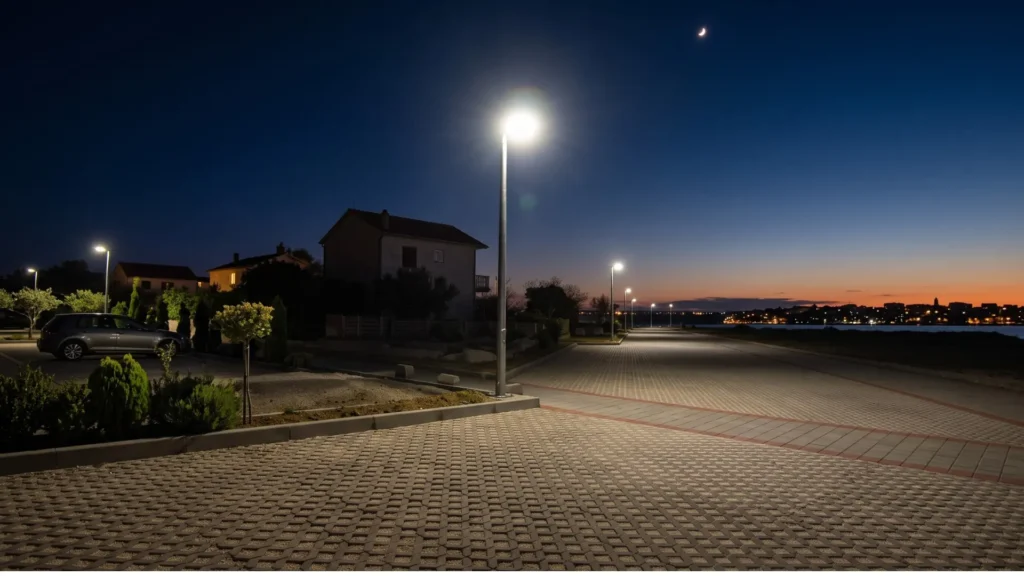
Located less than one kilometer from the Adriatic coast, a public parking lot in Dubrovnik faces many of the challenges common to coastal cities. Salt fog accelerates corrosion of infrastructure, and strong winter winds test the structural integrity of every lighting fixture. Furthermore, as the site is located within the buffer zone of the Old City of Dubrovnik—a UNESCO World Heritage Site—any new lighting installations must comply with strict environmental and lighting regulations.
To address these challenges, Dubrovnik-based Čistoća d.o.o. upgraded the 8,700-square-meter St. Nicholas Public Parking Lot by installing 47 SRESKY ATLAS SSL-36 solar street lights, thereby creating a lighting system that requires no connection to the power grid, no underground cabling, and has virtually zero monthly operating costs.
Project Overview
| Element | Details |
|---|---|
| Project Name | St. Nicholas Public Parking Lot Solar Lighting Retrofit |
| Location | Northeast edge of Dubrovnik’s Old Town, Croatia (UNESCO World Heritage buffer zone) |
| Client/Authority | Čistoća d.o.o. Dubrovnik (Municipal Public Utilities Company) |
| Luminaire Model and Quantity | SRESKY ATLAS SSL-36 × 47 units (6,000 lumens per luminaire) |
| Coverage Area | Approximately 8,700 m² of open-air parking lot |
Three Major Engineering Challenges and Solutions
Challenge 1: Harsh coastal environment characterized by strong sea winds, high salt fog, high humidity, and strong winter winds
Located less than 400 meters from the Adriatic coastline, the project is exposed to extreme environmental conditions year-round. The three most pressing issues are:
- Structural failure: Conventional luminaires become heavily corroded in less than two years. Once screws rust solid, they cannot be removed or repaired.
- Luminous efficacy decline: High humidity and significant nighttime temperature fluctuations at the coast cause condensation and fogging on the lamp surface, leading to light scattering and reduced ground illumination.
- Safety hazards: Strong winter winds in the area often exceed 30 meters per second, equivalent to a Force 11 gale. Substandard components are prone to deformation or detachment.
Solution: Marine-Grade Corrosion Resistance and High Wind-Resistant Structural Design
To address these challenges, the project selected the ATLAS series of solar street lights and implemented systematic material upgrades:
- The lamp body is made of C5-grade corrosion-resistant aluminum alloy, which has passed rigorous high-intensity corrosion resistance testing.
- All screws and fasteners have been upgraded to 316-grade stainless steel to prevent rust at the source.
- A sealed battery and BMS (Battery Management System) design prevents salt fog intrusion.
- A low-drag lamp arm design improves stability in wind environments exceeding 30 m/s.
As a result, the luminaires can operate reliably for 8–10 years within 400 meters of the sea, significantly reducing the hidden O&M costs associated with mid-term replacements.
Challenge 2: Light pollution restrictions in World Heritage conservation areas
Located within a UNESCO World Heritage buffer zone, the lighting design is subject to strict environmental regulations, primarily including the following requirements:
- No upward light emission: Lights must not be directed upward or obscure the nighttime silhouettes of the historic city architecture.
- No glare: Cool white light is strictly prohibited; color temperature must be limited to warm light at 3000K or lower.
- No visual discomfort: Streetlights must ensure safety for drivers and pedestrians without causing blinding glare for nearby residents.
Solution: A full-optical design focused on “control” rather than “enhancement”
Rather than pursuing maximum brightness, the project implemented a precise light control solution:
- 3000K warm white light to match the tones of stone architecture
- Full cut-off design
- Secondary optical lenses for precise light distribution control
- Additional shielding structures to reduce horizontal light spill
- Reduced glare and improved visual comfort
For municipal administrators, “bright yet comfortable, without spoiling the scenery” is the ultimate acceptance criterion.
Challenge 3: Lighting continuity under short daylight conditions in winter
Although winters in Dubrovnik are not as harsh as in Northern Europe, the following conditions still occur:
- Shorter daylight hours
- Prolonged overcast weather
- Thick cloud cover
- Reduced solar radiation
For fully off-grid solar lighting systems, insufficient energy management can lead to premature shutdowns during extended periods of low sunlight.
Solution: ALS intelligent management system ensures continuous operation even on rainy days
The SRESKY core ALS adaptive logic algorithm is embedded within the luminaires. It automatically estimates the available energy budget based on recent power generation and weather trends.
In the event of consecutive rainy or overcast days, the luminaires automatically switch to energy-saving mode, reducing brightness by approximately 30%. Combined with high-capacity energy storage batteries, this enables an extended runtime of up to 10 days.
This tiered dimming strategy fully utilizes available solar generation during low-light periods, ensuring 100% continuous operation with no power outages even after consecutive winter storms.
Project Outcomes
- No trenching required, reducing construction approval complexity
- Fully off-grid operation with zero electricity costs
- No light failures due to insufficient power during the first winter operation period
- Stable performance in a coastal environment with no significant corrosion issues
- Significantly reduced long-term maintenance workload for the parking lot
Customer Feedback
“Our biggest concerns were the corrosive coastal environment and consecutive overcast winter days. After the first winter of operation, the entire lighting system remained stable, and maintenance requirements were far lower than expected.”
— Technical Manager, Čistoća d.o.o., Dubrovnik
Frequently Asked Questions (FAQ)
Q: Is a coastal environment with high salt fog suitable for installing solar street lights?
A: Yes, but marine-grade protection is essential. The ATLAS series selected for this project has successfully passed the ISO 12944 C5 high-intensity corrosion standard. The entire series features 316-grade stainless steel fasteners and multi-layer protective coatings. With strong wind resistance and excellent sealing performance, it can operate reliably for 8–10 years within 400 meters of the sea.
Q: How many solar street lights are needed for a public parking lot?
A: The number depends on the parking lot’s area, target illuminance, and pole layout. In this case, 47 ATLAS SSL-36 units were installed across an approximately 8,700-square-meter parking area, providing uniform lighting for both parking spaces and traffic lanes.
Q: Can solar street lights be installed in World Heritage conservation areas?
A: Yes. As long as they incorporate full cut-off optics, 3000K warm white light, and precise light distribution technology, solar street lights can meet the requirements of historic districts, scenic areas, and Dark Sky initiatives.
Conclusion
With the global push toward low-carbon urban development and increased emphasis on ecological protection, off-grid solar lighting has become an important direction in infrastructure upgrades.
The successful implementation at the St. Nicholas Public Parking Lot in Dubrovnik, Croatia, provides a practical technical reference for municipal engineers, contractors, and urban planners working in extreme coastal environments and strictly regulated heritage zones. Selecting solar street lighting systems with intelligent energy management and high-grade corrosion resistance is key to achieving long-term cost reduction and operational efficiency.
If your project is also located in a coastal area, tourist destination, or historic district, SRESKY can provide illuminance simulations, lighting layout plans, and product selection recommendations tailored to your site conditions to help you build a stable, low-maintenance solar lighting solution.