
In the historic cities of Greece along the Mediterranean coast, ancient backstreets bear the marks of millennia of civilization. However, these streets often face challenges when upgrading their lighting infrastructure. SRESKY, a globally renowned manufacturer of smart city streetlights, successfully implemented its Alpha series—featuring innovative solar streetlight expansion board technology and rain-sensing solar streetlight design—in a project for the back alleys of a historic Greek city.
This project addressed the limitations of narrow-street lighting solutions while achieving a zero-electricity-cost urban lighting system. It provides municipal contractors, historic district developers, and environmental consulting firms with a replicable model for “Greek solar streetlight projects.” This case study details how the SRESKY Alpha series empowers smart city development through “dual-color-temperature switching for solar street lights” and the “advantages of SSL-56 technology.” Professionals searching for “solar street light expansion board technology” or similar solutions will gain comprehensive technical insights and practical application experience.
I. Project Background & Requirement Analysis
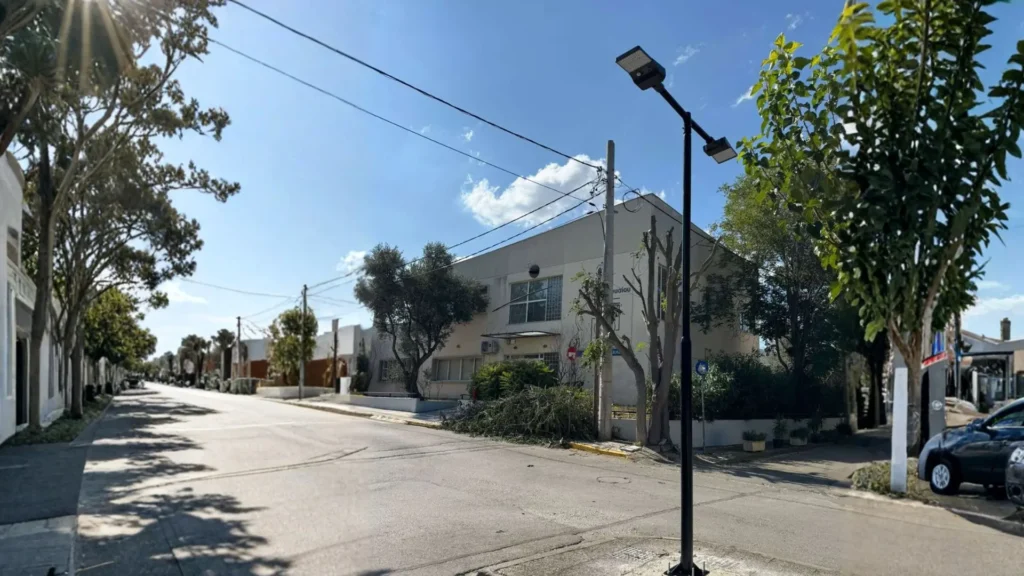
Greece, the cradle of Aegean civilization, is home to historic cities such as Athens and Thessaloniki, which are interlaced with narrow back alleys. These alleys serve as vital thoroughfares and cultural heritage sites, attracting tourists from around the world. The project is located in a Mediterranean climate zone within a historic city, characterized by abundant annual sunshine (over 2,500 hours), rainy winters, and hot summers. The alleys are typically less than 5 meters wide, paved with traditional stone-brick sidewalks, and surrounded by white buildings and olive or cypress trees, creating a distinct Mediterranean ambiance.
Environmental Characteristics and Challenges
- Cramped Spaces: Dense urban layouts and reflective white walls create intense sunlight, but winding alleys result in uneven illumination. Installation space for traditional streetlights is limited, necessitating compact designs.
- Severe Shading: Urban greenery and tall buildings block sunlight. Even when leaves fall in winter, branches continue to reduce efficiency. EU urban planning data indicates effective sunlight in similar areas is only 60%–70% of the standard value.
- Aging Infrastructure: Underground utility networks are complex, often containing relics from the Roman era. Excavating to lay municipal power cables is costly (over €150,000 per kilometer) and risks damaging cultural heritage, violating UNESCO regulations.
These challenges require lighting upgrades to prioritize sustainability and minimal intervention—conditions in which the SRESKY Alpha series excels.
Core Requirements
On-site surveys and resident interviews identified the following:
- No-dig installation: Preserve stone-paved sidewalks and landscapes for rapid, non-invasive deployment.
- High-efficiency charging: Maximize energy capture despite shading from trees and walls.
- Safety and Aesthetics: Enhance nighttime safety for pedestrians, reduce slip hazards, and integrate visually with the Greek streetscape using black poles, white walls, and green trees.
These requirements led to the adoption of smart solar streetlights. With a luminous efficacy of 230 lm/W and an IP65 waterproof rating, the Alpha series was the ideal solution.
II. Technical Solution Design
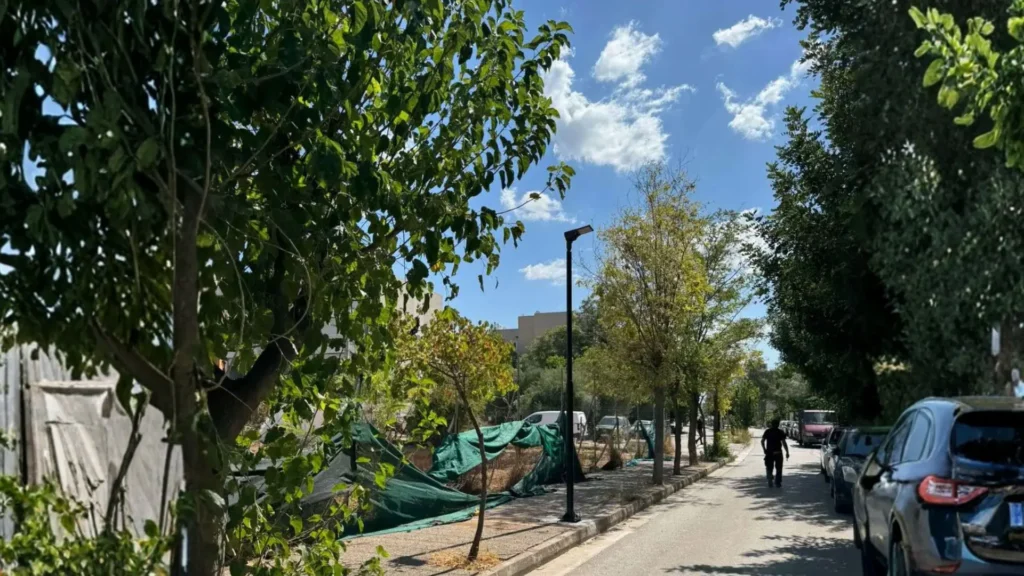
The project employed SRESKY Alpha series smart solar streetlights, combining monocrystalline silicon solar panels, lithium-ion batteries, and OSRAM 3030 LED chips (dual color temperature 3000K/5700K, Ra>70), with ALS 2.4 core technology to ensure high performance.
1. Breakthrough “Dual-Panel” Charging Technology (Extension Port Application)
The Alpha series Extension Port allows additional solar panels, backup batteries, or adapters to be connected. For this project, a “dual-panel” configuration was used: the main panel installed vertically and the auxiliary panel horizontally to optimize sunlight capture.
- Technical Adaptability: This configuration nearly doubles charging efficiency, reducing charging time to ≤6.5–7 hours and providing >3 days of runtime even in heavily shaded alleys. Based on the “SSL-56 Technical Advantages,” the 16W main panel and auxiliary panel operate at full capacity under limited sunlight, fully resolving urban energy challenges.
2. Innovative Rain Sensor and Dual Color Temperature (CCT) Adjustment
A precision rain sensor enables the luminaire to emit pure white light (5700K) on sunny days and switch to warm yellow (3000K) during rain. TYPE-4M light distribution ensures uniform coverage and reduces glare.
- Value Proposition: During Mediterranean rainy winters (annual rainfall 500–700 mm), warm yellow light penetrates better, reduces glare from stone and brick surfaces, and improves pedestrian safety. Dual-color-temperature switching increases visibility by 20% on rainy days.
3. LED Smart Management Display
An LED display shows real-time battery percentage (0–100%), lighting mode (M1/M2/M3), charging status, and sensor icons (rain sensor, PIR sensor). Icons flash when battery levels drop below 20%.
- Operational Advantages: Municipal staff can perform inspections without tools, simplifying maintenance in historic districts.
4. ALS 2.4 & APC Patented Technologies
- ALS 2.4 (Adaptive Lighting System): Provides >3 days of runtime on consecutive cloudy days and supports charging between -10°C and 55°C.
- APC (Automatic Power Control): Adjusts output in real time to protect the battery and ensure stability under high temperatures.
- PIR sensor: 120° coverage and 8m range; default brightness at 30% increases to 100% upon motion detection, saving up to 40% energy.
III. Project Implementation & Execution
Zero Infrastructure, Non-Invasive Installation
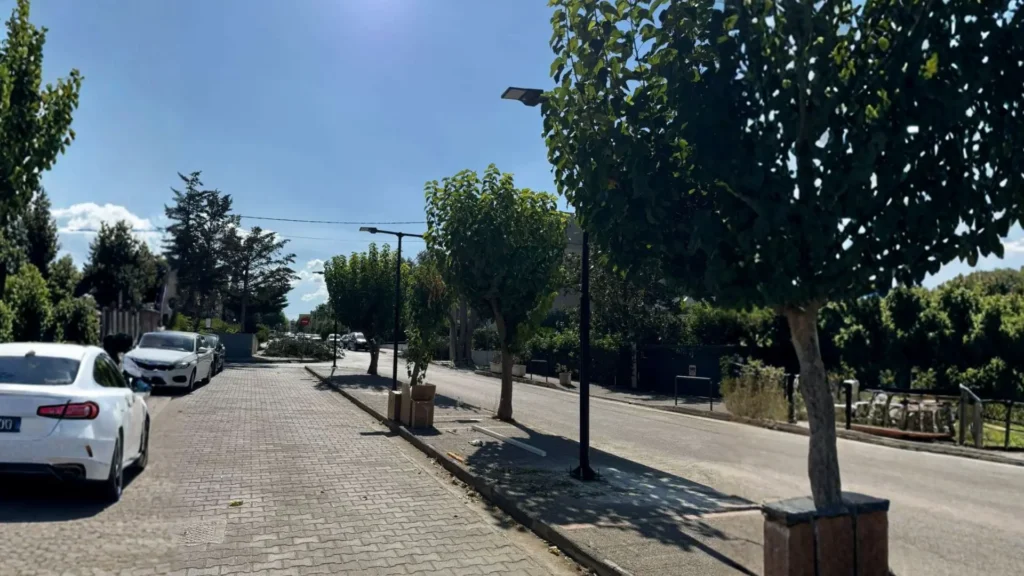
Integrated design eliminates trenching or buried wiring. Black poles are mounted on stone paths via adjustable bases (0°–90°), supporting horizontal, vertical, or wall installations for curved alleys.
Landscape-Adaptive Layout
Black poles contrast with white buildings, enhancing aesthetics. Lighting points are installed at 3–5 meters (SSL-53 for narrow sections, SSL-59 for main alleys), with extension panels positioned to avoid tree canopies.
User-Friendly Configuration
The multifunctional remote control includes a preset PIR mode, ensuring safety while minimizing light pollution. Automatic device recognition allows seamless system expansion.
IV. Project Results & Impact
Social Value: Revitalizing Community Life
Bright lighting has revitalized quiet alleys. Residents and tourists report a 25% decrease in public safety risks, with soft lighting enhancing the cultural atmosphere and attracting more tourist traffic.
Sustainability: A Benchmark for Carbon-Neutral Cities
Powered entirely by solar energy, the system saves thousands of euros annually and reduces CO₂ emissions by hundreds of tons. Installation preserved urban greenery, demonstrating harmony between technology and nature.
Technological Demonstration Significance
Expandable panel technology effectively addresses shading in tree-dense areas and is suitable for global replication. As a benchmark smart city streetlight manufacturer, SRESKY Alpha supports Greece’s green transition.
V. Risks and Mitigation Strategies
- Risk: Tree growth obstructing solar panels
Mitigation: Adjustable angles for extension panels combined with municipal pruning; ALS 2.4 automatic compensation. - Risk: Battery degradation from extreme rainy or cloudy weather
Mitigation: TCS temperature control system and high-quality Li-ion batteries (discharge range: -20°C to 60°C) prevent over-discharge and extend battery life beyond five years.
Conclusion
The SRESKY Alpha series safeguards the cities of the Aegean, demonstrating the potential of advanced solar streetlights in historic urban environments.