
Lighting design for ports, docks, and waterfront industrial areas cannot simply replicate conventional road lighting solutions. Sea breezes, salt spray, strong winds, high humidity, and prolonged rainy periods can affect the long-term reliability of lighting equipment. Meanwhile, ship berthing, heavy vehicle traffic, and nighttime loading and unloading operations place greater demands on illuminance, uniformity, and visual safety.
So, how should solar street lights be selected for ports? The key is not to pursue the highest power output or the largest battery capacity, but to determine whether the equipment can withstand the local environment, meet actual lighting requirements, and maintain reliable operation throughout its service life.
I. What Are the Special Lighting Requirements for Ports?
1. Salt Spray Corrosion: Waterproofing Alone Does Not Guarantee Suitability for Coastal Environments
Ports are constantly exposed to salt-laden air, which causes salt deposits to accumulate on the surfaces of luminaire housings, light poles, brackets, and fasteners. High humidity, rainfall, and temperature fluctuations can further accelerate metal corrosion and increase maintenance requirements for electrical connections.
Therefore, when procuring solar street lights for ports, buyers should not simply check whether a product is labeled as waterproof. They must also verify the corrosion-resistant design of the entire system.
Key considerations include:
- Luminaire Protection: Verify the IP protection rating, joint sealing, and cable entry design according to the installation environment.
- Materials and Surface Treatments: Inspect the galvanization process used for light poles, the quality of weather-resistant coatings, and the materials used for luminaire housings.
- Fasteners: Select appropriate corrosion-resistant materials based on the level of salt spray exposure, and consider the risk of galvanic corrosion caused by contact between dissimilar metals.
- Test Evidence: Require suppliers to provide relevant salt spray testing standards, test durations, and corresponding reports.
It is important to note that an IP65 rating primarily indicates protection against dust and water ingress; it does not directly demonstrate sufficient resistance to salt spray corrosion. Similarly, the IP rating of a luminaire cannot replace the corrosion-resistant design required for light poles, bolts, and foundation connections.
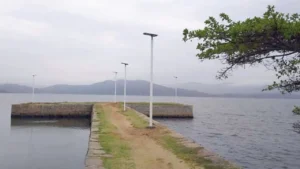
In a Brazilian coastal port project, Sresky deployed its ATLAS series solar street lights, incorporating environmental challenges such as salt spray, high humidity, and rainfall into the project design. This project provides a useful reference for evaluating the protective design of lighting equipment in coastal environments. However, for individual projects, relevant test data should still be verified against local corrosion conditions and procurement specifications.
Case Study: Sresky Brazilian Coastal Port Solar Street Light Project
2. High Winds and Extreme Weather: Light Poles, Solar Panels, and Foundations Must Be Evaluated Together
Ports and waterfront areas typically have limited shelter from surrounding buildings. Strong winds act not only on light poles and lamp arms but also on solar panels and their mounting structures, increasing the stress placed on connection points and foundations.
Therefore, the overall structural safety of a solar street lighting system cannot be determined solely by the wind resistance specifications advertised for its luminaires.
Before procurement, the following factors should be verified:
- Applicable local design wind speeds and wind load requirements.
- Structural calculations for light poles, lamp arms, and solar panel mounting structures.
- Foundation dimensions, anchor bolt specifications, and on-site geological conditions.
- Whether the equipment’s stated wind resistance rating corresponds to the actual installation height and structural configuration.
- Whether post-storm inspections and maintenance can be carried out efficiently.
Special attention should be paid to structural design in typhoon-prone areas, on islands, and at exposed docks. Even if the luminaires themselves pass the relevant tests, this does not guarantee that light poles of any height or foundations of any design will satisfy the same wind load requirements.
3. Nighttime Operations: Illuminance, Uniformity, and Glare Matter More Than Brightness Alone
Port lighting directly affects the safety of vehicle traffic, personnel patrols, cargo handling, and operations around ships. Different functional areas therefore require different lighting designs.
- Internal Port Roads: Must provide sufficient visibility for drivers to identify road boundaries, pedestrians, and obstacles.
- Logistics Parking Areas: Must accommodate vehicle parking, pedestrian movement, and security patrols.
- Pier Walkways: Should minimize noticeable dark spots to ensure pedestrian safety at night.
- Container Loading and Unloading Areas: May require higher illuminance levels and stricter illumination uniformity.
- Public Waterfront Areas: Must balance visual comfort with the need to minimize light pollution in the surrounding environment.
When purchasing lighting fixtures, buyers should not rely solely on comparisons of wattage or lumen ratings. Lumens measure luminous flux, whereas illuminance measures the amount of light received by a surface. Even when two luminaires have the same luminous flux, their actual lighting performance can vary significantly depending on beam distribution, installation height, and pole spacing.
The correct approach is to first establish the lighting requirements for each functional area and then use IES or LDT photometric files to conduct lighting simulations. These simulations should verify average illuminance, minimum illuminance, uniformity, and potential glare.
4. Cloudy and Rainy Weather: Solar Panels and Batteries Must Be Matched to Local Solar Conditions
The ability of solar street lights to operate reliably depends not only on battery capacity but also on local solar irradiance, luminaire load, and overall system efficiency.
In tropical coastal areas, regions with frequent rainfall, and locations with limited winter sunlight, the following factors require particular attention:
- Solar irradiance during the least favorable month.
- Solar panel orientation, tilt angle, and potential shading.
- Daily lighting duration and actual average power consumption.
- Usable battery capacity and allowable depth of discharge.
- The required number of consecutive rainy days that the system must withstand, along with overall energy conversion losses.
Smart dimming can reduce power consumption during periods of lower demand, but it cannot generate additional solar energy. If a port road must maintain a specified lighting level throughout the night, dimming alone cannot compensate for insufficient energy storage capacity.
For areas with stringent safety requirements, energy storage redundancy, backup power supplies, and emergency lighting measures in the event of system failure should also be evaluated.
II. Why Do Some Port Projects Choose Solar Street Lights Instead of Traditional Grid-Connected Lighting?
Solar street lights are not a universal replacement for traditional grid-connected lighting. Their primary advantage is that certain areas can operate without newly installed external power lines. This makes them particularly suitable for locations where cable installation is difficult, existing power distribution facilities are far away, or phased construction is required.
1. Reducing Disruption Caused by Underground Cable Installation and Construction
Existing ports typically contain underground utilities, including power, telecommunications, water supply, and drainage systems. Installing additional lighting circuits may require excavating paved surfaces, coordinating work around existing utility lines, and restoring the original ground surface. In continuously operating ports, these activities may also disrupt vehicle traffic and on-site operations.
Standalone solar street lights integrate power generation, energy storage, and lighting into the lighting unit, reducing the need to install new power supply lines. However, investments in pole foundations, structural installation, and ongoing maintenance are still required.
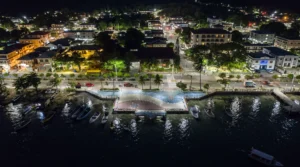
In a waterfront plaza project on Colombia’s Caribbean coast, Sresky deployed 105 sets of UFO solar landscape lights. According to the project documentation, the solution addressed challenges involving the protection of existing pavement and underground construction, demonstrating the potential value of standalone solar lighting in paved public spaces.
This case study is more suitable for illustrating how solar lighting can reduce the need for certain underground construction activities than for proving that the same fixtures can be directly applied to large-scale port loading and unloading areas. The lighting objectives, structural requirements, and safety standards of a waterfront plaza differ considerably from those of an industrial wharf.
Case Study Reference: Sresky Colombia Waterfront Plaza Solar Lighting Project
2. Suitable for Roads and Pathways Far from Power Distribution Facilities
Port perimeter roads, remote berths, island-based terminals, and newly developed logistics zones may be located far from existing power distribution facilities.
If cables must be extended to supply only a small number of lighting fixtures, a comprehensive comparison should be made of cable lengths, power distribution equipment, construction costs, and future maintenance expenses. In such situations, solar street lights can reduce the need for additional power supply infrastructure.
However, if the same area also requires high-power lighting, video surveillance, or other equipment that needs a continuous power supply, grid-connected, standalone solar, and hybrid power solutions should be evaluated in advance to avoid unnecessary additional construction in the future.
3. Cost-Effectiveness Must Be Evaluated Based on Total Life-Cycle Costs
Solar street lights can reduce electricity consumption for lighting and certain cable-related maintenance expenses. However, this does not mean that the entire system has no operating costs. Solar panels require periodic cleaning, batteries have a limited service life, and luminaires, controllers, and structural components also require regular inspection.
Therefore, procurement teams should compare the following costs:
- Equipment procurement and infrastructure construction costs.
- Cable installation, power distribution equipment, and road restoration costs.
- Electricity consumption and related maintenance expenses.
- Battery replacement and equipment repair costs.
- Downtime resulting from equipment failures, maintenance accessibility, and labor costs.
Only by incorporating these factors into a comprehensive life-cycle cost model can buyers determine which lighting solution offers the best long-term value.
III. How Should Solar Street Lights Be Selected for Ports?
For procurement teams and engineering contractors, the selection process can be summarized around three key questions: Does the lighting meet the required standards? Is the power supply reliable? Is the equipment suitable for the actual site environment?
1. Determine the Application Area First, Then Select the Luminaire Power Rating
Do not begin by choosing a specific luminaire wattage and then attempting to use it to meet the lighting requirements of the entire port.
The correct approach is to first clarify the road width, installation height, pole spacing, lighting hours, and target illuminance, and then conduct simulations using actual photometric data.
For general roads, walkways, and perimeter access routes, evaluate directional light distributions that suit the geometric characteristics of the road. For container loading and unloading areas or large operational zones, specialized lighting designs are necessary. High-mast or grid-connected lighting should also be considered when appropriate.
2. Calculate Energy Requirements Based on Daily Load
Solar panel and battery selection should be based on actual energy consumption rather than solely on the equipment’s rated power.
Daily energy consumption can be preliminarily estimated using the following formula:
Edaily = Pavg × t
Where:
- Edaily: Daily lighting energy consumption, measured in Wh.
- Pavg: Actual average luminaire power after dimming, measured in W.
- t: Daily lighting duration, measured in hours.
For example, if a luminaire consumes an average of 60 W per night and operates for 12 hours, its daily energy consumption is approximately 720 Wh.
This is simply an example of load calculation and should not be interpreted as a universal power recommendation for port street lighting. Actual system design must also account for energy conversion losses, local solar conditions, solar panel generation efficiency, usable battery capacity, and the required operating duration during consecutive cloudy or rainy days.
When procuring equipment, request that suppliers provide power generation and load balance calculations, together with details of the meteorological data, energy storage assumptions, and dimming strategies used.
3. Verify Protection, Structural Integrity, and Maintenance Requirements
After completing the lighting and energy assessments, verify that the equipment is suitable for the actual installation environment.
Key considerations include the corrosion-resistant design of luminaires and electrical connections, structural calculations for solar panel mounts and light poles, the operating temperature range of batteries, and the ease of replacing critical components.
For docks and remote areas that are difficult for maintenance vehicles to access, the availability of spare parts, warranty conditions, and procedures for handling equipment malfunctions should also be confirmed in advance. A lower initial equipment price does not necessarily translate into lower long-term operating costs.
IV. Are Solar Street Lights Suitable for Different Port Areas?
| Application Area | Selection Recommendations | Key Considerations |
|---|---|---|
| Port perimeter roads | Prioritize evaluating suitability based on local sunlight conditions and environmental exposure. | Battery life, corrosion resistance, wind resistance, and sunlight availability. |
| Pier access roads far from power distribution facilities | Prioritize evaluating the economic and technical advantages of standalone solar lighting. | Cable installation costs and actual lighting loads. |
| Seaside promenades and public walkways | Generally worth evaluating as potential solar lighting applications. | Glare control, weather resistance, and installation constraints. |
| Logistics parking areas | Determine suitability through lighting simulations. | Illuminance uniformity and operating duration. |
| Container yards and loading/unloading areas | Require specialized technical verification before adopting solar lighting. | High-load lighting requirements, power supply reliability, and operational safety standards. |
| Large-area lighting zones with high masts | Require specialized assessments of system capacity and structural performance. | High-power loads, structural integrity, and maintenance requirements. |
| Critical safety lighting areas | Should not adopt off-grid power without prior technical verification. | Backup power availability and continuous lighting requirements. |
For large ports, adopting a hybrid lighting strategy is often more practical than applying a single technology uniformly across the entire site. For example, high-load loading and unloading areas can retain grid-connected lighting, while perimeter roads, parking areas, and remote access routes can use standalone solar street lights where local conditions permit.
V. What Information Should Be Requested from Suppliers Before Procurement?
When comparing suppliers, procurement teams should include the following information in their technical evaluation checklist:
- Lighting Data: IES/LDT photometric files, lighting simulation reports, and luminaire installation parameters.
- Energy Data: Solar panel rated power, usable battery capacity, load calculations, and the design basis for continuous operation during rainy periods.
- Environmental Data: IP protection ratings, salt spray test reports, and specifications of key materials.
- Structural Documentation: Wind load calculations and relevant design parameters for light poles, brackets, and foundations.
- Operation and Maintenance Documentation: Battery and controller replacement procedures, warranty conditions, spare parts availability, and maintenance recommendations.
It is also important to distinguish between a supplier’s project case studies and product test reports, as they serve different purposes. Case studies can illustrate how equipment performs in specific application environments, but they cannot replace the structural calculations, lighting simulations, and energy assessments required for a new project.
VI. Conclusion: Selecting the Right Application Areas Is Key to Successful Port Solar Street Lighting
When selecting solar street lights for ports, docks, and coastal industrial areas, priority should be given to three key questions: Can the equipment withstand the local environmental conditions? Does the lighting meet operational requirements? Can the energy storage system support the intended load under unfavorable weather conditions?
For perimeter roads and access routes where cable installation is difficult and power distribution facilities are far away, standalone solar street lights deserve priority consideration. For high-power loading and unloading zones and critical safety lighting applications, specialized designs should be developed based on actual loads, lighting standards, and power supply reliability requirements.
Project references from Sresky—including coastal port facilities in Brazil, yacht marinas in Cyprus, and waterfront public spaces in Colombia—provide useful insights into marine environmental adaptability, light distribution design, and reducing the need for underground construction, respectively. Their value lies in helping procurement teams understand the technical considerations associated with different applications, rather than serving as substitutes for project-specific engineering assessments.
For port operators, EPC contractors, and procurement teams, the most reliable decision-making approach is to first clarify lighting requirements, then verify energy and structural conditions, and finally compare total life-cycle costs. Only through this systematic approach can solar street lights move beyond being a seemingly flexible equipment option and become a reliable lighting solution that genuinely meets the operational needs of ports.