
At 3:00 p.m. in winter, when the sun is blocked by mountain ridges, the available charging time for solar streetlights is significantly reduced. Prolonged periods of overcast and snowy weather, snow accumulation on solar panels, and sub-zero temperatures can cause even normally functioning streetlights to run out of power prematurely. Meanwhile, slippery downhill surfaces can reflect light and create glare, making it more difficult for patrol vehicles and pedestrians to navigate safely.
Project Snapshot
Project Description
- Location: Cold-temperate mountainous regions in central-eastern South Korea, including mountain parks, forest trails, and connecting paths within scenic areas.
- Target Client Type: Management offices under the National Park Service.
- Quantity: Approximately 120 sets of SRESKY Thermos Self-Cleaning Solar Street Lights (SSL-716).
- Core Operating Conditions: Short winter daylight hours, mountain shading, snow accumulation, low temperatures, and wet or icy road surfaces.
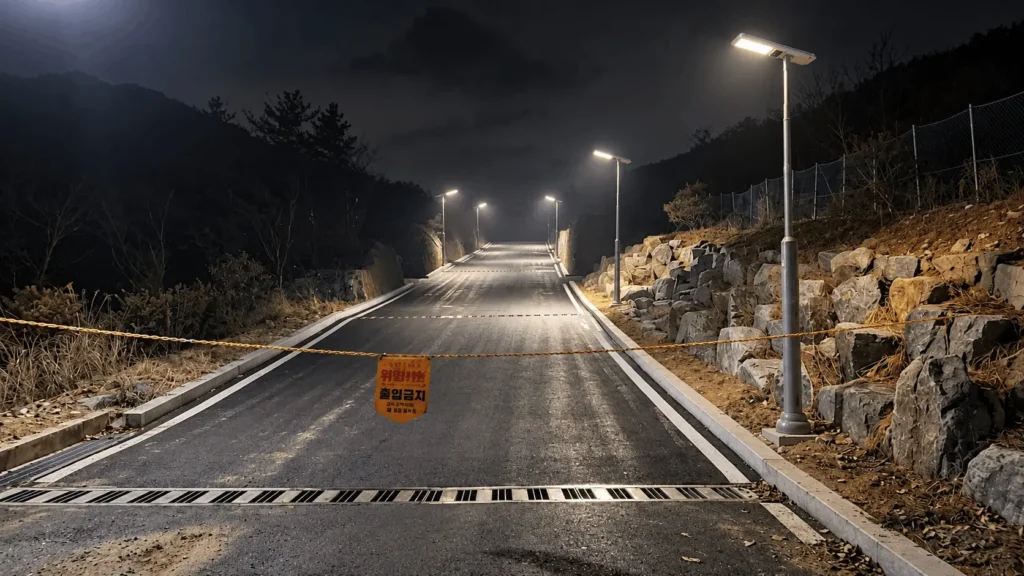
Engineering Challenge 1: How Can Solar Streetlights Maintain Stable Illumination Despite Limited Winter Sunlight?
Winter daylight hours are short in South Korea’s mountainous regions. Mountain shading and persistent snowfall further reduce photovoltaic (PV) power generation. Low temperatures can also restrict battery charging, potentially resulting in insufficient power at night, even when sunlight is available during the day.
Key Challenges Faced by the Project:
- Prolonged overcast and snowy weather increases the risk of nighttime power outages.
- Snow accumulation on PV panels reduces charging efficiency, while snow removal in remote areas can be costly and labor-intensive.
- Simply increasing battery capacity may raise procurement costs and add structural loads to light poles.
SRESKY Solution: Optimizing Winter Energy Management to Reduce the Risk of Power Outages
To address the challenges of limited daylight, heavy snowfall, and low temperatures in South Korea’s mountainous regions, the SRESKY Thermos solar streetlight is designed to optimize energy utilization and reduce operational pressure during winter.
- Low-Temperature Battery Protection: TCS temperature control technology, combined with the battery management system (BMS), helps minimize the impact of temperature fluctuations on battery performance. Actual performance when temperatures fall below the battery’s minimum charging threshold should be verified through real-world testing.
- Improved PV Recharging: The self-cleaning design primarily targets dust and other surface contaminants. Combined with an appropriate on-site installation angle, it helps reduce the impact of accumulated contaminants on power generation and minimizes manual maintenance requirements. However, its effectiveness under snow and ice conditions requires on-site verification.
- Optimized Nighttime Energy Consumption: Through ALS (Ambient Light Sensing) intelligent dimming technology, the system automatically adjusts brightness according to the remaining battery charge. This helps reduce unnecessary energy consumption and extend available lighting time during prolonged periods of rain, snow, or overcast weather.
Core Value: Improves the utilization efficiency of limited solar energy and reduces the risk of winter power shortages, rather than relying solely on increased battery capacity.
Engineering Challenge 2: How Can Lighting Effectiveness Be Balanced with Glare Prevention on Slippery Mountain Roads?
Snowmelt, wet ice, and mountain fog can change the reflective characteristics of road surfaces. Improper light distribution may create significant glare, making it difficult for drivers and patrol personnel to identify curbs, warning signs, and road boundaries.
Key Challenges Faced by the Project:
- Reflections from wet and icy road surfaces make road features more difficult to identify.
- Light spilling beyond road boundaries increases the risk of glare.
- Developing customized light distribution solutions for relatively small mountain projects may increase engineering and development costs.
SRESKY Solution: Optimizing Road Light Distribution to Improve Visibility on Wet and Slippery Surfaces
To address steep mountain road gradients and the high reflectivity of wet and icy surfaces, SRESKY Thermos solar streetlights prioritize optimized light distribution rather than simply maximizing brightness.
- Controlled Light Direction: Type II light distribution, suitable for road lighting applications, is used in combination with road width and installation layout to minimize unnecessary light spill.
- Optimized Installation Layout: The illumination range is adjusted according to pole height, installation angle, and spacing between lights to ensure appropriate coverage of the road surface and its boundaries.
Core Value: Concentrates illumination on areas where it is needed, helping improve road boundary visibility while balancing visual comfort and road safety.
Project Outcomes: Design Optimized Around Winter Reliability
- Winter Energy Planning: Power generation, energy storage, and nighttime energy consumption are planned according to the most challenging month of the year.
- Reduced Maintenance Burden: The combination of a self-cleaning design and optimized PV panel tilt angles helps reduce the maintenance burden caused by dust and snow accumulation. However, regular inspections and necessary maintenance remain essential during winter.
- Improved Road Visibility: Light distribution simulations and optimized installation layouts help control light spill and reduce glare risks.
- Enhanced Operational Flexibility: Basic lighting, motion-activated dimming, and appropriate power supply configurations are selected according to actual road usage requirements.
For mountain trail projects, the real value of a solar streetlight solution lies not in simply adding more hardware, but in adapting the system to local winter conditions while balancing lighting reliability with long-term maintenance costs.
Customer Feedback
“Our concern wasn’t simply whether the lights would turn on, but whether we could clearly see the road boundaries on icy roads. Combining basic lighting with motion-activated dimming makes the lighting design much more targeted.”
— Project Acceptance Engineer
Frequently Asked Questions (FAQ)
1. How should solar streetlights be selected for winter conditions in South Korea’s mountainous areas?
The key is to evaluate power generation and energy storage performance during the harshest month of the year rather than relying solely on rated power specifications.
- Calculate winter sunshine hours, mountain shading, and the expected number of consecutive overcast or snowy days.
- Verify the battery’s low-temperature charging protection and actual usable capacity.
- Determine the system configuration based on required lighting duration, dimming strategies, and the expected number of consecutive overcast or snowy days.
2. Can solar streetlights still charge at sub-zero temperatures?
This depends on the battery type, actual ambient temperature, and the battery management system.
- Lithium iron phosphate (LiFePO₄) batteries generally cannot be charged directly below their specified minimum charging temperature.
- Select products equipped with low-temperature charging protection or proven battery heating solutions.
- Before purchasing, verify the battery’s operating temperature range, charging temperature range, and low-temperature test data.
3. How can solar streetlights in mountainous areas minimize the impact of snow accumulation?
Both the PV panel installation method and routine maintenance arrangements must be considered.
- Select an appropriate PV panel tilt angle based on actual site conditions.
- Evaluate the self-cleaning structure and verify its actual effectiveness under snow and ice conditions.
- Include winter inspections and necessary manual snow removal in the operation and maintenance plan.
Conclusion: Solar Streetlight Projects Are Shifting from Equipment Selection to Context-Specific System Design
For mountain trails, forest roads, and scenic area access routes in South Korea, solar streetlight selection is evolving beyond simple considerations of brightness, power, and battery capacity. Increasingly, the focus is on winter energy reliability, road visibility and safety, and full life-cycle operation and maintenance costs.
For municipal management departments, priority should be given to defining lighting requirements, winter operating conditions, and project acceptance criteria.
For EPC contractors, winter energy balance calculations, light distribution simulations, and low-temperature battery protection should be incorporated into the engineering design.
For project planners, factors such as mountain shading, snow accumulation, road gradients, and maintenance accessibility should be identified and evaluated in advance.
The SRESKY Thermos series can serve as a potential product option for such projects. However, the final configuration should always be determined according to specific model specifications, on-site surveys, and engineering validation.