
Table of Contents
For marinas along the Adriatic coast, nighttime lighting involves more than simply addressing “insufficient brightness.”
Salt fog carried by sea breezes continuously corrodes light poles, bolts, and connecting structures. At the same time, the complex environment along marina roads—including boats, parking areas, and the water surface—creates additional challenges for light distribution.
For coastal areas, one of the key challenges for solar streetlights is whether they can remain stable, safe, and easy to maintain after years of operation—not just whether they can be installed successfully.
Therefore, this project, designed specifically for the Marina dock environment in Croatia, deployed 47 sets of SRESKY ATLAS all-in-one solar streetlights to provide an off-grid lighting solution for harbor roads and public areas.
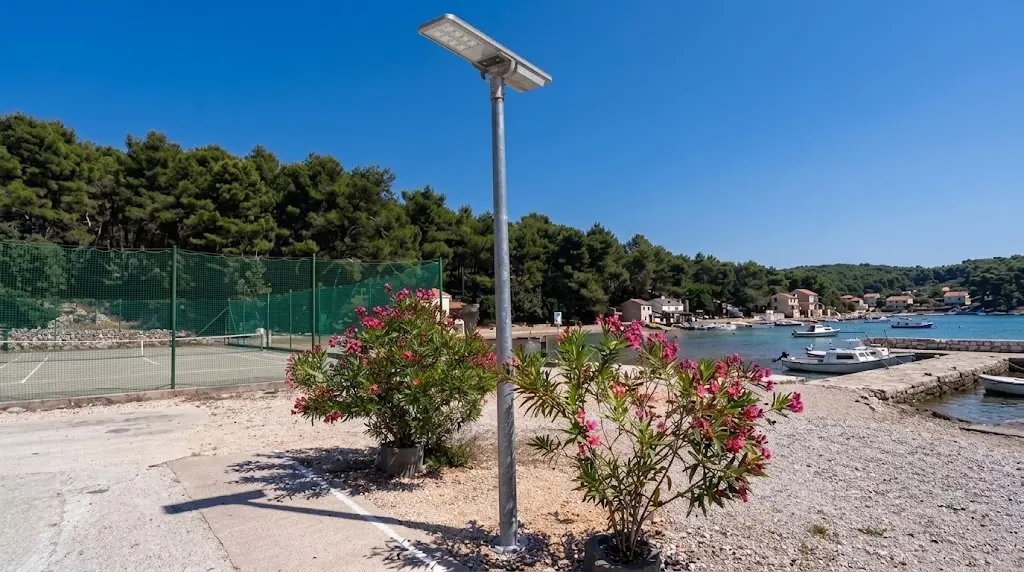
Project Information
Project Location: Small harbor/marina area along the Adriatic coast of Croatia
Client Type: Local municipal public utilities department
Deployment Scale: 47 sets of ATLAS solar streetlights
Engineering Challenges and Solutions
Challenge 1: How can long-term reliability of solar streetlights be ensured in a coastal salt fog environment?
An often-overlooked risk in coastal projects is that while the waterproof performance of luminaires is certainly important, maintaining the structural stability of the entire installation system under long-term salt fog exposure is equally critical.
Salt in coastal air continuously affects lamp posts, brackets, bolts, and flange connections—components that are often more vulnerable to corrosion than the luminaires themselves.
Key risks include:
- Corrosion of bolts and fasteners, increasing the difficulty of future maintenance;
- Salt accumulation in flange areas, potentially compromising structural safety;
- Galvanic corrosion caused by contact between dissimilar metals;
- Higher corrosion risks for material combinations and connection structures commonly used in standard road projects when exposed to long-term salt fog conditions.
Therefore, the design of this project focused on the overall corrosion resistance and reliability of coastal solar streetlights, rather than simply improving the protection rating of the luminaires themselves.
Solution: Optimizing Corrosion Protection Configurations for Marine Environments to Enhance Long-Term Operational Reliability
Given the environmental conditions along Croatia’s Adriatic coast, the project did not simply adopt standard installation configurations. Instead, a comprehensive corrosion assessment was conducted for the lamp heads, brackets, poles, and foundation connection systems.
ATLAS solar streetlights feature reinforced configurations designed for seaport environments:
- Material compatibility was considered for connecting components such as brackets, bolts, and washers to reduce corrosion risks caused by contact between dissimilar metals;
- Flange and anchor connection areas received enhanced protection, focusing on locations most vulnerable to salt accumulation;
- Technical specifications suitable for coastal environments were provided during the project design phase, rather than limiting documentation to basic product parameters.
This comprehensive corrosion-resistant design ensures that the solar streetlights not only meet installation requirements but are also better suited for long-term operation and maintenance needs.
For coastal, municipal, and island projects, whether luminaires can remain stable after several years of operation is often a greater concern than the initial purchase price.
Challenge 2: How can bayfront roads achieve precise lighting while reducing light pollution?
The lighting environment at a marina differs significantly from that of conventional roads.
One side of the road may face the water, while the other may face boats, parking areas, or buildings. If lighting is arranged in the same way as for ordinary roads, problems may occur where “the road surface is not bright enough, but the water is unnecessarily illuminated.”
The main impacts include:
- Light directly reaching the water surface, resulting in wasted energy;
- Reflections from ship hulls, metal structures, and local water surfaces increasing visual interference and glare;
- Uneven illuminance across different road sections;
- Reduced nighttime comfort for tourists, crew members, and nearby residents.
Therefore, this project relied on precise light distribution design rather than simply increasing luminaire wattage.
Solution: Optimizing Bay Road Lighting Through Lighting Simulation and Directional Light Distribution
The project team conducted DIALux lighting simulations based on actual road dimensions, pole heights, and environmental conditions to determine appropriate installation parameters and luminaire orientations.
Ultimately, the ATLAS SSL Series solar streetlights were selected. This series provides a single-lamp luminous flux range of approximately 8,000 to 15,000 lumens, with specific models selected according to road width. The lighting design was optimized using a TYPE-II light distribution pattern.
Key advantages include:
- Precise forward-directed light distribution: The TYPE-II light distribution pattern helps concentrate the primary beam on the road area, reducing unnecessary illumination toward the sea;
- DIALux simulation optimization: By combining selectable pole heights of 8–12 meters with a luminaire spacing range of approximately 25–31 meters, the site layout was simulated and validated to optimize obstruction angles and illuminance uniformity;
- Intelligent dimming management: Output levels are adjusted according to harbor nighttime usage patterns, reducing energy consumption while maintaining safe lighting conditions.
Simulation results confirmed that this solution provides effective road illuminance distribution and uniformity while significantly reducing light spill toward the water, making it highly suitable for waterfront terminals and tourist areas.
Project Outcomes
A total of 47 sets of ATLAS SSL Series solar streetlights were deployed, enabling off-grid lighting throughout the harbor area.
Key Achievements:
- Zero Grid Dependency: No underground cable installation was required, reducing construction costs and environmental impact.
- Long-term corrosion resistance and reliability: Enhanced anti-corrosion measures improved the stability of the connection system in coastal environments.
- Optimized nighttime lighting experience: Precise light distribution reduced light spill over the water while ensuring sufficient road illumination.
- Reduced operating costs: Solar power enabled long-term, low-maintenance operation.
Customer Feedback
“We were quite concerned about corrosion affecting connectors and light poles in a coastal environment after several years of operation. However, the supplier quickly provided detailed material specifications and treatment solutions, which gave us confidence. One rainy season has passed since installation, and feedback regarding lighting performance at the pier has been positive.”
— Engineering Manager, Municipal Public Facilities Department (Project Site)
FAQ: Frequently Asked Questions About Coastal Solar Streetlight Projects
1. What should be considered when installing solar streetlights by the sea?
Coastal solar streetlights should not be selected based solely on standard road specifications. Key considerations include:
- Corrosion resistance of light poles and connectors;
- Material selection for bolts and flanges;
- Adaptability to salt spray environments;
- Long-term maintenance costs.
2. Why is DIALux lighting simulation necessary for solar streetlights?
The environments of docks, marinas, and coastal roads are complex. Simulation allows early optimization of:
- Luminaire installation locations;
- Light distribution directions;
- Road illuminance uniformity;
- Control of light pollution over the water.
3. Are solar streetlights suitable for the Adriatic coast of Croatia?
Yes, but they must be designed according to year-round environmental conditions. Projects must comprehensively consider:
- Winter solar irradiance;
- Overcast and rainy weather;
- Salt fog corrosion;
- Wind-related impacts.
Off-grid solar streetlight systems typically need to be designed based on the most challenging conditions expected throughout the year.
Conclusion
The Marina Pier project in Croatia demonstrates that the key to successful coastal solar lighting lies not only in increasing brightness but also in addressing long-term salt fog corrosion and optimizing light utilization in complex waterfront environments.
Through targeted design of mounting structures, corrosion-resistant configurations, lamp placement, and light distribution, the ATLAS series is better positioned to meet the off-grid lighting requirements of pier roads, parking areas, and coastal public spaces.
I also standardized terms such as “solar street lights” → “solar streetlights,” “light pollution,” “illuminance uniformity,” and “coastal environment” for a more professional engineering case-study style.