
When purchasing solar street lights in bulk, price is only one factor in the decision-making process. The lamp power, battery capacity, and solar panel power listed in a quotation do not fully reflect a product’s actual performance at the project site. Even when two suppliers offer products with identical nominal specifications, significant differences may still exist in usable battery capacity, optical design, control strategies, structural strength, and quality control standards.
For government procurement departments, EPC contractors, engineering firms, and overseas distributors, bulk purchasing of solar street lights involves more than comparing prices. It also requires verifying technical specifications, outdoor reliability, supplier delivery capabilities, and long-term maintenance costs.
This article outlines 10 key points that buyers should verify before placing an order. It also provides a checklist of supplier documentation to help buyers mitigate risks associated with configuration discrepancies, batch-to-batch quality variations, and project delivery.
I. Core Performance: Do the Specifications Truly Meet Project Requirements?
1. Batteries: Evaluate Total Energy and Usable Capacity—Don’t Just Look at Ah
Batteries determine a solar street light’s ability to provide illumination during prolonged periods of rain or overcast weather, as well as the overall system’s service life. Currently, lithium iron phosphate (LiFePO₄) batteries are a common choice for solar street lights.
When purchasing, pay particular attention to the following:
- Rated Energy: Do not rely solely on Ah. Calculate the energy capacity in Wh (watt-hours) based on the rated voltage to determine the actual energy storage capacity.
- Usable Depth of Discharge (DoD): Verify the battery’s permitted depth of discharge (DoD) to avoid confusing rated capacity with actual usable capacity.
- Cycle Life: When suppliers claim a cycle life of several thousand cycles, verify the test temperature, depth of discharge, and charge/discharge rates.
- BMS Protection: Verify protection against overcharging, over-discharging, short circuits, and temperature-related issues, as well as the permitted charging and discharging temperature ranges.
- Cell Specifications: Confirm the cell brand, model, and technical specifications rather than relying solely on product brochures.
Procurement Recommendations: Request a battery datasheet, supporting documentation for cycle life test results, and a detailed description of the BMS protection functions.
2. Solar Panels and Controllers: Calculate the Energy Balance for the Worst-Case Month
A higher-wattage solar panel does not necessarily guarantee a more reliable system. The key is whether daily power generation can meet nighttime lighting requirements and recharge the battery after prolonged periods of overcast or rainy weather.
Key Verification Points:
- Evaluate power generation during the month with the lowest solar resource availability, taking into account the project’s peak sunshine hours (PSH), seasonal variations, installation angle, shading, and system losses.
- Verify key solar panel parameters, including rated power (Wp), Vmp, Imp, Voc, and Isc.
- Confirm whether the controller uses MPPT or PWM technology, and understand its protection functions against overcharging, over-discharging, short circuits, reverse polarity, and temperature-related issues.
- If smart dimming is used, specify the brightness levels and operating times for each period to avoid overstating battery autonomy by excessively reducing brightness.
Procurement Recommendations: Require suppliers to provide a System Energy Calculation (SEC) demonstrating that the selected combination of solar panels, batteries, and luminaires can meet the actual sunlight conditions at the project site.
3. Total Luminaire Luminous Flux and IES Files: Verify Road Lighting Performance with Data
The nominal power of an LED does not directly indicate its actual lighting performance. LED chips, driver efficiency, optical distribution, and thermal management design all influence the final roadway lighting performance.
During procurement, distinguish between LED chip specifications and complete luminaire specifications, paying particular attention to the following:
- Total luminaire luminous flux (lm) and luminous efficacy (lm/W).
- Color temperature (CCT), color rendering index (CRI), and lumen depreciation data.
- Whether the IES/LDT files correspond to the actual luminaire models being procured.
- Average illuminance, illuminance uniformity, and glare performance in road lighting simulations.
IES files can be imported into DIALux or Relux software and used together with actual road width, pole height, spacing, and installation angles to conduct lighting simulations and determine whether the proposed lighting solution meets project requirements.
Procurement Recommendations: During the technical evaluation stage, request the IES files and complete luminaire photometric test reports for the corresponding models. For critical road lighting projects, an independent lighting consultant should review the simulation results.
II. Outdoor Reliability: Can the Product Operate Reliably Over the Long Term?
4. Luminaire Housing: Protection Rating, Heat Dissipation, and Corrosion Resistance
Since solar street lights are installed outdoors for extended periods, the housing’s protection rating and heat dissipation capabilities directly affect the service life of electronic components and the entire luminaire.
Key Verification Points:
- Confirm that the IP protection rating applies to the entire luminaire, not just the controller or junction box.
- If required by the project, verify the IK impact resistance rating and sealing structure.
- For coastal projects, pay particular attention to salt spray testing and corrosion resistance.
- For desert and high-temperature regions, evaluate the effects of dust and high temperatures on the housing, seals, and electronic components.
- Inspect the heat dissipation design to reduce the risk of LED lumen depreciation and component failure caused by prolonged operation at high temperatures.
Procurement Recommendation: Request IP/IK test reports for the corresponding product model, along with salt spray and high-/low-temperature test data where required by the project.
5. Light Pole Structure: Consider Wind Loads and Foundations as an Integrated System
Light poles must not only support the weight of the luminaire but also withstand wind loads acting on the solar panel and other environmental forces at the project site.
During procurement, verify the following:
- Light pole height, wall thickness, steel grade, and corrosion protection.
- Flange dimensions, anchor bolts, and light arm length.
- Design wind speed at the project site and wind load calculations for the light pole.
- Foundation dimensions, geological conditions, and overall load-bearing capacity.
The luminaire, solar panel, lamp arm, light pole, and foundation should be evaluated as one integrated system. Do not focus solely on pole height or the strength of individual components.
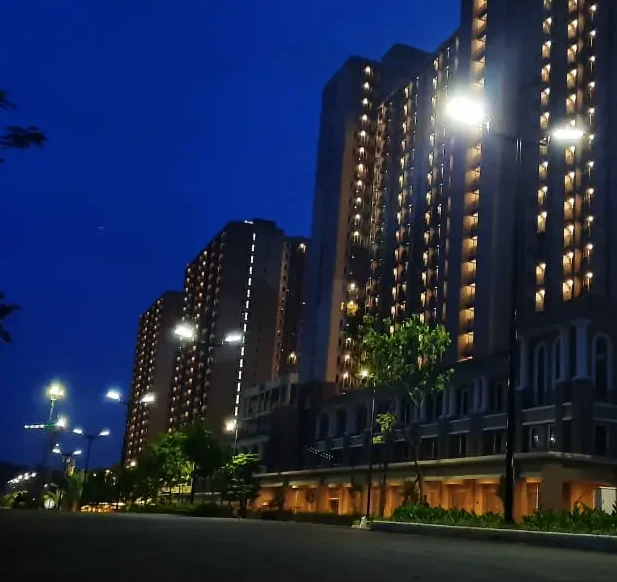
Project Reference: In a road lighting retrofit project in Indonesia, SRESKY developed a solution that reused existing 10-meter light poles to install solar street lights, reducing the costs and construction time associated with installing new poles.
Such retrofit projects highlight an important consideration for procurement teams: when planning to reuse existing light poles, verify their corrosion condition, load-bearing capacity, mounting interfaces, and local wind load requirements in advance.
Procurement Recommendation: Require suppliers to provide light pole structural drawings, material specifications, and applicable wind load calculation data.
6. Batch Consistency and Delivery Capability: A Good Sample Does Not Guarantee a Good Production Batch
For government projects and large-scale EPC projects, a supplier’s mass production capacity is just as important as its quality control standards. A sample that performs well does not guarantee that hundreds or thousands of units will maintain the same quality.
Recommended Key Verification Points:
- Determine whether the supplier is a manufacturer or distributor, and identify the sources of key components such as batteries, controllers, and LED modules.
- Verify whether the supplier’s quality control processes cover IQC (Incoming Quality Control), IPQC (In-Process Quality Control), FQC (Final Quality Control), and OQC (Outgoing Quality Control).
- Check whether records are available for aging tests, charge/discharge tests, and random sampling inspections before shipment.
- Confirm whether the supplier has batch numbering and traceability capabilities for key components.
- Verify whether the supplier can provide a clear production and delivery schedule organized by batch.
For high-volume orders, arrange an on-site factory audit or commission a third-party audit, focusing on actual production processes, quality management, and order fulfillment capabilities.
Procurement Recommendation: Specify in the contract that mass-produced products must match the approved samples. Any changes to key components, such as batteries, controllers, LEDs, and optical structures, must receive the purchaser’s prior written approval.
III. Documentation and Delivery: Ensure Accuracy and Clearly Define Responsibilities
7. Certifications and Technical Documentation: Verify the Scope, Not Just the Certificates
Possessing CE or RoHS documentation does not automatically mean that a product meets all project requirements. Buyers should determine the applicable standards based on the product’s composition, the regulations of the destination country, and the requirements specified in the tender documents.
Commonly relevant standards include:
- IEC 60598: Safety requirements for luminaires.
- IEC 61215 / IEC 61730: Design qualification and safety requirements for photovoltaic modules.
- UN 38.3: Transportation testing requirements for lithium batteries.
- IEC 62133 / IEC 62619: Battery safety requirements; specific applicability depends on the battery type and application.
- ISO 9001: Quality management systems.
When verifying certificates, confirm the certification body, certificate number, validity period, product model, and scope of certification. If necessary, verify this information through the certification body or official databases.
In addition, collect complete product datasheets, battery and solar panel specifications, IES files, installation and maintenance manuals, and a list of key components. Confirm that all documentation matches the configuration specified in the final quotation.
Procurement Recommendation: Require suppliers to provide complete certificates or test reports rather than screenshots of certificates alone. The following is a recommended list of documents to request when purchasing solar street lights in bulk.
Bulk Purchasing of Solar Street Lights: What Documents Should You Request from Suppliers?
Before placing a formal order, buyers should collect relevant information regarding product performance, structural safety, quality control, and after-sales service. They should also confirm that the model numbers and configurations in all documents match those specified in the final contract.
| Verification Item | Recommended Documents to Request from Suppliers | Key Verification Points |
|---|---|---|
| Battery | Battery Datasheet, BMS Protection Specifications, Cycle Life Test Report | Cell brand, Wh capacity, DoD, cycle life test conditions, and BMS protection functions |
| Solar Panel | PV Module Datasheet, Module Test Report, System Energy Calculation | Wp, Vmp, Imp, Voc, Isc, and energy balance for the most unfavorable month |
| Lighting Performance | IES/LDT Files, Complete Luminaire Photometric Test Report, DIALux/Relux Report | Total luminous flux, luminous efficacy, light distribution curve, average illuminance, and uniformity |
| Structural Safety | Light Pole Drawings, Material Specifications, Wind Load Calculation Report, Foundation Design Data | Pole height, wall thickness, steel grade, design wind speed, and foundation bearing capacity |
| Outdoor Protection | IP/IK Test Reports, Salt Spray and High-/Low-Temperature Test Reports (if required by the project) | Water resistance, dust resistance, impact resistance, corrosion resistance, and environmental adaptability |
| Batch Consistency | Sample Verification Records, Final Specifications, IQC/IPQC/FQC/OQC Records | Consistency between samples and mass-produced products, changes to critical components, and batch traceability |
| Certification Compliance | CE, RoHS, Applicable IEC Certificates or Test Reports, UN 38.3 (if applicable) | Certificate numbers, validity periods, certification scope, and product models |
| After-Sales Service | Warranty Terms, Spare Parts List, After-Sales Service Commitment | Component-specific warranty periods, response times for malfunctions, and spare parts supply lead times |
Document Review Recommendations:
- Collect Electronic Documents First: Request complete PDF product specifications, test reports, and technical drawings from the supplier.
- Verify Product Models: Ensure that the models of batteries, solar panels, LED modules, and controllers match those specified in the final quotation and contract.
- Verify Key Test Data: For critical metrics such as battery safety, total luminaire luminous flux, IP protection ratings, and light pole structural performance, third-party verification may be required based on the project’s risk assessment.
- Include Documents as Contract Attachments: Incorporate the final specifications, drawings, sample verification records, and acceptance criteria into the contract as technical appendices to minimize delivery disputes.
Document requirements may vary by project. The final list should be determined based on government tender specifications, destination country regulations, and actual site conditions.
8. Warranty and Spare Parts: Specify Coverage by Component and Include It in the Contract
Solar street lights consist of multiple key components, and their service lives and warranty responsibilities vary by component.
Consider the following during procurement:
- Confirm Warranties by Component: LED luminaires, batteries, solar panels, controllers, light poles, and structural components may have different warranty periods.
- Distinguish Between Rated Service Life and Warranty Period: A battery’s expected cycle life is not equivalent to its actual warranty period.
- Clarify After-Sales Responsibilities: These should include fault verification procedures, response times, replacement methods, shipping costs, and the allocation of responsibilities.
- Confirm Spare Parts Availability: For projects covering large areas or located in remote regions, verify the long-term availability of battery packs, controllers, and LED modules.
Procurement Recommendation: Include the warranty coverage, liability allocation, spare parts prices, and delivery lead times in the contract rather than simply stating a general warranty period in the quotation.
IV. Costs and Acceptance: Avoid Additional Risks After Placing an Order
9. Sample Testing and Pilot Installation: Verify Performance Under Real-World Conditions
Testing solar street light samples should involve more than checking their appearance and confirming that they turn on. Actual performance must also be evaluated.
Recommended Key Test Items:
- Actual brightness, light distribution, and road illumination uniformity.
- Solar panel charging performance and battery charging/discharging status.
- Light-sensing, dimming, and timing functions.
- Battery performance during prolonged periods of rainy or overcast weather.
- Waterproof sealing, structural installation, and controller protection functions.
- Adaptability to the high and low temperatures, humid conditions, or coastal environments found at the project site.
If the budget and schedule permit, it is recommended to conduct a small-scale pilot installation before finalizing a large-volume order.
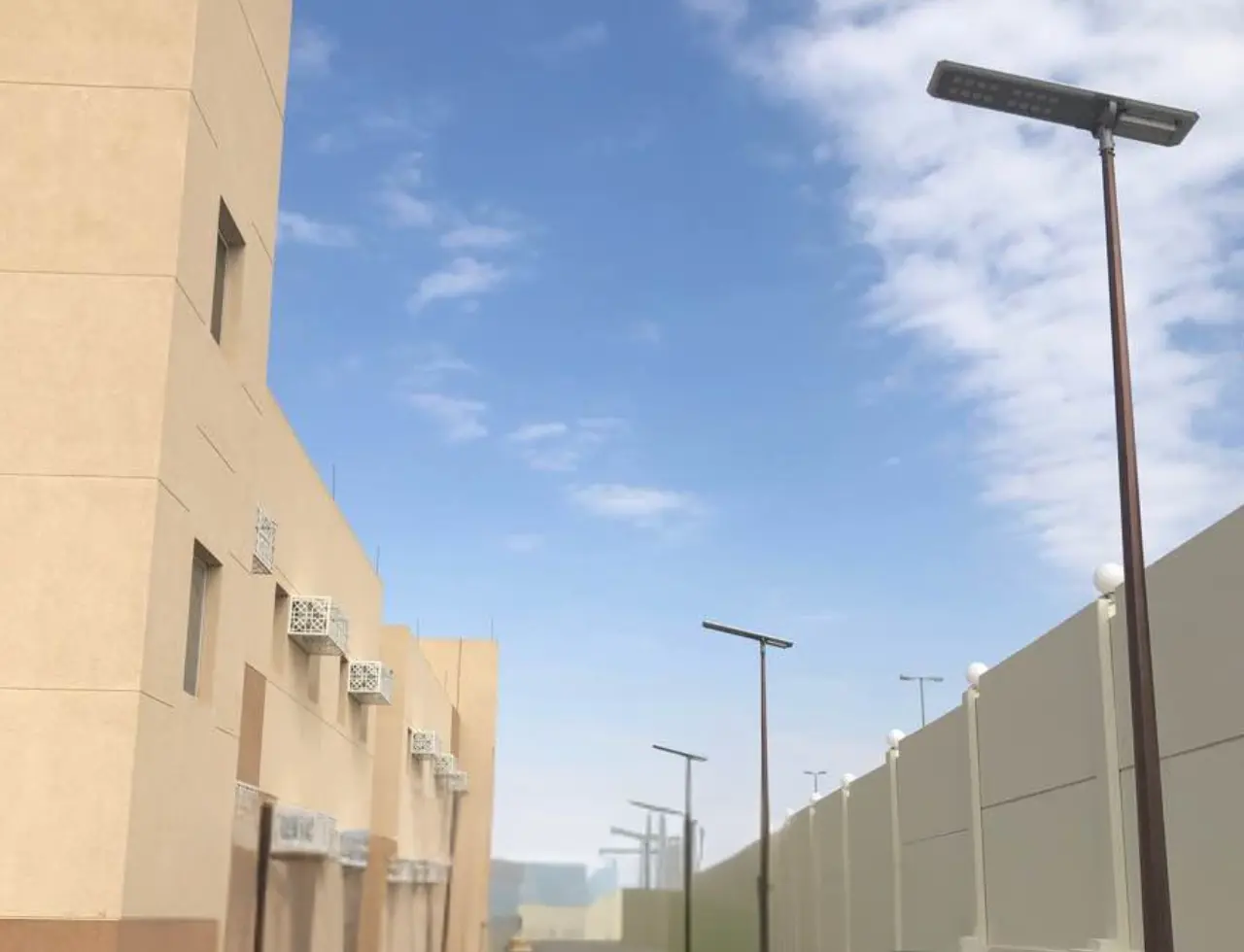
Project Reference: In an industrial park lighting project in Saudi Arabia, SRESKY developed a solution designed to withstand summer temperatures of approximately 50°C and significant daily temperature fluctuations.
In addition to luminaire brightness, the selection process also considered temperature adaptability, control systems, and on-site commissioning.
This illustrates why buyers should not base their decisions solely on specifications measured under normal temperature conditions. They must also verify the battery’s charging and discharging temperature ranges and the luminaire’s performance under actual environmental conditions.
Procurement Recommendations: Confirm the final samples before mass production, and use the approved product models, configurations, functions, and test results as the basis for acceptance. If necessary, specify the sampling ratio, testing methods, and procedures for handling non-conforming products in the contract.
10. Total Procurement Cost: The Lowest Quotation Does Not Necessarily Mean the Lowest Project Cost
The procurement cost of solar street lights should not be determined solely by the unit price. For overseas projects, transportation, installation, foundation construction, and post-installation maintenance also affect the total project budget.
In addition to the product unit price, consider the following costs:
- Light poles, foundations, and installation materials.
- International shipping, insurance, import duties, and customs clearance fees.
- On-site installation and commissioning costs.
- Spare parts, maintenance, and battery replacement costs.
Also, clearly define the applicable trade terms (FOB, CIF, or DAP), as the allocation of responsibilities for shipping, insurance, customs clearance, and delivery varies depending on the selected Incoterm.
Procurement Recommendation: Calculate the total life cycle cost (LCC) and comprehensively compare procurement, installation, energy, maintenance, and replacement costs rather than focusing solely on the unit price.
Quick Reference: 10-Item Checklist for Bulk Procurement of Solar Street Lights
To help government procurement departments, EPC contractors, and overseas distributors evaluate suppliers, the following table summarizes 10 core verification items and their corresponding supporting documents.
| No. | Verification Item | Key Verification Points | Key Documents |
|---|---|---|---|
| 1 | Battery | Cells, Wh, DoD, cycle life, BMS | Battery Datasheet, BMS Manual |
| 2 | Solar Panels and Controllers | Energy balance for the most unfavorable month, MPPT/PWM, dimming schedule | PV Module Datasheet, Energy Calculation Report |
| 3 | Complete Luminaire Luminous Flux and IES | Total luminaire lm and lm/W, light distribution, illuminance uniformity | IES/LDT Files, Photometric Test Report |
| 4 | Luminaire Housing | IP rating, heat dissipation, salt spray resistance, and high-temperature adaptability | IP/IK Reports, Environmental Test Reports |
| 5 | Light Pole Structure | Wall thickness, wind load calculations, foundation design, compatibility with existing poles | Light Pole Drawings, Structural Calculation Data |
| 6 | Batch Consistency | IQC/IPQC/FQC/OQC, batch traceability, delivery schedule | Final Specifications, Quality Inspection Records |
| 7 | Certifications and Technical Documentation | Certification scope, product models, test reports | Applicable Certifications and Test Data |
| 8 | Warranty and Spare Parts | Component-specific warranty coverage, response times, spare parts supply | Warranty Terms, Spare Parts List |
| 9 | Samples and Pilot Tests | Actual lighting performance, battery performance during cloudy or rainy weather, environmental adaptability | Sample Records, Pilot Test Reports |
| 10 | Total Procurement Cost | Logistics and customs clearance, installation and maintenance, trade terms | Formal Quotation, Cost Breakdown |
Frequently Asked Questions (FAQ)
1. What should be verified first when purchasing solar street lights in bulk?
We recommend prioritizing verification of the battery’s usable capacity and the solar panel’s energy balance during the most unfavorable month. These two factors determine whether the system can operate reliably during overcast and rainy weather and in winter.
Afterward, verify road lighting performance using the IES files corresponding to the proposed luminaire models.
2. How should buyers evaluate the battery capacity of solar street lights?
Do not focus solely on Ah. Instead, calculate the total energy capacity (Wh) based on the rated voltage, and then verify the depth of discharge (DoD), cycle life test conditions, and BMS protection functions.
When purchasing, it is recommended to request a complete battery datasheet from the supplier.
3. What is the purpose of IES files?
IES files contain photometric distribution data for luminaires. They can be imported into DIALux or Relux to simulate illuminance and uniformity based on actual road width, pole height, spacing, and installation angles. This helps determine whether the proposed lighting solution meets project requirements.
4. What documents must solar street light suppliers provide?
Typically, suppliers should provide battery specifications, solar panel specifications, BMS protection documentation, IES/LDT files, complete luminaire luminous flux test reports, light pole structural drawings, applicable structural calculation data, certifications and test reports, final product specifications, quality inspection records, and after-sales warranty documents.
5. How can buyers avoid discrepancies between mass-produced products and approved samples?
The contract should stipulate that mass-produced products must match the approved samples and that any changes to key components require the purchaser’s prior written approval.
Additionally, require the supplier to provide quality inspection records, batch numbers, and shipment sampling data. For large-scale projects, factory audits or third-party inspections may also be arranged.
Conclusion
Bulk procurement of solar street lights is a comprehensive engineering procurement process. The most effective approach is not simply to compare quotations, but to first clarify project requirements, standardize technical parameters and acceptance criteria, and then conduct a comprehensive evaluation based on product quality, supply capacity, and total life cycle cost.
Before placing an order, buyers should verify not only product specifications but also request complete technical documents, test reports, structural drawings, and warranty documentation from suppliers. All submitted materials must match the final products to be delivered.
By verifying all 10 points above and incorporating key technical documents and acceptance requirements into the contract, buyers can effectively reduce risks such as configuration discrepancies, batch-to-batch quality variations, delivery delays, and difficulties with post-installation maintenance.
This helps make the entire solar street light project—from procurement and installation to long-term operation—more manageable.
Table of Contents