
At 4 a.m., the welcome boulevard of an industrial new town in Sulawesi, Indonesia, remains shrouded in dense fog caused by the tropical maritime climate.
For this main thoroughfare connecting the port area with the core industrial park, the biggest challenge in the past was not simply the “availability of lighting,” but the complexity of the road environment itself. Continuous curves, high-brightness landscape signage, and visual interference caused by humid air made it easy for drivers to experience temporary visual adaptation issues when entering certain sections of the road.
To address the lighting requirements of the industrial park’s entrance road, the project team deployed 160 sets of Sresky ATLAS smart solar streetlights, successfully completing a targeted road lighting upgrade. The goal of this upgrade was not merely to increase brightness, but to establish a uniform, stable, and easy-to-maintain lighting system tailored to the site’s complex environmental conditions.
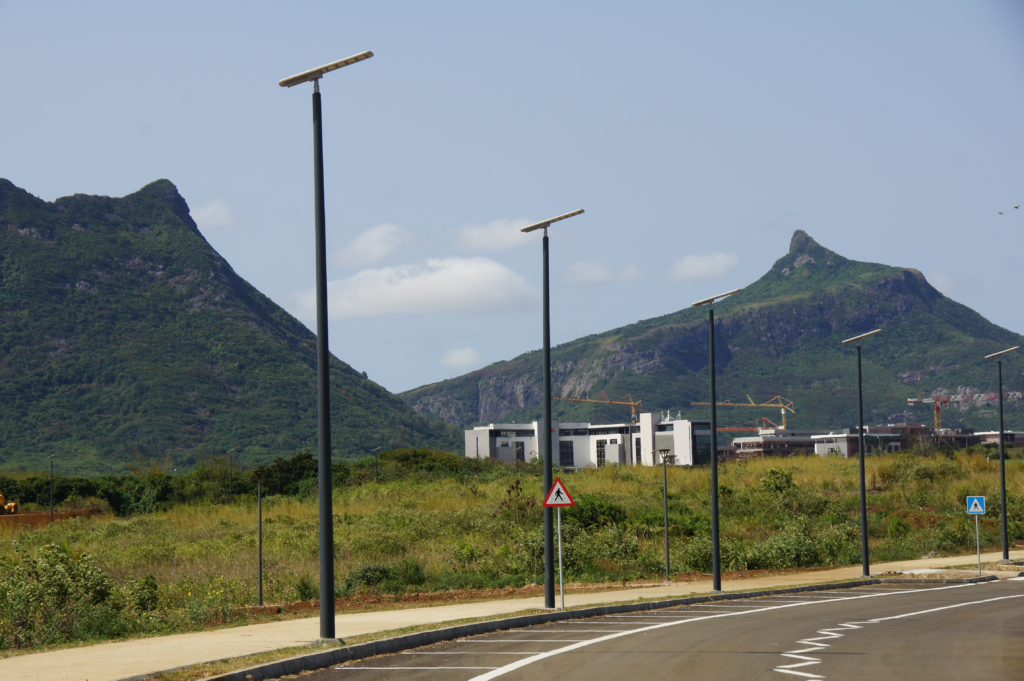
Project Snapshot
| Project Details | |
|---|---|
| Project Location | Main Welcome Axis of the Industrial Park (Kawasan Industri), Industrial New City, Sulawesi Province, Indonesia |
| Project Owner | Park developer and operator, as well as industrial real estate developer |
| Road Scale | The main axis is approximately 1.5–2.5 kilometers long, including lighting for roundabouts and landscape nodes |
| Deployed Product | Sresky ATLAS Smart Solar Streetlight Series |
| Number Deployed | 160 units |
| Key Requirements | Visual safety on curved roads, effective illumination in dense fog, and remote operation and maintenance management |
Challenges Faced by the Industrial Park Solar Streetlight Project
Challenge 1: Curves and Dense Fog Compromise Road Safety
Road lighting in industrial parks must focus not only on average illuminance but also on maintaining visual continuity for drivers.
On continuous curved sections, traditional symmetrical light distribution often concentrates illumination in the center of the road, potentially creating darker areas along the edges and affecting drivers’ ability to accurately judge road conditions.
Meanwhile, the Sulawesi region experiences a tropical maritime climate throughout the year, resulting in high humidity and dense fog, especially during early mornings and the rainy season. Some traditional LED luminaires are prone to light scattering in humid air, increasing visual fatigue for drivers.
In addition, highly illuminated landscape signage at entrance areas can create strong brightness contrasts with the roadway, requiring drivers to readjust their vision when entering the road.
Solution: Road-Optimized Asymmetric Light Distribution
The Sresky ATLAS series adopts an asymmetric optical design optimized for road applications, providing more precise illumination for both vehicle lanes and road edges.
Compared with traditional lighting solutions, this approach can:
- Improve lighting coverage on curved road sections;
- Reduce unnecessary light output;
- Enhance visual continuity along the roadway;
- Minimize brightness fluctuations during driving.
For industrial park road projects, optimized light distribution is often more important than simply increasing luminaire power.
Challenge 2: High-Humidity Tropical Environments Increase Maintenance Pressure
Industrial park road lighting requires long-term and stable operation.
This project deployed 160 solar streetlights across an extended roadway. If equipment were to experience battery degradation, internal moisture intrusion, or lighting failures, the cost of manual inspections would increase significantly.
The Sulawesi region is characterized by:
- High air humidity;
- Frequent rainfall;
- Long-term outdoor exposure.
Therefore, solar streetlights must provide reliable energy storage, strong environmental protection, and intelligent management capabilities.
Sresky Solution: Highly Reliable Energy System
The Sresky ATLAS series uses high-performance lithium-ion batteries and is equipped with an intelligent BMS (Battery Management System), which optimizes charging and discharging processes to improve solar energy utilization efficiency.
This system helps to:
- Improve lighting stability during extended periods of cloudy or rainy weather;
- Extend battery service life;
- Reduce long-term maintenance costs.
Additionally, the lamp body features an aluminum alloy structure and achieves an IP65 protection rating, effectively reducing the risk of water and dust ingress while ensuring reliable operation in tropical outdoor environments.
Furthermore, the Sresky ATLAS Smart Lighting System supports remote management through an app or PC platform, enabling real-time monitoring of:
- Battery status;
- Solar charging status;
- Luminaire operating status;
- Lighting mode settings.
This allows industrial park management teams to monitor system performance remotely and significantly reduces the need for manual inspections.
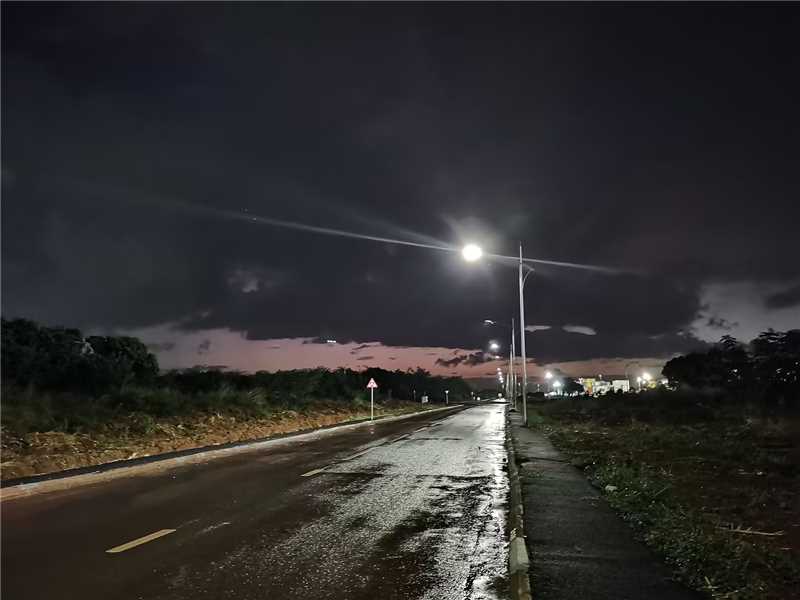
Project Outcomes
- Improved road visibility: The asymmetric optical design enhances lighting coverage on curved road sections, creating a safer driving environment.
- More reliable operation in tropical climates: The high-protection structure, battery management technology, and intelligent energy control improve system adaptability in high-humidity environments.
- Reduced maintenance burden: Remote monitoring capabilities eliminate the need for frequent manual, lamp-by-lamp inspections, improving overall project management efficiency.
Customer Feedback
“We chose Sresky because our previous lighting fixtures did not perform well on curved roads or in foggy conditions. After switching to ATLAS, the stability of our road lighting has improved significantly. At the same time, the remote management platform has greatly reduced the need for manual inspections, and many operational statuses can now be viewed directly online.”
— Project Manager, Park Infrastructure Department
Frequently Asked Questions
- Are solar street lights suitable for roads in industrial parks?
Yes.
Solar streetlights are particularly suitable for:
• Entrance roads to industrial parks;
• Internal transportation routes within industrial parks;
• Roads in newly developed industrial areas;
• Locations where cable installation costs are high.
Compared with traditional grid-connected streetlights, solar solutions reduce the need for underground cable installation and can accelerate project construction. - How do solar street lights adapt to tropical, high-humidity climates?
When selecting solar streetlights, key factors include:
• Water resistance rating;
• Battery lifespan;
• Heat dissipation design;
• Lamp housing materials;
• Smart management capabilities.
The Sresky ATLAS series used in this project improves operational reliability in tropical environments through IP65 protection and an intelligent BMS system. - What factors should industrial parks consider when selecting solar street lights?
The main considerations include:
• Road layout and lighting requirements;
• Local climate and environmental conditions;
• Battery cycle life;
• Post-installation maintenance methods;
• Support for remote management.
For industrial infrastructure projects, the lowest initial procurement cost does not necessarily represent the lowest total life-cycle cost.
Summary: From Road Lighting to Smart Infrastructure Management
The Sulawesi Industrial New City solar streetlight project addresses more than just whether roads are “bright enough.”
Through road-optimized optical design, a highly reliable energy system, and a remote smart operation and maintenance platform, the project has transformed industrial park road lighting from traditional illumination into intelligent infrastructure management.
For industrial park projects facing similar challenges—such as tropical climates, complex road structures, and large-scale operation and maintenance requirements—this case study provides a reliable reference for implementing solar streetlight solutions.