
When winter arrives, solar street lights in high-altitude, cold-climate cities face a real test.
Low temperatures can affect battery performance, short winter daylight hours reduce the charging window, and snow, soot, and spring dust can further reduce photovoltaic power generation efficiency.
For residential areas, commercial roads, and urban public spaces, solar street lights must not only “light up when it gets dark” but also maintain relatively stable illumination under prolonged low-irradiance and low-temperature conditions.
This project utilizes the new version of Sresky Atlas’s SSL-314 series solar street lights, comprising approximately 55 units. The system was specifically designed to address the extreme cold and low winter sunlight in Mongolia’s high-altitude, cold-climate urban environments while also meeting long-term operational requirements under dusty spring conditions.
Project Snapshot
Project Information
- Project Type: Urban Solar Streetlight Upgrade
- Project Location: Central Ulaanbaatar, Mongolia
- Project Scale: Approximately 55 units
- Product Series: Sresky Atlas SSL-314 Series
- Primary Applications: Urban roads, residential areas, and roads surrounding commercial districts
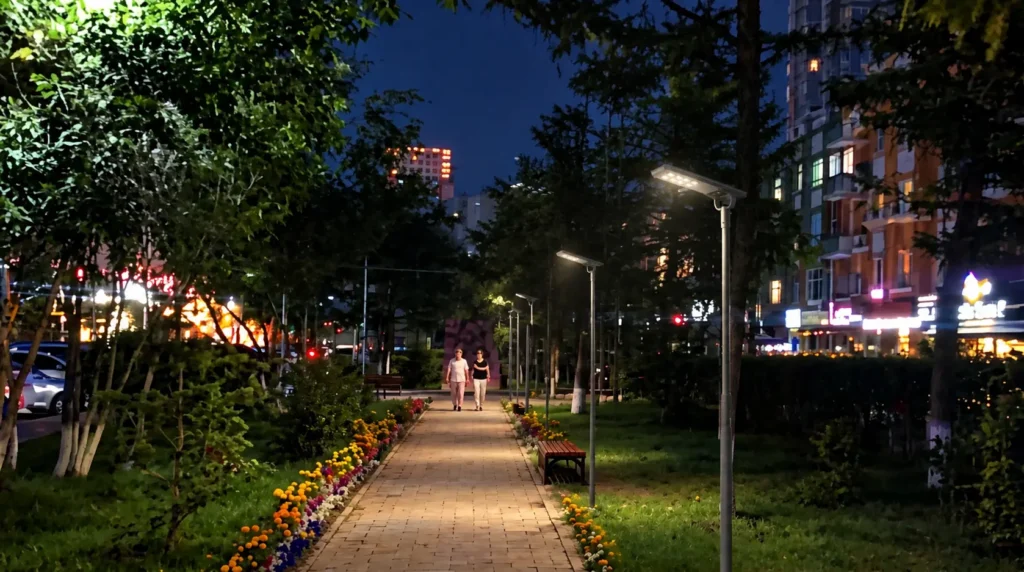
Why Do High-Altitude, Cold Regions in Mongolia Place Higher Demands on Solar Streetlights?
For typical urban projects, the design of solar streetlights usually centers on photovoltaic power, battery capacity, and LED power.
However, in extremely cold regions, system design must also consider:
- Minimum ambient temperature in winter
- Battery charging and discharging temperature ranges
- Effective solar irradiance in winter
- Prolonged periods of overcast and snowy weather
- Snow accumulation on solar panels and seasonal dust
- Nighttime lighting duration
- Dimming strategies
- Post-installation maintenance conditions
In other words, solar street lights in extremely cold regions require not only products that can withstand low temperatures but also system-level energy and temperature management strategies tailored to local conditions.
Engineering Challenge 1: How Can Solar Street Light Batteries Operate Stably in Extremely Cold Environments?
This is the first issue that must be addressed in this project.
The low winter temperatures in Mongolia affect both the charging and discharging of solar street light batteries, as well as the effective charging time available during the day. It is particularly important to note that while batteries may be able to discharge at low temperatures, this does not mean they can charge normally at the same temperature.
If temperature management is inadequate, it may lead to:
- Decreased battery performance
- Slower winter recharge rates
- Increased risk of lighting failures following prolonged periods of overcast or snowy weather
Atlas SSL-314 Solution: Temperature Control Technology
The new version of Sresky Atlas’s SSL-314 series employs TCS temperature control technology to facilitate more effective battery charging management in low-temperature environments.
Specifically, the SSL-314’s minimum charging temperature is approximately -10°C, while its minimum discharge temperature is -20°C, subject to the specifications of the selected model.
Simply put, faced with Mongolia’s cold winter weather, the SSL-314 focuses on “how to ensure batteries operate more safely and stably,” rather than simply relying on increased battery capacity to cope with low temperatures.
Engineering Challenge 2: With Low Winter Sunlight, How Can Solar Street Lights Maintain Nighttime Lighting?
Winters in high-altitude, cold regions are characterized not only by low temperatures but also by reduced solar resources. Shorter daylight hours, low irradiance, and prolonged periods of overcast and snowy weather can all reduce the amount of energy solar panels capture each day.
Potential issues include:
- Decreased daily power generation
- Longer battery recharge times
- Increased energy storage pressure following prolonged periods of overcast or snowy weather
- Reduced nighttime illumination duration
For projects in high-latitude, frigid regions like Mongolia, low winter sunlight and cold temperatures often occur simultaneously. Therefore, the system cannot rely solely on photovoltaic power generation or battery capacity.
Atlas SSL-314 Solution: Smart Lighting Technology
The Atlas SSL-314 series employs ALS smart lighting technology, which intelligently adjusts nighttime lighting power based on the battery’s state of charge. This reduces unnecessary energy consumption when solar input is insufficient, helping to extend the number of days of illumination during prolonged periods of rain, overcast, or snowy weather. Actual project calculations still require consideration of local meteorological conditions and specific system configurations.
During winter, when “power generation is low,” the SSL-314 helps optimize the use of limited energy through intelligent power management.
Therefore, for solar streetlight projects in extremely cold regions, photovoltaic modules, batteries, LED power, and intelligent dimming must be matched as an integrated system.
Engineering Challenge 3: Spring Dust—How Can Its Impact on Solar Panel Power Generation Be Minimized?
Compared with the extreme cold and low sunlight levels in winter, spring dust poses a secondary environmental challenge for this project.
Once the winter period of low sunlight ends, spring dust emerges as a new challenge. In high-dust environments, dust that accumulates on the surface of solar panels over time can reduce actual photovoltaic power generation efficiency while increasing the burden of future cleaning and maintenance.
Key considerations for the project include:
- The impact of dust on actual power generation
- Outdoor protection for solar panels
- Seasonal cleaning and maintenance
- Long-term operating costs
Atlas SSL-314 Solution: Protective Design + System Capacity Reserve
The Atlas SSL-314 series features a protective design tailored for outdoor use, meeting the dust-proof and waterproof requirements of solar streetlights in outdoor environments.
Additionally, during the project design phase, capacity assessments should not be based solely on the theoretical power output of the solar panels. They should also take into account local seasonal irradiance and potential power-generation losses caused by dust and other contaminants, while incorporating solar panel cleaning into the maintenance plan.
For projects in Mongolia, dust is primarily a seasonal factor. Rather than simply increasing the protection rating, a well-designed system and comprehensive maintenance plan are equally important for mitigating the impact of environmental factors on lighting stability.
Project Summary
For solar streetlight projects in extremely cold cities, it is essential to focus on system reliability under the combined conditions of “low temperatures and low sunlight,” while also taking into account seasonal environmental factors such as dust, rather than relying on a single environmental parameter.
Customer Feedback
“Our biggest concern was widespread streetlight failure during extremely cold weather. The Atlas SSL-314 uses TCS to manage battery charging at low temperatures, and when combined with smart lighting, its stability after a full winter of operation met our expectations.”
— On-site Manager, General Contractor
Selecting Solar Street Lights for Extremely Cold Regions: What Should Buyers Prioritize?
When selecting solar street lights for extremely cold regions, in addition to price and LED power, it is recommended to consider the following aspects:
- Low-Temperature Performance: Battery charging/discharging temperature range and temperature control capabilities
- Winter Battery Life: Whether the solar panel and battery capacities are sufficient to support the required number of consecutive overcast or snowy days
- Smart Lighting: Whether the system supports adjusting lighting power based on battery status and environmental conditions
- Environmental Protection: Dust and water resistance, as well as post-installation cleaning and maintenance requirements
- Project Configuration: Customized calculations based on local weather conditions, lighting duration, and road conditions
For projects in extremely cold regions, in addition to the technical specifications themselves, it is crucial to ensure that the product configuration aligns with the local environment. Taking the Atlas SSL-314 series used in this project as an example, low-temperature temperature-control capabilities and smart energy management under low-sunlight conditions are key factors to prioritize during the selection process.
FAQ: Top Concerns for Solar Street Light Buyers in Mongolia
1. Will Solar Street Lights Function Properly During Winter in Mongolia?
This depends on local winter conditions. In addition to the minimum operating temperature specified for the luminaire, we recommend:
- Verifying the battery charging temperature range
- Verifying the battery discharge temperature range
- Validating the system against local minimum temperatures
- Recalculating the winter PV-to-storage balance
The Atlas SSL-314 series has a minimum discharge temperature of -20°C and a minimum charging temperature of approximately -10°C, and is equipped with TCS temperature control technology. Specific details depend on the specifications of the selected model.
2. How Do Solar Street Lights in Extremely Cold Regions Cope with Low Winter Sunlight?
It is recommended to address this issue by optimizing the overall system energy balance rather than simply adding more battery capacity:
- Increase the effective power generation capacity of photovoltaic modules
- Properly configure battery capacity
- Adopt intelligent dimming strategies
- Calculate system capacity based on the number of consecutive days of low irradiance
- Use intelligent lighting technologies such as ALS to optimize nighttime energy consumption
For projects in extremely cold regions like Mongolia, both low winter sunlight and low temperatures must be factored into the system design. The ALS technology in the Atlas SSL-314 series adjusts power distribution based on battery status, helping to extend lighting duration during consecutive days of rain, overcast, or snowy weather. Actual projects in Mongolia should be designed based on the specific model selected and local meteorological data.
3. How Do Solar Street Lights Ensure Lighting During Consecutive Days of Overcast or Snowy Weather?
It is recommended to design the system’s energy balance based on local meteorological conditions rather than directly applying a fixed “number of operating days.”
Key Factors to Verify:
- Solar panel power
- Battery capacity
- LED power
- Nightly illumination duration
- Dimming strategy
- Number of consecutive days of overcast or snowy weather
The ALS technology in the Atlas SSL-314 series adjusts power distribution based on battery status, helping to extend illumination time during prolonged periods of overcast, rainy, or snowy weather. Actual projects in Mongolia should be designed based on the specific model selected and local meteorological data.
Conclusion
In cold, high-altitude regions like Mongolia, solar streetlights face stricter requirements than those in typical urban projects: battery management is critical in extreme cold, energy balance is essential during periods of low winter sunlight, and actual power generation and maintenance requirements must be considered in dusty environments.
The Sresky Atlas SSL-314 series provides systematic solutions to these critical challenges through TCS temperature control technology, ALS intelligent lighting, and outdoor protection design.
For municipal departments, EPC contractors, and lighting planners, selecting solar street lights for cold regions requires consideration not only of product specifications but also of whether the lights can achieve long-term, stable operation under local environmental conditions.
Table of Contents