
On mountain roads in winter, the greatest concern is not darkness itself, but whether solar street lights can operate reliably when lighting is needed most.
Low temperatures can affect battery charging and discharging performance; heavy snow accumulation may cover solar panels; and prolonged periods of overcast and snowy weather can further reduce solar energy input. For rural roads and winding mountain roads in high-altitude, cold regions, standard solar street lights must contend with operating conditions that are far more challenging than those in ordinary areas.
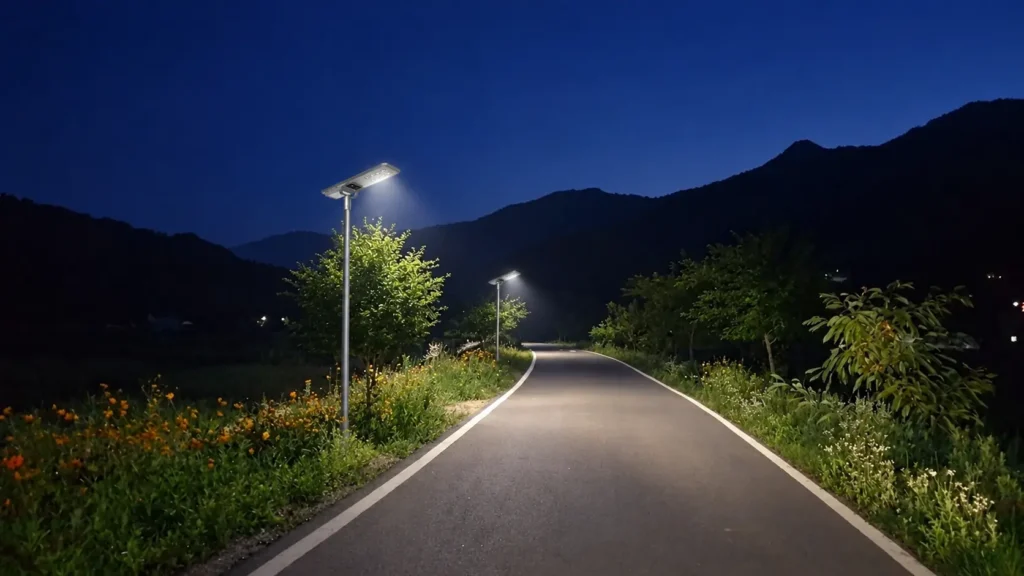
To address these environments, characterized by extreme cold, heavy snow, low solar irradiance, and strong winds, this project deployed 120 units of the Sresky Atlas SSL-315 Series all-in-one solar street lights, spaced approximately 25–30 meters apart, with a customized system design tailored to winter operating conditions.
Project Snapshot
Project Details
- Project Location: Winding mountain roads and rural sections bordering farmland in the high-altitude, cold mountainous regions of Gangwon-do, South Korea
- Client: Construction Bureau/Road Management Division under a South Korean local government
- Project Scale: 120 units in a single phase, with luminaire spacing of approximately 25–30 meters
- Product Solution: Sresky Atlas SSL-315 Series All-in-One Solar Street Lights (customized configuration)
Why Are Solar Street Lights in High-Altitude, Cold Regions More Challenging to Design?
For solar street lights in ordinary regions, the focus is typically on sunlight exposure, lighting duration, and overall system capacity.
However, in high-altitude, cold regions, the system must simultaneously address:
- Low temperatures: Affect the charging performance and usable capacity of LFP batteries
- Snow accumulation: May cover solar panels for extended periods
- Low irradiance: Reduces effective solar energy input during winter
- Long lighting duration: Longer winter nights increase energy demand
- Strong winds: Mountainous canyon winds increase structural loads on lighting fixtures
- Warm white light requirements: Color temperature and ecological lighting requirements place higher demands on optical design
Therefore, solar street lights in high-altitude, cold regions should not be viewed simply as a matter of “increasing battery capacity.”
More importantly, the photovoltaic system, battery, controller, structural components, and optical system must all be adapted to the local environment.
Engineering Challenges and Solutions
Challenge 1: Low Temperatures, Snow Accumulation, and Low Irradiance Can Cause Solar Street Lights to Experience Power Shortages in Winter
In high-altitude, cold mountainous regions, nighttime temperatures are low in winter, and heavy snow accumulation is common. Low temperatures affect battery charging and discharging performance, while snow can cover solar panels for extended periods. Furthermore, winter daylight hours are limited, while nighttime lighting durations are relatively long.
Consequently, conventional solar street lights may experience:
- Reduced battery charging efficiency at low temperatures
- Decreased power generation due to snow accumulation on solar panels
- Insufficient power following prolonged periods of overcast or snowy weather
- Increased demand for manual maintenance during winter
Sresky Atlas SSL-315 Solution
The core approach is to ensure that the battery can charge effectively, the solar panels can generate sufficient power, and the system conserves as much energy as possible under low-light conditions.
Low-Temperature Battery Heating: Battery heating and independent temperature control are configured to support low-temperature operating conditions. The system automatically activates when temperatures drop, helping the battery maintain a suitable charging state.
Optimized Solar Panel Tilt Angle: The installation tilt angle is appropriately adjusted to reduce the risk of prolonged snow accumulation.
Automatic Snow Melting and Low-Light Charging: A low-voltage snow-melting function is integrated with ALS intelligent control and N-type TOPCon solar cells to improve charging and energy-saving performance during winter and under overcast or snowy conditions.
Core Value: System-level optimization for low temperatures, snow accumulation, and low irradiance helps improve the operational stability of solar street lights during winter.
Challenge 2: Balancing Warm White Lighting Performance in High-Wind Mountain Environments
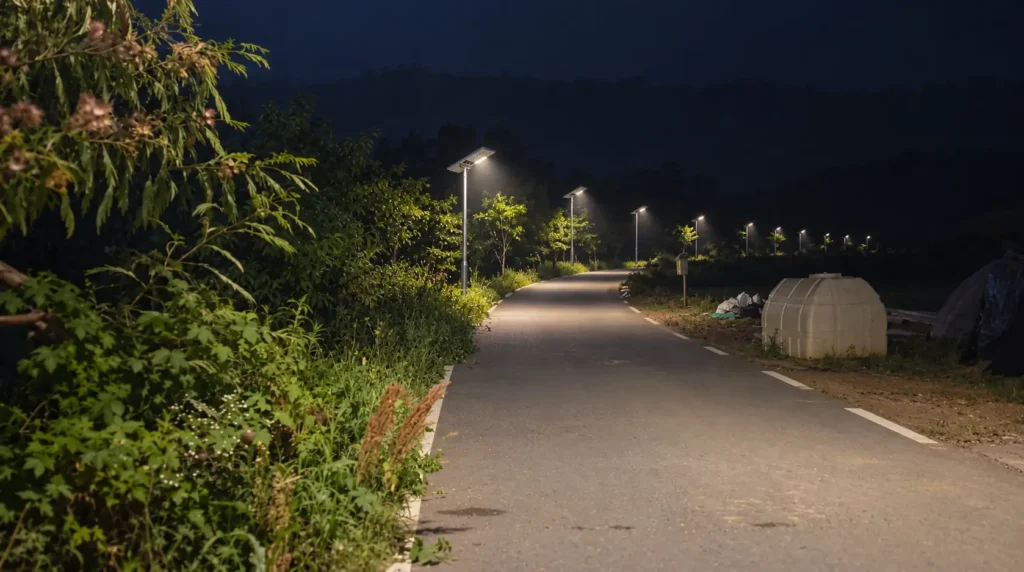
Strong winds in mountain canyons increase the structural load on all-in-one solar street lights, while the solar panels themselves create a large wind-exposed surface. Therefore, the lamp head connections, clamps, and fastening structures must be adequately reinforced.
At the same time, the project utilizes warm white lighting. The luminous efficacy of warm white LEDs is typically lower than that of cool white LEDs, and using standard lenses without further optimization may affect actual light output and road lighting distribution.
Key Challenges to Address:
- Structural stability of the luminaire under strong winds
- Risk of loosening caused by long-term wind-induced vibration
- Lower luminous efficacy of warm white LEDs
- Uniformity of road lighting and glare control
Sresky Atlas SSL-315 Solution
The core concept is to achieve greater structural stability and optimized light distribution, enabling more effective use of warm white light for road lighting.
Reinforced Structural Design: Stainless steel brackets are used, while the lamp head connections, clamps, and fastening points are reinforced to enhance structural stability in high-wind environments.
Warm White Light Optical Optimization: The optical design is re-optimized for warm white LEDs to improve the utilization of effective light output.
Road Light Distribution Optimization: A light distribution design suitable for road lighting is adopted to balance illumination uniformity and glare control.
Core Value: The solution balances structural stability, warm white light performance, and road lighting quality in high-wind mountainous environments.
How to Select Solar Street Lights for Cold, High-Altitude Mountainous Regions
If a project is located in a cold, high-snowfall, or mountainous environment, the following factors should be prioritized during product selection:
- Minimum Temperature: Does the battery feature low-temperature charging management?
- Winter Sunlight: Does the system have sufficient energy reserves to maintain operation during prolonged periods of overcast or snowy weather?
- Snow Accumulation: Is the solar panel tilt angle appropriately designed, and is automatic snow melting required?
- Design Wind Speed: Has the luminaire structure undergone appropriate wind-resistance testing?
- Lighting Requirements: Do the color temperature, light distribution, illuminance, and glare control meet project requirements?
Solar street lights in extremely cold regions require more than just increased battery capacity; they also need systematic configuration based on local environmental conditions.
Customer Feedback
“The real issue isn’t that the lights aren’t bright enough, but that they must maintain stable operation during winter—when lighting is needed most.”
— Project Manager (anonymous upon request)
FAQ: Common Questions About Solar Street Lights in Extremely Cold Regions
Q1: Will Solar Street Lights Run Out of Power During Winter in High-Altitude, Cold Mountainous Areas?
They can generally meet winter operating demands, but the system configuration must be tailored to local winter conditions:
- Implement low-temperature battery management
- Optimize charging under low-light conditions in winter
- Design battery capacity based on the number of consecutive days of overcast or snowy weather
- Install a battery heating system if necessary
Q2: Will Solar Street Lights Still Function if Snow Covers the Solar Panels?
In areas with heavy snowfall, we recommend a combined solution of “optimized tilt angle + automatic snow melting”:
- Adjust the solar panel tilt angle appropriately
- Install a low-voltage snow-melting function if necessary
- Automatically activate the function based on light levels and charging status
- Reduce the need for manual snow removal
Q3: What Level of Wind Resistance Is Required for Solar Street Lights in Mountainous Areas?
There is no one-size-fits-all value; assessments should be based on local design wind speeds and topographical conditions.
Key considerations include:
- Product design wind speed
- Wind-exposed area of the solar panels
- Luminaire mounting structure
- Clamps and fasteners
- Wind tunnel testing or structural validation data
Conclusion
For solar street lights in cold, high-altitude mountainous regions, the focus should not merely be on increasing battery capacity, but on ensuring that the battery, photovoltaic, structural, and lighting systems are all adapted to the local winter environment.
For municipal departments, EPC contractors, and project planners, when selecting solar street lights, it is recommended to prioritize the assessment of low temperatures, snow accumulation, winter sunlight, and design wind speeds before determining the appropriate system configuration.
The key lesson from the Sresky Atlas SSL-315 project in the high-altitude, cold regions of South Korea is that solar street light solutions for such areas should not simply replicate those used in ordinary regions. A system design that considers multiple factors—including energy, temperature, snow accumulation, structural stability, and optical performance—is more effective in ensuring that off-grid road lighting can adapt to complex environmental conditions.
For municipal departments, contractors, and planners currently planning projects involving high-altitude cold regions, rural roads, mountain roads, or other off-grid lighting applications, this approach can serve as a valuable reference during the initial selection and design phases of solar streetlight projects.
Table of Contents