
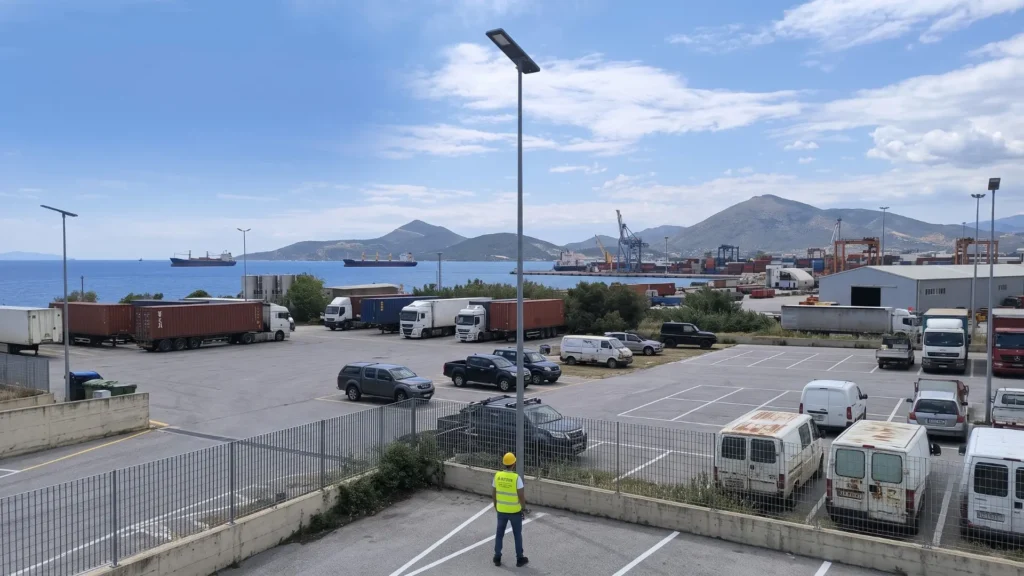
In a coastal industrial zone in the Attica region of Greece, a port logistics parking area has been facing long-term operational and maintenance challenges caused by its traditional lighting system.
Located directly beside the Aegean Sea, the area operates around the clock with container handling and heavy-duty truck transportation. It is exposed year-round to the combined effects of strong Mediterranean winds, high salt fog levels, and intense UV radiation.
Standard outdoor lighting fixtures often experience problems such as loose mounting brackets, yellowed lenses, and aging electrical components after prolonged exposure. Unlike ordinary municipal roads, port environments present additional maintenance difficulties. When a 12-meter-high pole light fails, repairs may require temporary road closures, crane coordination, and certified high-altitude workers, with a single repair potentially costing thousands of euros.
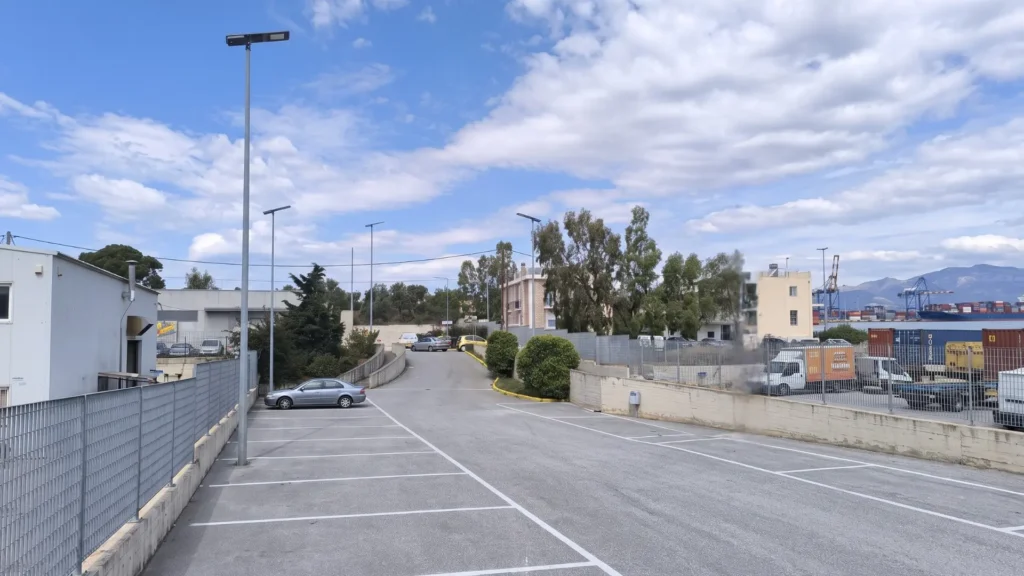
Following an environmental assessment, the port logistics parking area deployed 120 sets of SRESKY BASALT Series solar street lights to replace part of the traditional grid-powered lighting system and provide stable illumination for port roads and parking areas.
Project Overview
| Project Details | |
|---|---|
| Project Location | Coastal Industrial Park and Port Logistics Parking Area, Attica Region, Greece |
| Project Type | Port Logistics Infrastructure Lighting |
| Number Deployed | 120 units |
| Product Model | SRESKY BASALT Series SSL-912A |
| Application Scenarios | Port roads and vehicle parking areas |
| Core Requirements | Wind resistance, salt fog resistance, and reduced maintenance costs |
Major Challenges Faced by Port Solar Street Lights
Challenge 1: Strong Coastal Winds Cause Structural Fatigue and Increase Maintenance Costs
Port areas are constantly exposed to sea and land breezes.
For 12-meter-tall solar street lights, even without extreme weather events, continuous minor wind vibrations can lead to:
- Fatigue in bracket connections;
- Loosening of mounting structures;
- Misalignment of luminaires.
Traditional lighting equipment typically requires regular manual inspections. However, construction logistics in port areas are complex, resulting in high maintenance costs.
Therefore, when selecting equipment for such projects, the focus should not only be on brightness but also on: The structural reliability of the equipment after years of operation.
Solution: Reinforced Structural Design + Intelligent Remote Management
Designed specifically for port environments, the SRESKY BASALT series features an integrated structural design that reduces the number of connection components used in traditional split-type structures, thereby improving overall luminaire stability.
At the same time, the system is equipped with smart lighting management functions that enable:
- Adjustment of operating modes;
- Battery status monitoring;
- Operational status monitoring.
Managers can perform certain equipment management tasks remotely without the need for frequent high-altitude inspections.
For large outdoor areas such as ports, airports, and industrial parks, this low-maintenance approach can effectively reduce operational pressure.
Challenge 2: Salt Fog, UV Radiation, and High Temperatures Accelerate Equipment Aging
Port environments are not only highly humid but also contain persistent salt particles.
Salt fog can cause:
- Corrosion of metal components;
- Reduced fastener performance;
- Shortened equipment lifespan.
Additionally, intense UV radiation and high summer temperatures in Greece can affect:
- The light transmission performance of lampshades;
- Battery cycle life;
- Overall system stability.
Many lighting projects operate normally at the beginning but begin to experience issues after 1–2 years, including:
- Reduced lighting duration;
- Component aging;
- Increased maintenance frequency.
Therefore, port lighting projects must focus on: Total life-cycle costs rather than specifications that only meet installation-day requirements.
Solution: Weather-Resistant Materials + Smart Temperature Control for Enhanced Long-Term Reliability
The SRESKY BASALT series is designed for coastal environments and features:
- Aluminum alloy luminaire housing;
- Tempered glass construction;
- IP65 protection rating.
These features help reduce:
- The risk of rainwater ingress;
- The impact of salt fog corrosion;
- Outdoor aging effects.
In terms of lighting performance, the system provides:
- High-efficiency LED light sources;
- High luminous efficacy;
- Type III road light distribution.
Type III light distribution is better suited for roads, large parking areas, and open spaces, improving lighting coverage efficiency while reducing energy waste.
Additionally, the SRESKY BASALT series is equipped with TCS battery temperature control technology, which helps maintain stable battery operation in both high- and low-temperature environments, extending the overall system lifespan.
Project Outcomes
- Reduced Need for High-Altitude Maintenance
Through structural optimization, remote management, and intelligent monitoring capabilities, the project has reduced the need for frequent manual inspections at elevated heights. - Improved Lighting Efficiency in Port Areas
High-efficiency LED light sources combined with road-oriented light distribution provide more uniform illumination across parking areas and roadways. - Enhanced Long-Term Operational Reliability
Solar power reduces dependence on cable installation and maintenance, providing a more flexible lighting solution for port logistics areas.
Customer Feedback
“When we used conventional solar street lights in the past, we experienced issues such as lens aging and loose mounting brackets within the first year, and each repair required coordination with the port authority. After switching to the BASALT series, the equipment has operated much more stably during inspections, and maintenance requirements have been significantly reduced.”
— Project Facilities Engineering Manager
Frequently Asked Questions
- What heights are typically used for solar street lights in ports and logistics parks?
This varies depending on road width and application requirements:- Main roads and container areas typically use heights of 10–12 meters;
- Parking areas and internal roads can use heights of 6–8 meters.
Specific designs should consider: Road width, Vehicle types, Lighting requirements, Installation spacing.
The final configuration should be based on these factors. - How do solar street lights in coastal areas prevent salt fog corrosion?
For coastal projects, it is recommended to focus on:- Aluminum alloy lamp bodies;
- IP protection ratings;
- Weather-resistant materials;
- Sealed construction;
- Anti-corrosion treatment of fasteners.
At the same time, proper maintenance is also essential for extending equipment service life.
- Why are solar street lights increasingly adopted in ports?
The main reasons include:- Reduced need for underground cable installation;
- Lower long-term energy costs;
- Faster and more convenient deployment in expansion areas;
- Reduced pressure on power line maintenance.
For ports, logistics parks, and industrial areas, solar lighting has become an important alternative to traditional grid-connected lighting solutions.
Summary: The Value of Solar Street Lights in Ports Lies Not Only in Illumination but Also in Reducing Operational Risks
The solar street light project at the Port of Attica in Greece demonstrates that, in complex coastal environments, lighting system selection cannot be based solely on initial brightness parameters.
Solar street lights truly suited for port and industrial applications must provide:
- Wind-resistant structural design;
- Salt fog resistance;
- Adaptability to high-temperature environments;
- Stable energy management;
- Low-maintenance operation.
For ports, logistics parks, and large-scale industrial infrastructure, the value of a high-quality solar lighting system lies not only in providing nighttime illumination but also in:
- Reducing maintenance costs;
- Minimizing operational risks;
- Ensuring continuous and stable infrastructure operation over many years.