
Case Study: Smart Lighting Solutions for High-Dust and Complex Climate Environments
1. Project Background & Requirements
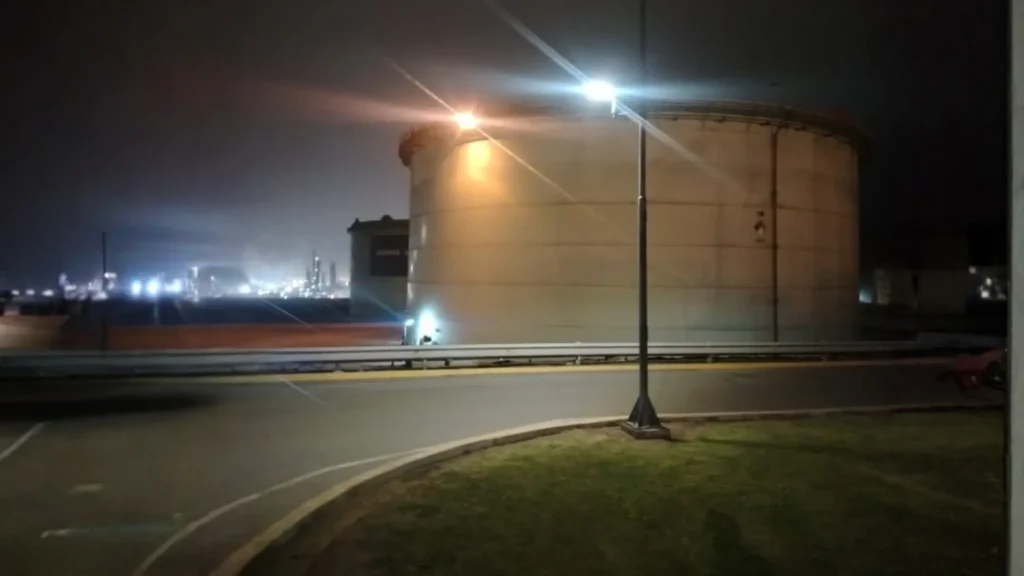
As a major resource exporter in South America, Peru’s industrial zones are often located in remote or climatically volatile regions. This project takes place in a critical energy industrial park in central Peru, responsible for storing and transporting energy resources such as oil and natural gas. The park contains numerous large metal storage tanks and busy transportation routes—facilities essential to the national energy supply chain and the protection of high-value assets.
However, this industrial zone faces severe environmental challenges. High dust levels are a constant issue: nearby mining operations and heavy truck traffic fill the air with particulate matter, causing traditional solar streetlight panels to become easily covered and significantly reducing charging efficiency. The Peruvian highlands also experience extreme diurnal temperature fluctuations, with daytime highs exceeding 40°C (104°F) and nighttime lows dropping below 0°C (32°F), sometimes even reaching freezing. These conditions negatively affect battery performance and increase maintenance complexity.
Additionally, deploying traditional grid-connected lighting systems is prohibitively expensive. In remote industrial areas, cable installation requires crossing complex terrain, and maintenance costs can be overwhelming. Customer feedback indicates that conventional solar lights typically operate for fewer than three days after consecutive rainy periods or dust buildup—severely compromising nighttime safety for operations.
In terms of lighting needs, safety is the top priority. Large metal storage tanks stand dozens of meters tall, while surrounding roads serve as primary routes for heavy vehicles. High-intensity, uniform illumination is essential for nighttime inspections, vehicle navigation, and emergency response. This prevents accidents and enhances surveillance accuracy. The client also emphasized the need for “maintenance-free” or “low-maintenance” solutions, as manual cleaning requires dispatching specialized teams into high-risk areas—a costly and hazardous task.
2. Technical Solution Design
To address these challenges, the Sresky team selected the Thermos Series as the core product. Originally designed for urban main roads and harsh outdoor environments, this series offers brightness levels ranging from 4000 LM to 12000 LM and is widely regarded as the “preferred luminaire for urban main roads.” Its selection aligns perfectly with industrial park requirements: high luminous efficiency, intelligent management, and superior weather resistance.
Technical Adaptability
Automatic Cleaning System:
This is the signature feature of the Thermos Series for high-dust regions. Its built-in side-brush mechanism automatically removes dust, snow, and dirt from the solar panel surface. Monocrystalline silicon solar panels (charging efficiency >23%) maintain high photovoltaic conversion efficiency after cleaning, avoiding the 20–30% efficiency loss seen in traditional solar lights. In Peru’s dusty industrial zones, this “self-cleaning” capability saves customers thousands of dollars in annual maintenance costs.
High-Temperature Resistance & TCS (Temperature Control System):
Extreme heat in industrial zones can lead to battery overcharging and shortened lifespan. The Thermos Series integrates TCS, which automatically stops charging during abnormal heat to prevent damage to Li-ion batteries. TCS ensures stable operation across a wide temperature range (-20°C to 60°C) and extends battery cycle life by more than 50% compared to standard Li-ion batteries. Under high temperatures, TCS-protected batteries achieve over 2000 charge cycles.
High Luminous Efficiency Output:
The project uses high-power models such as SSL-76A, equipped with OSRAM 3030 LED chips (96–336 pcs), delivering up to 230 lm/W. With a color temperature of 4000K and a color rendering index of Ra > 70, these fixtures achieve lighting coverage of 36–54 meters at installation heights of 8–12 meters—uniformly illuminating tank exteriors and surrounding roadways.
Hybrid Energy System (Customized):
Developed for critical road sections, this hybrid feature provides power redundancy. When battery levels drop below a preset threshold (e.g., 30%), the system automatically switches to AC mains charging. Once the battery exceeds the threshold, it returns to solar-only mode. This ensures 365-day uninterrupted lighting, ideal for industrial environments requiring continuous operation.
Additionally, the Thermos Series supports Super Remote Control, enabling customizable settings such as lighting modes
-
M1: 30% + PIR until dawn
-
M2: 100% for 5h + PIR 25% for 5h + 70% until dawn
- M3: 70% until dawn
and timers. Smart Lighting (Customized) further enhances functionality by enabling remote monitoring of battery and solar panel status via APP/PC, as well as adjustments to CCT and other parameters.
3. Project Outcomes & Impact
Results after implementation were highly positive.
Enhanced Visual Safety:
Tank surfaces and surrounding areas are now brightly illuminated, eliminating blind spots and reducing nighttime intrusion and operational risks. High-CRI lighting improves color recognition for surveillance cameras, enhancing monitoring accuracy. The client reported a 30% reduction in accident rates.
Reduced O&M Costs:
The self-cleaning system extended maintenance intervals to 1–2 times per year, eliminating the need for frequent access to hazardous industrial areas. ALS 2.1 (Adaptive Lighting System) automatically adjusts power output during cloudy or rainy periods, ensuring more than 10 days of illumination and supporting continuous industrial operations. The FAS (Fault Alarm System) provides real-time monitoring and minimizes downtime.
Environmental Benefits:
Using zero-carbon monocrystalline panels and Li-ion batteries, the project reduces several tons of carbon emissions annually, supporting Peru’s green industrial transformation. Overall, the initiative enhances operational efficiency while establishing a benchmark for sustainable lighting in the national energy sector.
4. Conclusion
The lighting project in Peru’s industrial zone demonstrates that the Sresky Thermos Series is far more than a solar streetlight—it is a comprehensive intelligent maintenance solution. With self-cleaning capability, extreme weather resistance, and high-efficiency performance, it effectively addresses challenges in high-dust and complex climates while providing reliable, safe illumination for industrial parks worldwide.
If you face similar lighting challenges, the Thermos Series—with its “automatic cleaning” and “weather-resistant” advantages—will be a powerful and reliable solution.
Table of Contents