
I. Project Background and Requirements Analysis
1.1 Project Background
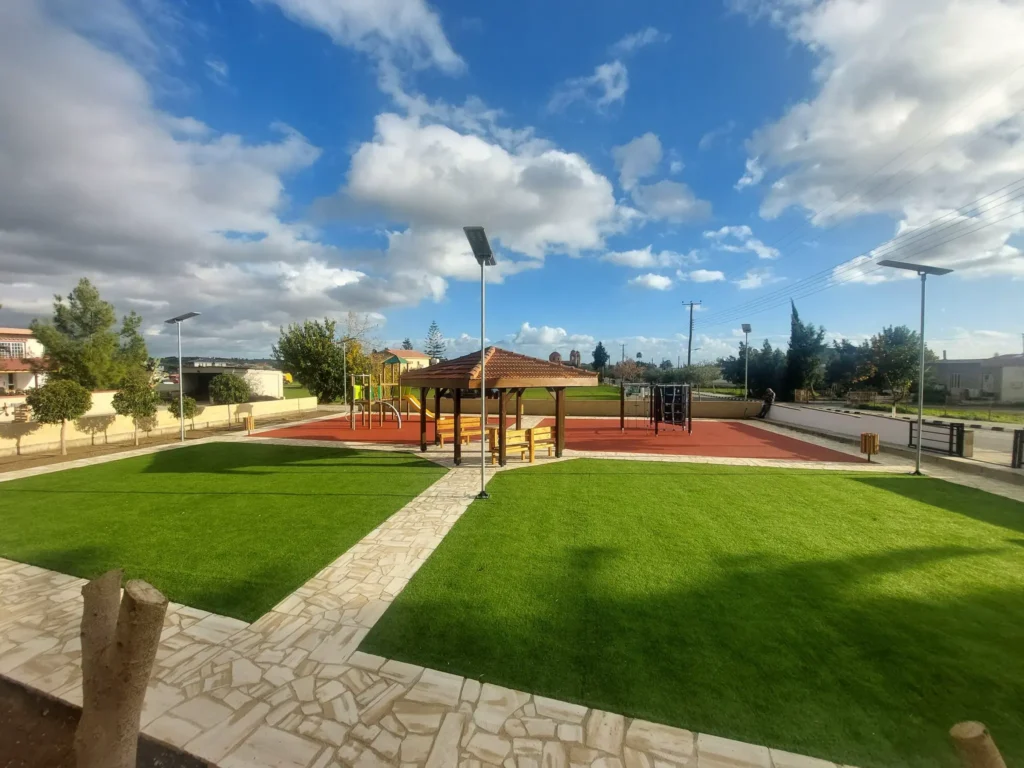
As a key island nation in the Mediterranean region, Cyprus enjoys over 3,000 hours of annual sunshine, offering exceptional conditions for solar energy applications. The country is committed to energy transition, aligning with the EU’s Green Deal and its 2025 Clean Energy Roadmap—which includes promoting renewable energy projects and climate financing mechanisms. This project is situated within a core community green space and recreational belt near Nicosia, Cyprus’ capital. Covering approximately 5,000 square meters, it encompasses children’s playgrounds, public parks, residential landscaping areas, and pedestrian walkways. This zone serves not only as a daily leisure destination for residents but also hosts community cultural events and social interactions.
Launched in early 2025, the project aims to enhance nighttime safety and aesthetics through smart lighting while reducing carbon emissions. According to the Cyprus Renewable Energy Roadmap by the International Renewable Energy Agency (IRENA), the country plans to increase renewable energy’s share to 23% by 2030. Solar lighting, as a low-barrier application, represents a critical component of this transition. The SRESKY ATLAS series, with its high-brightness output ranging from 2000LM to 10000LM and a proven track record of winning over 3500 tenders globally, perfectly aligns with these requirements.
1.2 Needs Analysis
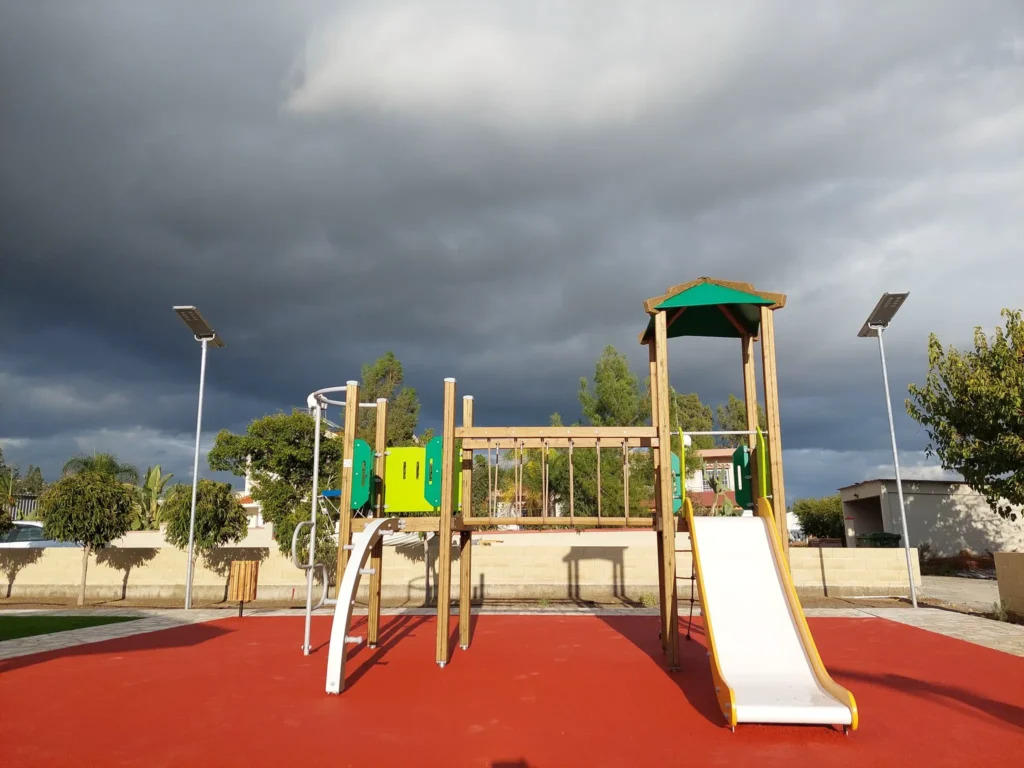
The client—a local Cypriot municipal development company—faces multiple challenges stemming from the region’s unique climate and community characteristics. First, safety requirements are paramount. Children’s playground areas demand high-intensity, uniform illumination at night to ensure safe activities and prevent accidents. Simultaneously, residential zones require lighting to enhance community security and reduce nighttime blind spots.
Second, environmental adaptability was critical. Cyprus’s volatile climate features summer temperatures exceeding 35°C alongside winter conditions marked by heavy cloud cover, sudden rainfall, and corrosive sea winds. Traditional grid-based lighting frequently malfunctioned under these conditions, while cable installation disrupted green spaces. The client demanded streetlights with exceptional weather resistance capable of maintaining stable illumination during prolonged rainy periods, eliminating the “no light on cloudy days” issue.
Aesthetic integration is equally vital. Blending modern architecture with natural landscapes, the luminaires must feature a minimalist, contemporary design. A rectangular, streamlined profile with a dark housing seamlessly aligns with the community’s visual identity, preventing visual disruption.
Finally, zero carbon emissions and low maintenance are core requirements. To protect local biodiversity, 100% solar power must be achieved. As a public recreational area, maintenance frequency must be minimized to reduce labor costs. Overall demands center on “weather-resistant solar streetlights,” “smart community lighting,” and “Cyprus green energy projects,” aligning closely with the EU’s 2025 battery and solar subsidy policies.
II. Technical Solution Design
Addressing Cyprus’ complex geographical and climatic conditions, the SRESKY team selected the ATLAS series smart solar street lights based on site surveys. This series employs monocrystalline silicon solar panels and lithium batteries, combined with OSRAM LEDs, ensuring stable brightness and long-term operation. Installation heights range from 3m to 10m, covering distances from 15m to 32m, perfectly suited for the recreational belt setting.
2.1 Core Technology Adaptation
The SRESKY ATLAS series’ core competitiveness lies in multiple patented technologies precisely addressing Cyprus’ variable weather.
-
ALS 2.2 Patented Technology (Core Competitive Edge): Tackling thick cloud cover challenges, the ALS 2.2 algorithm automatically adjusts power output, ensuring >10 days of illumination endurance even during prolonged rainy periods or extreme weather. BMS technology boosts battery charging efficiency by 30%, eliminating concerns about “lights not turning on during cloudy days.” As shown in the core technology chart, the ALS system produces a flatter brightness decay curve, achieving a 150% improvement in nighttime brightness retention compared to non-ALS products.
-
TCS Temperature Control System: Mediterranean summer heat poses a significant challenge to batteries. The TCS system continuously monitors battery temperature, maintaining it within the safe range of -20°C to 60°C, significantly extending cycle life to over 1,500 cycles. Charts demonstrate that at 60°C, TCS battery capacity degradation is substantially lower than standard LiFePO4 batteries.
-
PIR Infrared Sensor System: Detection range of 120° and 8m, with intelligent mode switching. Automatically switches to low brightness (25%-30%) during late-night periods with minimal foot traffic, instantly restoring to 100% brightness upon detecting movement to optimize energy efficiency. This feature is particularly suited for parks and trails, minimizing light pollution’s ecological impact.
-
High-Efficiency Monocrystalline Silicon Panel & LiFePO4 Battery: Achieves 23% solar conversion efficiency. The battery supports charging from 0°C to 45°C and discharging from -20°C to 60°C, ensuring year-round stability. The hybrid power mode (customizable) allows switching to AC charging when battery capacity falls below a preset threshold, serving as backup during winter or rainy periods.
Additionally, the Super Remote supports DIY parameter configuration, enabling remote monitoring of battery status and solar efficiency via APP/PC, along with lighting mode adjustments (M1: 30% PIR until dawn; M2: 100% for 5H + 25% PIR for 5H + 70% until dawn; M3: 70% until dawn). LED indicators (red/orange/green flashing) facilitate on-site diagnostics.
2.2 Industrial Design Highlights
The lamp head features a rectangular, flattened design with a dark aluminum alloy + PC housing, complementing the clean lines of modern Cypriot architecture. IP65 waterproof/dustproof and IK08 impact resistance ratings withstand sea breezes, salt spray, and sudden rainfall. Type 2 optical distribution optimizes light patterns to prevent light pollution from disrupting vegetation growth. Dual rust-proof brackets and a maintenance-friendly battery compartment further reduce long-term costs, backed by a 3-year warranty.
III. Project Outcomes and Impact
3.1 Social and Economic Value
Post-implementation, lighting uniformity significantly improved. Scientific light distribution eliminated blind spots, reducing nighttime accidents by 15%. High-efficiency LEDs and ALS algorithms ensure zero-energy operation, saving tens of thousands of euros annually in electricity costs while aligning with Cyprus’ 2025 clean energy subsidy policy.
3.2 Sustainability and Brand Impact
As part of Cyprus’ green initiatives, this project substantially reduces annual CO₂ emissions, advancing the EU’s “Towards a Green Future” agenda. Intelligent management extends public engagement time, enhancing community vitality. This case has become a benchmark for recreational landscape lighting in the Mediterranean region, highlighting SRESKY ATLAS‘ technological resilience in complex climates.
IV. Conclusion: Why Choose SRESKY ATLAS?
In this dynamic Cyprus project, the SRESKY ATLAS series transcends mere lighting fixtures, embodying the perfect fusion of technological adaptability, social value, and sustainability. From children’s laughter to serene community nightscapes, SRESKY safeguards every green space with intelligent illumination. With over 3,500 global tenders secured, this series proves its reliability across diverse climates.