
An In-Depth Analysis of Philippine Government Tender Standards to Help Contractors Overcome Solar Street Light Compliance Challenges
I. Introduction: The “Extreme Challenge” of Road Lighting in the Philippines
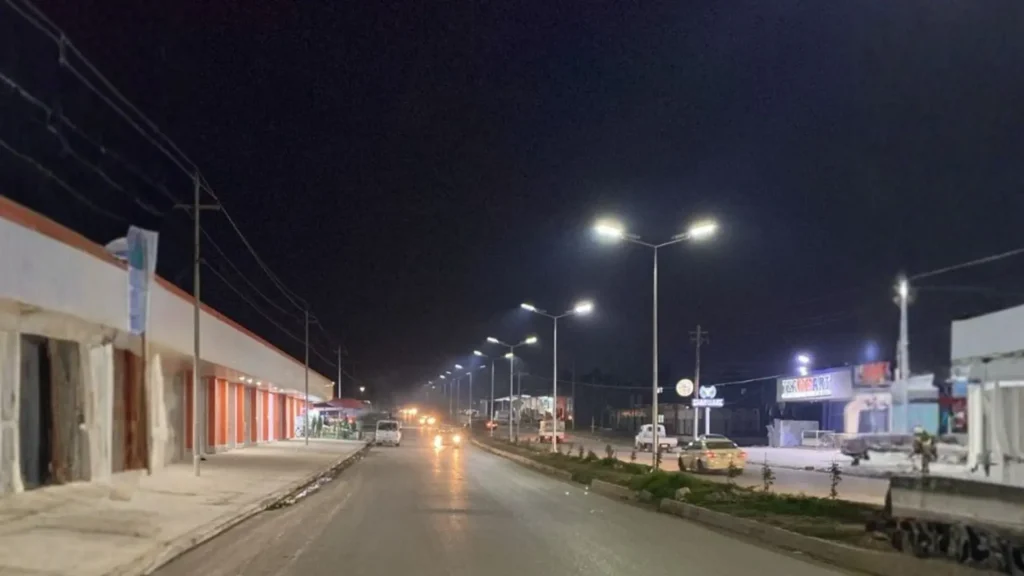
Comprising 7,641 islands, the Philippines is currently in a golden age of infrastructure development. Although the DPWH budget for 2026 has been adjusted to 529.6 billion pesos, the shift toward a “quality-first” policy means that every expenditure must withstand the test of extreme weather. Secretary Vince Dizon has clearly stated: “2026 marks the transition from quantity to quality.”
Against this backdrop, road lighting is critical to public safety and climate resilience. Under DPWH Departmental Order No. 19 of 2023, solar street lights have been officially approved for public works projects, with Secretary Manuel Bonoan highlighting their advantages of “stability, longevity, ease of installation, and energy efficiency.”
The Three-Month Curse—Why Are Low-Cost Street Lights Doomed to Fail in the Philippines?
Low-cost solar street lights in Manila and Cebu often fail within three months. During the rainy season, cloud cover reduces charging efficiency; typhoons damage structures; and high temperatures shorten battery life. In 2026, the Philippine government will impose increasingly stringent reviews on the “local adaptability” of new energy equipment, and products lacking climate resilience verification will be directly excluded.
This article adopts a dual perspective to analyze the technical core of the DPWH’s latest specifications. It explains why High Lumen Reserve and Typhoon-Resistant Structure are not merely compliance minimums, but core competitive advantages that determine project acceptance, post-sales costs, and eligibility for participation in the DPWH’s 2026 budget of 529.6 billion pesos.
II. In-Depth Analysis: The “Mandatory Thresholds” of the DPWH Road Lighting Specifications
Technical Parameter Comparison
DPWH specifications categorize roads into detailed classes based on their function:
- Class A (Arterial Roads): ≥20–30 lux | Uniformity ≥0.4
- Class B (Collector Roads): ≥15–20 lux | Uniformity ≥0.35
- Class C (Feeder Roads): ≥10–15 lux | Uniformity ≥0.3
DPWH DO No. 19 stipulates:
- Color temperature: 2,000K–6,500K (warm white light required for arterial roads)
- Minimum protection rating: IP65
- Modular components (individually replaceable)
- Minimum 6-year warranty
Compliance Analysis: From “Focusing on Wattage” to “Focusing on System Efficiency”
The core of tender evaluations in 2026 has shifted to system luminous efficacy (lm/W) and effective illumination time. For example, comparing a 100W/120 lm/W product (12,000 lumens) with an 80W/180 lm/W product (14,400 lumens), the latter significantly outperforms in Philippine tenders. Lower energy consumption delivers higher output, resulting in reduced solar panel requirements, longer battery life, and lower total cost of ownership (TCO).
The DPWH also requires LED light sources to provide IESNA LM-80-08 and TM-21-11 test reports to verify lumen maintenance under high tropical temperatures.
Policy Trend: Tightening of “Local Adaptability” Reviews in 2026
A key feature of the Philippine government’s 2026 budget is the reinforcement of the “maintenance-first” policy. The DPWH has allocated 14.5 billion pesos specifically for routine highway maintenance, while all new locally funded flood control projects have been eliminated. This sends a clear signal: the government will no longer bear the cost of low-quality, high-maintenance infrastructure.
For solar street light procurement, this means:
- Mandatory ICC/PS Certification: Imported products must hold an Import Clearance Certificate (ICC) issued by the Bureau of Philippine Standards (BPS), while locally manufactured products must bear the Philippine Standards (PS) mark.
- Verified Project References: Case studies from similar climatic regions carry greater weight in bid evaluations.
- Warranty and After-Sales Network: A 6-year warranty must be supported by a local service network or authorized distributors.
III. Why Is “High Lumen” the Only Solution for the Philippine Rainy Season?
Climate Reality: A Prolonged Rainy Season
During the Philippine rainy season (June–October), solar irradiance drops to 30%–50% of dry-season levels, causing standard street lights to frequently shut off at night. Data from a rural project in Iloilo Province shows that after upgrading to a high-lumen system, the community’s crime rate dropped by 65% within three months.
ALS Technology: Adaptive Lighting System
To address the long-standing issue of street lights shutting down during the rainy season, SRESKY developed the ALS (Adaptive Lighting System). This patented technology dynamically adjusts LED output power in real time based on remaining battery charge and weather conditions, ensuring continuous illumination during extreme weather.
When battery levels fall below a safety threshold, ALS automatically reduces output to 30%–70%, maintaining essential safety lighting. This meets the DPWH requirement for “continuous system operation under adverse conditions.”
Lumen Premium: 180 lm/W+ as the Bid Threshold
- <150 lm/W: Suitable only for private applications; being phased out in government projects
- 150–180 lm/W: Mainstream tier; limited competitive advantage
- >180 lm/W: High technical scoring; enables longer operation during extended rainy periods
The SRESKY platform achieves up to 230 lm/W, converting energy savings into extended battery life and improved reliability in tropical climates.
IV. Withstanding Category 17 Super Typhoons: The Balance Between Mechanical Structure and Materials
Wind Load Benchmark: 250 km/h
The Philippines experiences over 20 typhoons annually, with super typhoons exceeding 250 km/h. Typhoon Haiyan recorded gusts above 315 km/h, and the 2026 National Building Code has increased the design wind speed for Greater Manila to 270 km/h.
DPWH Requirements:
- Pole yield strength ≥ 248.2 MPa with hot-dip galvanization
- Luminaire must pass IEC 60598 vibration testing
- Concrete foundations must meet Class A standards
Structural Design: Typhoon-Resistant Engineering
SRESKY Solution:
- Integrated die-cast aluminum alloy luminaire (AL6063/Q235 steel) reduces wind-exposed surface area by 15%–20%
- Optimized center of gravity reduces overturning moment
- Modular reinforced connections and seismic brackets prevent internal damage
Materials Science: Corrosion Resistance in Coastal Environments
Salt fog levels in the Philippines (800–1,200 mg/m²/day) exceed those in Florida:
- Standard plastic: 2–3 years (inland only)
- Powder-coated aluminum: 10–15 years (urban use)
- PVDF-coated aluminum: 30+ years (coastal and typhoon-prone zones)
The SRESKY premium series uses anodized + PVDF coatings, ensuring over 20 years of structural durability in coastal environments.
Protection Ratings: IP66 and IK10
- IP66: Exceeds DPWH minimum; withstands heavy rain (200–400 mm/6 hours)
- IK10: 20-joule impact resistance against debris
- Dual rain sensors (e.g., Delta S series): Automatically adjust luminaire positioning before heavy rainfall
V. Case Study: From Lab to Field in the Philippines
Atlas Max Series (SSL-340 to 370) — High-Temperature Endurance
- 230 lm/W luminous efficacy (8,800–15,400 lumens)
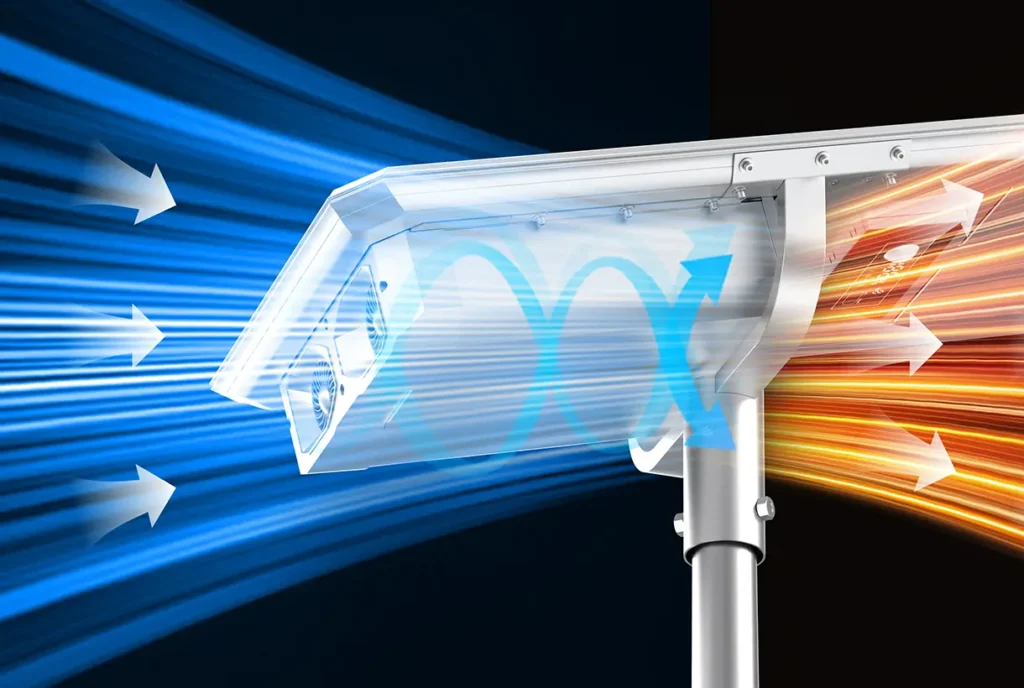
- TCS Thermal Management System with dual fans, insulation, and heat sinks
- Battery cycle life increased from 2,000 to 4,000+ cycles
- 6-year warranty
In Eastern Visayas deployments, the system handled frequent typhoons, high humidity, and sustained temperatures of 35–40°C. When ambient temperature exceeds 45°C, thermal barriers isolate battery compartments while fans maintain optimal internal temperatures (25–35°C), doubling battery lifespan.
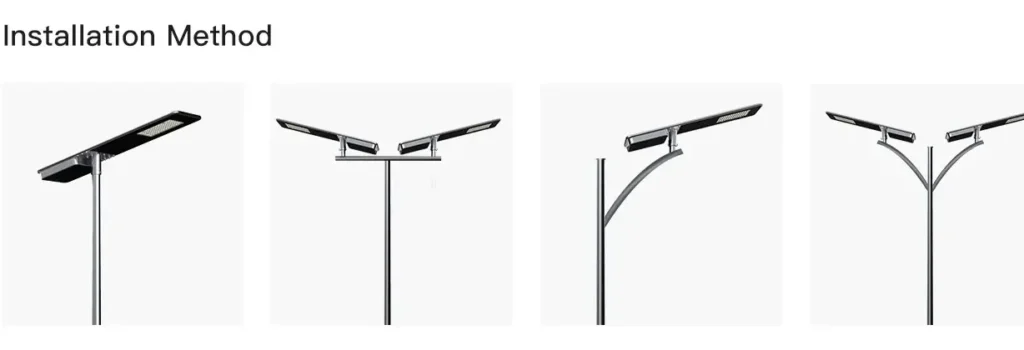
Basalt Series (SSL-94A to 912A) — Ultra-Thin Yet Wind-Resistant
- Tempered glass (light transmittance >91%)
- Quadruple fault monitoring (PV, battery, controller, LED)
- 36-hour backup with ALS support
B2B Insight: Test Reports Reduce After-Sales Costs by 40%
- IES reports prevent lumen overstatement disputes
- IP66/IK10 verified by SGS/Intertek
- Wind tunnel/CFD testing validates 270 km/h resistance
- Rainy-day battery performance is a new 2026 evaluation metric
Cost Comparison (2,000 units):
- Low-cost suppliers: 15%–20% failure rate ($150,000–$200,000)
- SRESKY: 1%–2% failure rate ($10,000–$20,000) → Over 80% savings
VI. Conclusion: Capitalizing on the 2026 Philippine Infrastructure Boom
Despite budget tightening, the “maintenance-first” policy is driving demand for lighting upgrades. Successful products must meet:
- Compliance: DPWH Item 624, DO No. 19, ICC/PS certification
- Climate Resilience: >180 lm/W, ALS adaptive control, TCS thermal management, IP66/IK10, typhoon-resistant structure (250 km/h+)
- Economic Viability: 6-year warranty, <5% failure rate, optimized lifecycle cost
VII. Call to Action (CTA)
Preparing for 2026 Philippine government lighting projects?
Get the SRESKY DPWH Compliance Product Package (including IES files, compliance checklists, and climate selection guides).
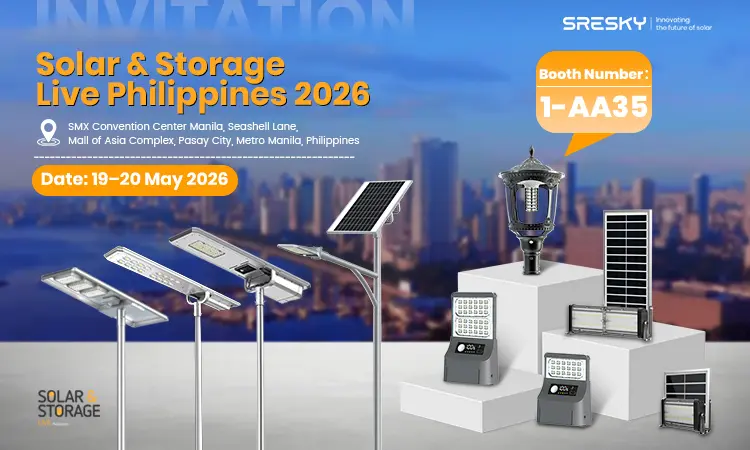
Exhibition Preview:
SRESKY will participate in Solar & Storage Live Philippines—the country’s largest energy exhibition—held at the SMX Convention Center in Manila on May 19–20, 2026. Our technical team will be available for in-depth, one-on-one consultations.