
I. Project Background & Needs Analysis
As South America’s largest nation, Brazil’s extensive coastline serves not only as an economic lifeline but also as a treasure trove of ecological and recreational resources. However, lighting at coastal marinas often presents challenges due to complex environmental conditions. This project was specifically designed to address these challenges.
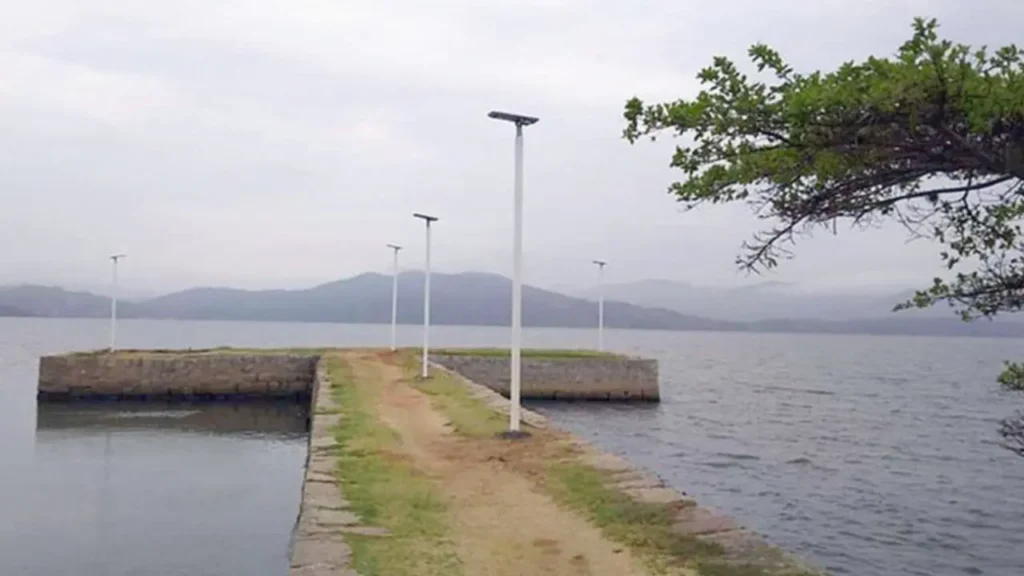
1.1 Project Geography: A Coastline Where Serenity Meets Wildness
Located at a picturesque coastal leisure pier in southeastern Brazil, the site features a T-shaped pier extending into the sea, constructed of concrete and stone. It is surrounded by lush green lawns and gravel paths, with rolling hills and the vast ocean in the distance. This area serves as both a mooring point for fishing boats and yachts and a popular spot for locals to stroll, fish, and gather with families.
Picture the scene at sunset: thick clouds blanket the sky, lush tropical vegetation sways in the sea breeze—a quintessential view of the project site.
Yet behind this beauty lies a critical lighting challenge:
-
Difficult Grid Access: The pier extends deep into the water, making traditional utility cable installation through complex terrain costly and risky. The remoteness of Brazil’s coastal regions further compounds this issue, leaving many similar areas reliant on diesel generators or manual lighting for years.
-
Harsh Environment: High salt fog corrosion is the “killer” of coastal settings. Salt carried by sea winds rapidly erodes metal components, causing ordinary streetlights to rust and circuits to short-circuit. Combined with high humidity (often above 80% year-round) and strong sea winds (exceeding 20 m/s), the durability of lighting fixtures faces immense challenges.
-
Unpredictable Climate: Brazil’s coastal regions experience a tropical rainforest climate characterized by frequent cloud cover and rainfall. Project site imagery reveals overcast skies and dense cloud layers, with continuous rainy periods exceeding 10 days. This poses severe challenges to solar streetlights’ charging efficiency and endurance—traditional solar lights often cease functioning during insufficient sunlight, creating safety hazards at night.
Combined, these factors make nighttime dock illumination an urgent priority for local governments and communities. Improper choices not only increase maintenance costs but may also lead to pedestrian slips or vessel collisions.
1.2 Core Client Requirements
Local municipal authorities and dock management outlined clear demands:
-
Safety First: High-brightness lighting is essential for clear pedestrian pathways and accurate vessel berthing at night. Insufficient brightness could lead to accidents and compromise community safety.
-
Durability and Adaptability: Fixtures must withstand salt spray, wind, rain, and high temperatures. In Brazil’s tropical climate, summer temperatures can exceed 35°C, demanding long-term resilience.
-
Zero Electricity Costs and Low Maintenance: Solar power is expected to achieve zero operational expenses. Post-installation maintenance should be negligible for at least 3-5 years, minimizing labor input. Given the pier’s remote location and high maintenance difficulty, this requirement is particularly critical.
Based on these needs, the Sresky team conducted in-depth research and selected the Atlas Series as the core solution. This series has secured over 3,500 tender projects globally, with outstanding performance in Brazilian outdoor lighting projects.
II. Technical Solution Design: Sresky Atlas Series’ Perfect Adaptation
Addressing Brazil’s unique coastal challenges, Sresky delivered a customized solution centered on the Atlas Series. With luminous flux ranging from 2,000 LM to 10,000 LM and power from 20W to 100W, this series perfectly matches the pier’s scale. Key technical highlights include:
2.1 Material Upgrades for “Coastal Corrosion”
Seaside salt spray is the greatest enemy of lighting fixtures. The Atlas Series tackles this through innovative materials and protective design:
-
Double Protection for Rust-Proofing: The luminaire body utilizes high-strength aluminum alloy + PC material, with a specially coated surface providing a dual-layer rust barrier. This ensures the fixture remains rust-free and corrosion-resistant in high-salt-spray environments, tested to withstand over 1,000 hours of salt spray exposure.
-
IP65/IK08 Protection Rating: IP65 waterproofing effectively blocks sea spray and rain; IK08 impact resistance withstands accidental impacts from vessels or wind-blown debris. At Brazil’s coastal docks, this protection extends luminaire lifespan to over 10 years.
These upgrades stem directly from Sresky‘s meticulous design, ensuring the Atlas Series excels in salt-fog-resistant solar streetlights.
2.2 Core Technology for “Cloudy and Rainy Weather”
Brazil’s coastal regions experience frequent cloud cover and rainfall, where traditional solar lights often struggle. The Atlas Series features ALS2.2 (Adaptive Lighting System) technology:
-
ALS2.2 Adaptive Lighting: This system intelligently monitors light intensity and automatically adjusts output power. It charges efficiently on sunny days and reduces brightness during cloudy or rainy periods to extend runtime. Even after over 10 consecutive cloudy or rainy days, the luminaire maintains 100% illumination year-round—more than double the endurance of standard solar lights.
-
High-Efficiency Monocrystalline Silicon Solar Panels: Charging efficiency exceeds 23%, with a charging time of only 6.7-10 hours (depending on model), even under cloudy conditions. For example, the 60W solar panel on the SSL-36A rapidly replenishes energy, keeping battery capacity at safe levels.
This technology has received consistent acclaim in Sresky Atlas Series case studies, proving ideal for rainy scenarios in Brazilian solar streetlight projects.
2.3 Battery Management for “High Temperatures and Long Lifespan”
Brazil’s high temperatures can cause battery overheating and degradation. The Atlas Series incorporates a TCS (Temperature Control System):
-
TCS Temperature Control: Real-time battery temperature monitoring with a charging range of 0°C–45°C and discharging range of -20°C–60°C. Automatically reduces power output in high temperatures to prevent damage or lifespan reduction.
-
Automotive-Grade Lithium Batteries: New energy vehicle-grade lithium-ion batteries with BMS (Battery Management System) technology accelerate charging by over 30%, ensuring efficient and stable performance.
These features enable the Atlas Series to excel in high-temperature environments while reducing long-term maintenance costs.
2.4 Luminous Efficiency and Aesthetic Design
-
High Luminous Output: OSRAM 3030 LED chips deliver 230 lm/W efficacy at 5700K with Ra>70. Type 2 light distribution ensures uniform illumination across dock areas.
-
Minimalist Aesthetics: Streamlined silver-gray design blends seamlessly into coastal landscapes.
Additionally, the Atlas Series supports Super Remote Control and smart lighting (APP/PC control), allowing customization of parameters such as lighting modes (M1/M2/M3) and scheduling.
III. Project Implementation
From design to completion, the project took three months, demonstrating the Atlas Series‘ ease of use:
-
Minimal Installation Complexity: All-in-One integration of solar panel, battery, and LED. Installation requires only 4 steps: dig foundation pit, secure foundation cage, mount bracket, install luminaire, and secure pole. Direct on-pole replacement of components minimizes maintenance costs.
-
Modular Design: Easily maintainable battery pack integrates a high-sensitivity PIR sensor (120°, 8 m detection). Outdoor IP65-rated waterproofing ensures safe installation on slippery dock surfaces.
IV. Conclusion
The Brazilian coastal dock project validated the Sresky Atlas Series‘ exceptional performance in complex environments. Through ALS2.2, TCS, and rust-proofing technology, it illuminates the coastal defense line and sets a global benchmark for Brazilian outdoor lighting projects.