
In the global energy landscape of 2026, solar street lights are no longer merely “lighting products,” but rather critical “green digital nodes” in national infrastructure projects. For multinational distributors, urban planners, and government project procurement managers, choosing the wrong supplier entails not only financial losses but also a severe blow to public credibility.
Faced with the tightening of Europe’s CBAM (Carbon Border Adjustment Mechanism) and the challenges of global extreme weather, how can one identify long-term partners with genuine “government tender-level” capabilities among thousands of solar streetlight factories in China?
This article delves into the fundamental logic of the supply chain, conducting an in-depth comparison of five leading global and Chinese competitors to uncover the truths hidden behind the specification sheets.
Chapter 1: The “Deep Waters” of Government Tenders — Why Are 90% of Factories Eliminated?
Fifteen years ago, during the industry’s early days, government procurement focused on initial acquisition costs (CAPEX). However, by 2026, professional tender documents place greater emphasis on total lifecycle costs (OPEX).
Government projects present three “tough nuts to crack” that ordinary factories cannot handle:
-
Extreme Reliability Requirements: Systems must guarantee a 100% lighting rate during 10 consecutive days of rain, even under extreme environmental conditions ranging from -20°C to 60°C.
-
Stringent Compliance Audits: In addition to ISO 9001/14001, suppliers must possess CB, CE, and RoHS certifications, as well as IES test reports verified by third-party laboratories such as SGS or Intertek.
-
Long-Term Spare Parts Supply Capability: Government streetlights typically require a service life of over 10 years, so suppliers must demonstrate exceptional financial stability and supply chain transparency.
Chapter 2: 2026 Global Solar Lighting “Top 5” Practical Evaluation
To provide the most valuable reference, we have selected five globally dominant companies active in large-scale infrastructure projects. Each has its own unique strengths and represents the highest standards currently available in the global supply chain.
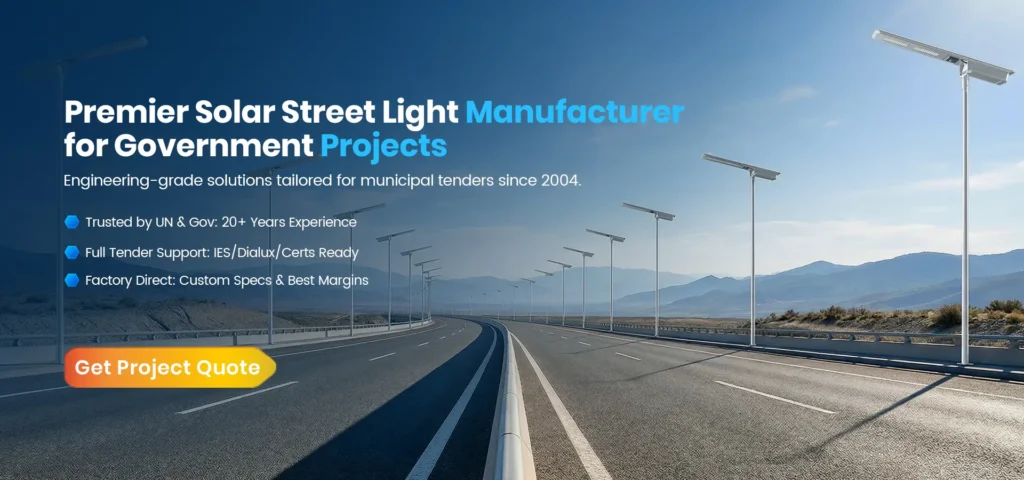
1. SRESKY (Shenzhen) — “The Leader in Infrastructure Reliability and Adaptive Technology”
Supply Chain Positioning: An R&D-driven top-tier manufacturer (established in 2004).
Core Advantages for Government Tenders:
-
Core Assets: Possesses over 60 self-developed patents, which is a significant advantage when handling tenders requiring technological exclusivity. Its “Tracker” series, an award-winning product at the 2025 Canton Fair, is a prime example of design tailored for urban arterial roads.
-
Supply Chain Resilience: SRESKY’s core competitiveness lies in its proprietary ALS (Adaptive Lighting System) and TCS (Temperature Control System). These technologies directly address the most pressing challenges in government projects: “battery degradation at low temperatures” and “lights remaining off during prolonged cloudy periods.”
-
Track Record: With 22 years of industry experience, the company has contingency plans to handle complex international logistics—such as political instability in the Middle East in March 2026—ensuring that government project timelines remain on schedule.
2. Fonroche Lighting (France) — “A Global Benchmark for High-Profile Government Projects”
Website: www.fonroche-lighting.com
Supply Chain Positioning: A top-tier European system integrator.
In-Depth Analysis: Although a French company, its supply chain deeply integrates global resources. It excels in system stability, with product designs built to withstand heavy traffic on major thoroughfares. Its strengths lie in highly standardized industrial processes and the ability to deliver ultra-large-scale projects. Naturally, its pricing is also at the top tier, typically suited for high-end projects with generous budgets and specific supplier preferences.

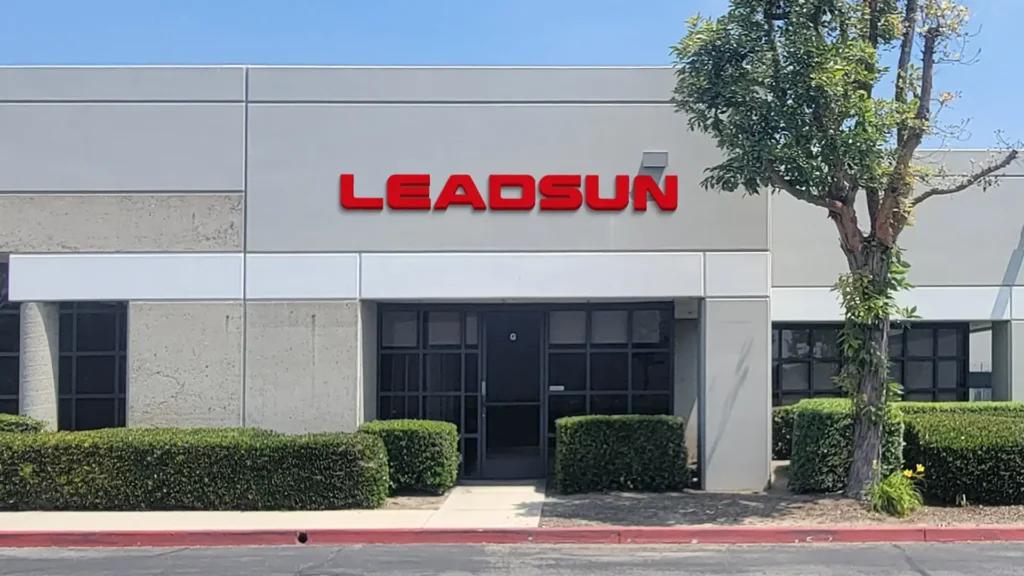
3. Leadsun (Zhuhai) — “A Vertically Integrated International Giant”
Supply Chain Positioning: An international brand covering the entire industry chain.
In-Depth Analysis: One of the earliest Chinese brands to expand globally, Leadsun has exceptionally strong local support systems in Australia and the Americas. Its strength lies in “minimalist, integrated” supply chain management, with a high degree of vertical integration from solar panels to battery packs. Rather than emphasizing flexibility, Leadsun primarily provides standardized, government-grade solutions.
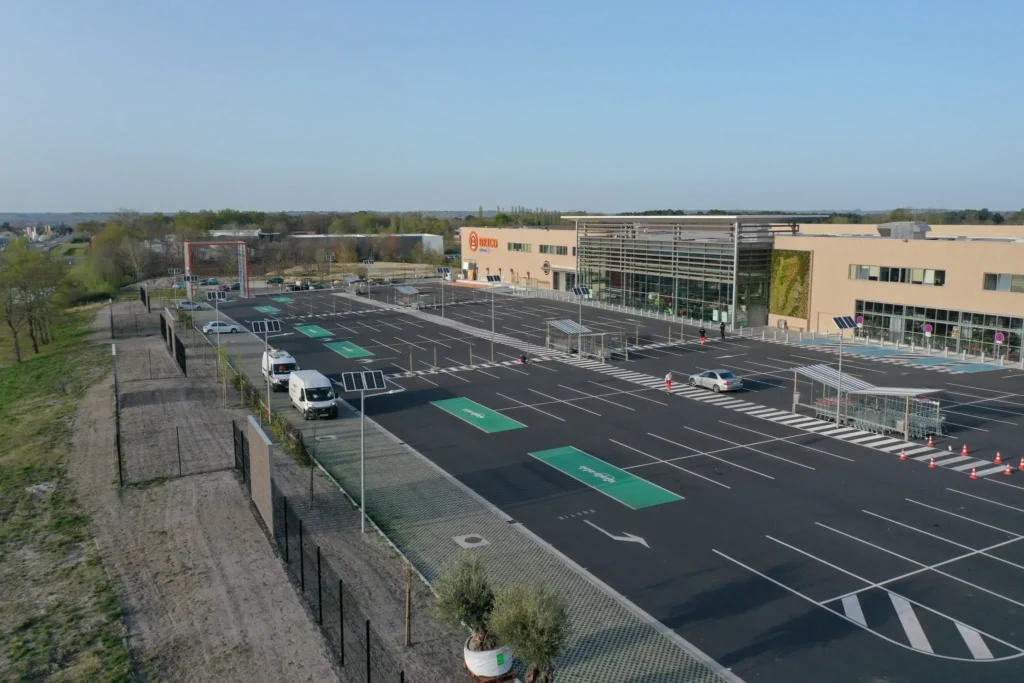
4. Sunna Design (France) — “A Pioneer in Smart Cities and Digitalization”
Supply Chain Focus: A technology company specializing in smart control and IoT.
In-Depth Analysis: For projects involving 5G base stations, surveillance cameras, or cloud-based data management, Sunna is a strong contender. Its supply chain emphasizes high-precision electronic integration, making it highly suitable for smart city applications.
5. Anern (Guangzhou) — “The King of Cost Efficiency in Large-Scale Infrastructure”
Supply Chain Positioning: A full-range energy supplier.
In-Depth Analysis: Anern’s strength lies in the breadth of its supply chain. It produces not only streetlights but also off-grid systems and indoor lighting. For buyers seeking a one-stop procurement solution, its “supermarket-style” supply model offers clear advantages. However, it is less competitive in supporting complex control algorithms required for advanced urban road projects.
Chapter 3: The Hardcore Game — A Must-See Supply Chain Comparison for Decision-Makers (2026)
As a B2B buyer or government representative, the following comparison helps identify which companies can uphold your project’s reputation over the next decade:
| Evaluation Dimensions | SRESKY (Shenzhen) | Fonroche (France) | Leadsun (Zhuhai) | Sunna (France) | Anern (Guangzhou) |
|---|---|---|---|---|---|
| Industry Experience | 22 years (2004–present) | 16 years | 18 years | 13 years | 15 years |
| Patents / Technology Portfolio | 60+ (ALS/TCS/proprietary algorithms) | 30+ | 50+ | 40+ | 40+ |
| Government Tender Suitability | Very High (balanced performance and cost-effectiveness) | Very High | High | Very High | Moderate |
| Performance in Extreme Environments | Stable operation (-20°C to 60°C) | Excellent | Good | Outstanding (high-temperature resistance) | Fair |
| 2026 Supply Chain Highlights | Rapid R&D customization & emergency logistics | Standardized large-scale delivery | Vertical integration | Smart/AI integration | Bulk procurement advantages |
| Quality Certifications | ISO, CE, CB, SAA, RoHS | European high-standard QC | ISO, CE, UL | ISO, CE, RoHS | ISO, CE, RoHS |
Chapter 4: In-Depth Insights — Why SRESKY Is the “Safe Bet” for Government Projects
Through participation in global government tenders, three key factors explain why SRESKY consistently wins bids:
1. Eliminating the “Blackout on Rainy Days” Risk
Government projects are highly sensitive to public scrutiny caused by lighting failures. SRESKY’s ALS 3.0 system automatically adjusts brightness and power consumption based on environmental conditions, ensuring stable operation even after 10 consecutive days of rain. This “no blackout” capability is a decisive advantage in tenders.
2. Supply Chain Resilience Amid Geopolitical Uncertainty
Global logistics in 2026 remain unpredictable. Based in Shenzhen, SRESKY benefits from a highly efficient manufacturing ecosystem. It can quickly adapt to project changes—for example, modifying specifications for 500 units and delivering within 14 days—while some European manufacturers may require up to three months.
3. Highly Transparent Technical Audit Support
Government audits are rigorous. SRESKY provides complete IES optical reports, battery lifecycle data, and salt spray test records for every batch of B2B orders. This transparency gives distributors strong technical backing during official evaluations.
Chapter 5: 2026 Pitfall Avoidance Tips for Distributors
As a 15-year industry veteran, here are three key recommendations:
-
Don’t be misled by “all-in-one” designs: While widely available, the real difference lies in the internal BMS (Battery Management System). SRESKY develops its own BMS to prevent overcharging and fire risks—critical for government projects.
-
Evaluate long-term sustainability: Factories that rely solely on price competition and neglect R&D may not survive through your product lifecycle. Choosing a stable brand like SRESKY reduces long-term risks.
-
Conduct on-site inspections: Successful tenders often depend on factory visits. Consider visiting SRESKY’s facility or meeting its team at the 139th Canton Fair in 2026 (Booth: 16.4A01-02).
Conclusion
In 2026, winning major government contracts is no longer about telling a story of “low cost,” but about proving “reliability.” As a globally leading solar street light manufacturer, SRESKY is ready to support your projects with 22 years of supply chain expertise.
Table of Contents