
I. Project Background and Demand Analysis
The Netherlands is located between 51° and 53° north latitude and has a typical temperate oceanic climate. The high latitude results in extremely short daylight hours during winter—typically only 6–8 hours—combined with frequent fog and rainfall. According to data from the Royal Netherlands Meteorological Institute (KNMI), the average number of foggy days in winter can reach 20–30, and relative humidity remains above 80% year-round. This environment poses a significant challenge to traditional lighting systems, particularly solar-powered streetlights.
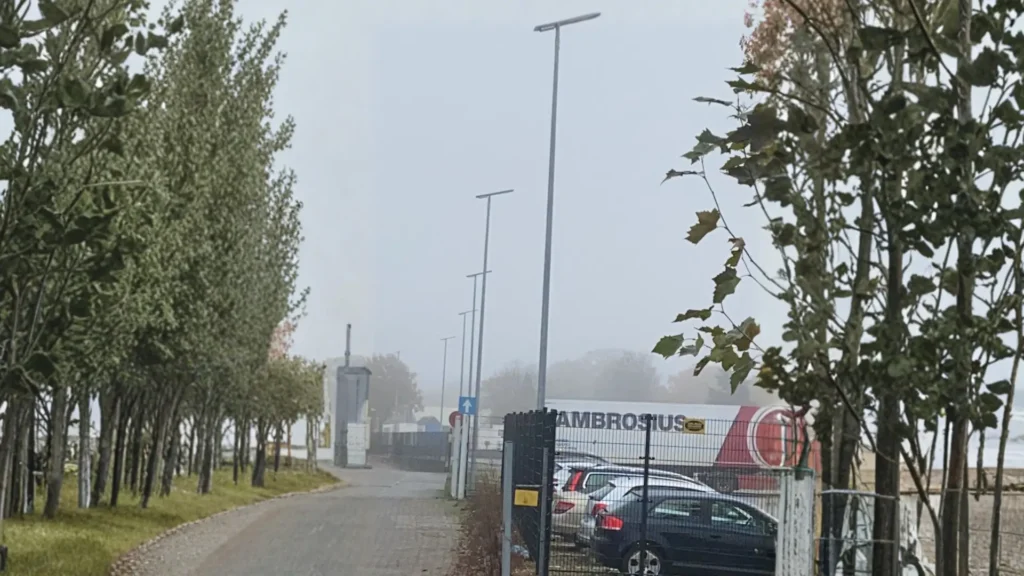
This project focuses on the outdoor parking lot and pedestrian walkways of the Ambrostus large-scale commercial and logistics center. The area is vast, with frequent vehicle traffic and pedestrian footfall reaching thousands during peak hours. Adjacent to a busy logistics hub, the lighting requirements extend beyond basic illumination to ensuring pedestrian safety and providing effective supplementary lighting for surveillance systems.
Key challenges include:
- Adaptability to Extreme Weather: Heavy fog and persistent rain during Dutch winters can significantly reduce the charging efficiency of solar panels. Traditional solar streetlights often deplete their power rapidly after consecutive overcast days, leading to lighting outages. This creates safety risks when visibility drops below 50 meters in foggy conditions.
- Safety Lighting Requirements: As a high-traffic area, the parking lot requires uniform, high-penetration lighting to cover sidewalks and parking space edges. In low-visibility conditions, streetlights must provide sufficient illuminance (at least 2,000 lumens) and support smart sensors to prevent energy waste.
- Zero-Carbon Emission Targets: In response to the Dutch government and the EU’s “Fit for 55” climate action plan, this project aims to achieve a 100% green energy supply and reduce the carbon footprint of commercial operations. As a model of sustainable development, the Ambrostus Center seeks to reduce reliance on the traditional power grid through solar streetlights, thereby improving its ESG (Environmental, Social, and Governance) performance.
- Maintenance Cost Control: High-humidity environments can lead to corrosion and equipment malfunctions. The project requires lighting fixtures with strong corrosion resistance, an IP65 waterproof rating, and modular maintenance capability to minimize long-term operational costs.
This analysis highlights the necessity of selecting high-performance solar street lights. The SRESKY ATLAS Series stands out in Dutch solar streetlight projects, offering tailored solutions for parking lot lighting.
II. Technical Solution Design
To address the specific needs of the Ambrostus parking lot, the project team selected the SRESKY ATLAS Series solar street lights (model range SSL-32A to SSL-310A). This series offers brightness levels from 2,000 LM to 10,000 LM and utilizes monocrystalline silicon solar panels and lithium-ion batteries to ensure efficient energy conversion.
Key technical features include:
- ALS 2.2 Core Patent Technology:
ALS 2.2 (Adaptive Lighting System) dynamically adjusts brightness using intelligent algorithms, optimizing battery usage under low-light conditions. It enables continuous illumination for over 10 consecutive days of cloudy or rainy weather—far exceeding industry standards and ensuring stable performance during foggy Dutch winters. - TCS Temperature Control System:
With winter temperatures dropping below -5°C, the TCS system ensures battery efficiency within a discharge range of -20°C to 60°C and a charging range of 0°C to 45°C. Combined with the BMS (Battery Management System), it improves charging efficiency by 30% and maximizes energy capture even under weak sunlight. - Smart PIR Sensing:
The PIR (Passive Infrared) sensor features a 120° detection angle and an 8-meter range, supporting multiple lighting modes:- M1: 30% brightness until motion is detected, then 100%
- M2: Timer mode (100% for 5 hours + 25% for 5 hours + 70% PIR)
- M3: Constant 70% brightness overnight
This ensures energy savings while maintaining safety in low-traffic periods.
- Modular Maintenance Design:
Constructed with aluminum alloy and PC materials, the system features IK08 impact resistance. Components such as OSRAM 3030 LED chips (efficiency up to 230 lm/W) can be replaced directly on the pole. A 5700K color temperature and high CRI (Ra > 70) ensure strong light penetration in foggy conditions. Installation heights range from 3 m to 10 m, with spacing between 15 m and 32 m.
These features meet the demands of foggy, high-humidity environments and provide a reliable model for green energy lighting projects across Europe.
III. Project Implementation
The project began with on-site surveys and was completed within three months. Streetlights were arranged linearly along brick-paved sidewalks, with lamp heads angled downward to precisely illuminate pedestrian paths and parking space edges. The upright pole design (3 m–10 m) and the integrated structure of the SRESKY ATLAS Series blend seamlessly with the modern architectural style of the Ambrostus Center.
For environmental durability, luminaires feature advanced anti-corrosion treatments, including double-layer anti-rust brackets. The IP65 waterproof and IK08 impact-resistant design ensures long-term performance in humid and foggy conditions.
Installation followed standard procedures:
- Excavation and stabilization of foundation pits with C20 concrete
- Fixing brackets and luminaires with screws
- Hoisting and aligning lamp posts with flanges, then securing them
Performance in dense fog is particularly notable. The Type II lighting distribution and high-efficiency light source (230 lm/W) clearly define road boundaries and improve overall visibility. The system also integrates a remote control for DIY parameter adjustments, such as seasonal mode optimization.
IV. Project Results & Impact
Following implementation, the Ambrostus parking lot achieved a high-efficiency lighting upgrade.
- Social Value:
The project enhances nighttime safety, ensuring reliable illumination even in low-visibility fog conditions and improving the separation of pedestrians and vehicles. - Environmental Impact (ESG):
Powered entirely by solar energy, the system reduces carbon emissions by hundreds of tons annually, supporting the Netherlands’ and the EU’s carbon neutrality goals. - Brand Value:
Backed by over 3,500 global tender projects, the SRESKY ATLAS Series demonstrates high reliability, strengthening SRESKY’s reputation as a provider of smart solar lighting solutions and attracting increased interest from European clients. - Economic Benefits:
The project reduces electricity costs by over 20% and lowers maintenance expenses through its modular, low-maintenance design.
V. Risks and Mitigation Strategies (Risk & Mitigation)
Despite its strong adaptability, potential risks and solutions include:
- Risk: Extremely short winter daylight hours leading to battery depletion
Mitigation: Utilize the BMS system to improve charging efficiency and adjust lighting modes via multi-level remote control (e.g., M3 constant 70% brightness). The system also supports hybrid power supply (Hybrid Mode), automatically switching to AC charging when battery capacity is low. - Risk: Electrical malfunctions due to high humidity
Mitigation: The IP65-rated sealed structure prevents moisture ingress. Regular monitoring of LED indicators (charging/discharging status) enables early detection. A 3-year warranty further ensures reliability.
Through these measures, operational risks are minimized, ensuring long-term stability.
Table of Contents