
I. Project Background and Requirements Analysis
1.1 Geographic and Environmental Context
Qatar, located on the eastern coast of the Arabian Peninsula along the Persian Gulf, experiences a typical tropical desert climate. Summer temperatures frequently exceed 50°C (122°F), accompanied by intense ultraviolet radiation and frequent sandstorms. These extreme environmental conditions pose significant challenges for outdoor lighting equipment. Traditional streetlights are prone to battery degradation, electronic component failure, and potential safety hazards caused by prolonged exposure to extreme heat.
This project is situated near Qatar’s capital, Doha, within a large multipurpose hall complex and its associated HR administrative offices. As a hub for commercial and administrative activities, the area experiences heavy daily traffic, making reliable nighttime lighting essential. Desert dust and high temperatures reduce solar charging efficiency and significantly increase maintenance costs. As a result, the project required a weather-resistant, wiring-free solar street lighting solution capable of ensuring long-term, stable operation.
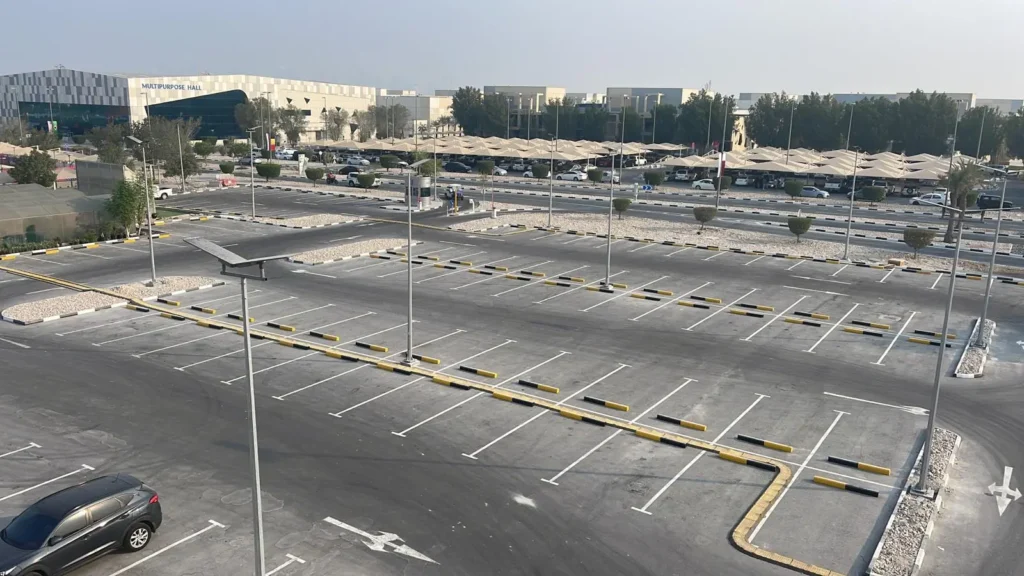
1.2 Scenario Requirements: Multipurpose Hall Parking Lot
The expansive parking lot surrounds the multipurpose hall and HR office buildings and accommodates hundreds of parking spaces. The core project requirements include:
High Safety Standards
The large parking area requires uniform, gap-free nighttime illumination to ensure safe vehicle circulation and pedestrian movement. Inadequate lighting increases accident risks, particularly under the low-visibility conditions common during desert nights.
Architectural Aesthetic Integration
The modern glass curtain wall architecture (similar to the blue glass structure referenced in Image 2) calls for streetlights with a minimalist, high-tech appearance that complements the industrial aesthetic without visual disruption.
Extreme Heat Resistance
Qatar’s summer climate often causes conventional lithium batteries to overheat and degrade, significantly shortening their service life. The project requires lighting systems capable of stable operation within a discharge temperature range of -20°C to +60°C.
Low-Maintenance Operation
Given high labor costs and operational efficiency requirements, the project demands smart management functions such as Fault Auto-Diagnosis (FAS) and remote control. DIY parameter configuration minimizes inspection frequency and reduces maintenance workload.
These requirements reflect common challenges in Middle Eastern solar lighting projects—balancing safety, energy efficiency, durability, and aesthetics in harsh environments. The SRESKY Basalt Series is specifically designed for such scenarios and has already been deployed in more than 100 global tender projects.
II. Technical Solution Design
For the Qatar multipurpose hall parking lot, the SRESKY engineering team selected the Basalt Series, offering lumen outputs ranging from 4000 lm to 12,000 lm. Designed for high-end infrastructure projects, this series integrates multiple patented technologies to ensure reliable performance in desert climates.
2.1 Core Technology Selection
The Basalt Series derives its competitive advantage from advanced technologies tailored for extreme environmental conditions:
TCS (Temperature Control System)
This core technology directly addresses Qatar’s extreme heat. TCS intelligently monitors and regulates battery charge and discharge currents, protecting lithium-ion batteries from overheating and performance degradation. Battery capacities range from 230.88 Wh (SSL-94A) to 692.64 Wh (SSL-912A). Charging temperatures are supported from 0°C to 45°C, with discharge temperatures from -20°C to +60°C. This ensures stable operation even when ambient temperatures exceed 50°C and significantly extends battery lifespan.
ALS 2.2 (Intelligent Ambient Sensing System)
When solar charging efficiency is reduced by sandstorms or dusty weather, the ALS 2.2 algorithm automatically adjusts light output to optimize energy consumption. Even during continuous rainy or dusty conditions lasting more than 10 days, the streetlights can maintain illumination for over 10 consecutive nights. This patented technology allows the Basalt Series to perform reliably in desert regions with limited effective sunlight.
Integrated Aerospace-Grade Aluminum Frame
The monocoque structure, constructed from high-strength aluminum alloy and tempered glass, distributes stress evenly to achieve exceptional impact resistance (IK08). An optimized thermal design enhances resistance to sandstorms and high winds, while the IP65 waterproof and dustproof rating ensures long-term reliability in Gulf-region climate extremes.
PIR Motion Detection and Smart Dimming
The integrated PIR sensor covers a 120° detection angle with a range of up to 8 meters. When no movement is detected, the system operates at 30% brightness to conserve energy. Upon detecting vehicles or pedestrians, brightness instantly increases to 100%.
Available lighting modes include:
-
M1: PIR mode until dawn
-
M2: 100% brightness for the first 5 hours, 25% PIR mode for the next 5 hours, then 70% brightness until dawn
-
M3: Constant 70% brightness
These modes provide an optimal balance between energy efficiency and security requirements.
Additionally, the Basalt Series supports super remote control, allowing users to configure parameters—such as brightness levels, operating modes, and timers—via mobile app or PC, further enhancing smart system management.
2.2 Hardware Specification Adaptation
Hardware configurations are flexibly tailored to different zones within the parking lot:
Brightness and LEDs
OSRAM 3030 LED chips with an efficiency of up to 230 lm/W, 4000K color temperature, and Ra >70 color rendering ensure clear and comfortable illumination.
Solar Panel and Battery System
Solar panel charging times range from 6.3 to 10 hours. Lithium-ion battery capacities are customized to ensure efficient energy storage and stable nighttime performance.
Automatic Alarm System (FAS)
The Fault Auto-Diagnosis System provides real-time status feedback through four LED indicators.
-
During charging: ≤20% capacity (LED1 flashing), >95% capacity (all LEDs fully lit)
-
During discharging: >80% capacity (LEDs fully lit), <5% capacity (LEDs off)
This intuitive visual feedback simplifies maintenance and reduces manual inspection requirements.
Installation Specifications
Pole diameter: Φ60 mm
Mounting height: 4 m to 12 m
Pole spacing: 18 m to 54 m for uniform illumination
The aluminum alloy and tempered glass construction ensures excellent corrosion resistance and structural durability.
These specifications enable the Basalt Series to deliver comprehensive, shadow-free lighting coverage across large parking facilities in Qatar.
III. Project Implementation and Execution
3.1 Visual Integration and Installation Layout
Project execution emphasized architectural harmony. The Basalt Series features dark-colored poles and minimalist rectangular luminaires that visually complement blue glass curtain walls and modern industrial architecture.
Spacing Optimization
Optical simulation confirmed that spacing between 18 m and 54 m provides uniform illumination of parking lines, signage, and obstacles, eliminating nighttime blind spots.
3.2 On-Site Visual Performance
Daytime Appearance
The luminaires’ clean, geometric design enhances the multipurpose hall’s modern image and integrates seamlessly into the surrounding urban landscape.
Nighttime Lighting Effect
High-CRI illumination delivers bright yet comfortable lighting, improving driver confidence during parking and pedestrian navigation. Field testing confirms that ALS 2.2 maintains consistent brightness even under dusty conditions.
IV. Project Outcomes and Impact
4.1 Social Value and Environmental Contribution
Zero Carbon Emissions
The fully solar-powered system eliminates grid electricity consumption, saving tens of thousands of dollars annually while reducing carbon emissions by several tons. The project directly supports Qatar’s green development initiatives.
Smart City Benchmark
This installation serves as a benchmark for solar-powered parking lot lighting in the Middle East and can be replicated across public facilities to accelerate regional sustainable development.
4.2 Performance Metrics
Stability Under Extreme Heat
During peak summer testing, the TCS system effectively prevented battery degradation, achieving zero downtime and no measurable brightness loss.
Maintenance Cost Reduction
The combination of FAS and remote control functionality improved maintenance efficiency by approximately 60%, significantly reducing manual inspection requirements.
V. Conclusion
The Qatar Multipurpose Hall Parking Lot project represents more than a conventional lighting upgrade—it is a comprehensive validation of technological adaptability in extreme environments. The SRESKY Basalt Series, equipped with TCS, ALS 2.2, intelligent sensing, and industrial-grade design, successfully meets stringent safety, sustainability, and performance requirements. This case study demonstrates that solar street lighting can deliver reliable, high-efficiency, zero-carbon illumination even under the most challenging desert conditions.
Table of Contents