
I. Project Background and Needs Analysis
Located near the equator and characterized by a tropical rainforest climate, Indonesia experiences year-round temperatures above 30°C. High humidity and a prolonged rainy season—lasting six to eight months annually—pose serious challenges for outdoor lighting systems. Extended periods of rainfall often cause conventional solar streetlights to “go dark,” creating safety risks for road users. At the same time, rapid urbanization has driven extensive expansion of main arterial roads. Both national and local governments urgently require a stable, energy-efficient lighting solution that avoids large-scale excavation for cable installation, thereby reducing infrastructure costs.
Against this backdrop, the project’s core requirements are clear and demanding. First, high brightness and safety are essential. As critical transportation corridors, main roads require strong nighttime visibility for both vehicles and pedestrians, necessitating luminaires capable of delivering up to 10,000 lm to cover wide road surfaces and eliminate blind spots. Second, all-weather reliability is crucial. Lighting interruptions during prolonged rainy periods must be eliminated, with a requirement for 100% illumination for more than 10 consecutive days to prevent weather-related safety hazards. Third, weather resistance is a key challenge. Batteries must maintain long service life in high-temperature environments while avoiding thermal runaway or accelerated capacity degradation.
These requirements test not only technical performance but also economic feasibility and environmental sustainability. As a global leader in solar lighting solutions, SRESKY precisely addressed these challenges with its Atlas Series, successfully securing multiple tenders across Indonesia.
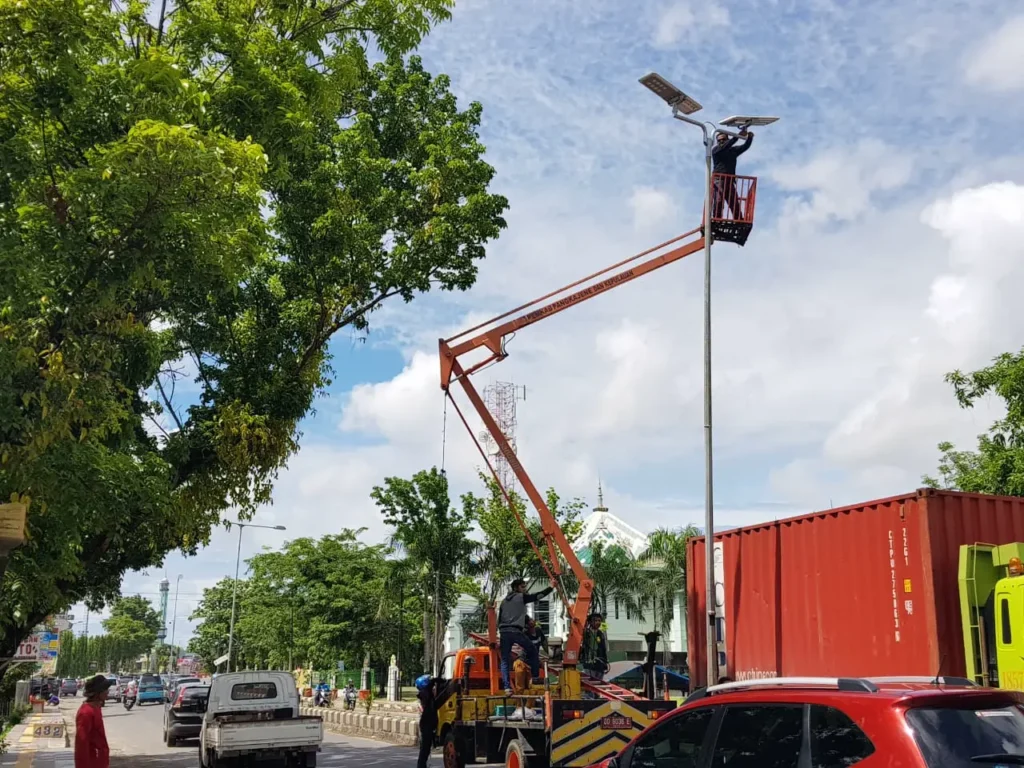
II. Technical Solution Design: Intelligent Adaptation of the SRESKY Atlas Series
The SRESKY Atlas Series solar street lights are purpose-built for tropical environments, offering brightness levels from 2,000 lm to 10,000 lm to accommodate different road widths and installation heights ranging from 3 m to 10 m. The series adopts high-efficiency monocrystalline silicon solar panels to maximize energy conversion. Lithium-ion batteries support charging temperatures from 0°C to 45°C and discharging temperatures from −20°C to 60°C, making them well suited to Indonesia’s hot and humid climate.
To address local environmental challenges, SRESKY integrates several targeted technologies:
ALS 2.2 Core Technology:
Under Indonesia’s dense cloud cover and frequent rainfall, ALS 2.2 dynamically adjusts light output to ensure uninterrupted illumination for more than 10 consecutive days. By continuously monitoring sunlight intensity, the system optimizes energy allocation and prevents rapid battery depletion commonly seen in conventional solar streetlights. Field tests show that ALS 2.2 extends lighting duration by over 30%, effectively eliminating blackout risks on major roads.
TCS Temperature Control System:
With ambient temperatures often exceeding 30°C, battery overheating and accelerated degradation are major concerns. The TCS system provides real-time thermal protection, activating at 45°C during charging and 60°C during discharging. Through intelligent heat dissipation and voltage regulation, it extends battery cycle life to more than 1,500 cycles. Compared with standard lithium batteries, TCS reduces capacity loss by approximately 20%, ensuring stable long-term performance in extreme climates.
BMS Efficient Charging:
The integrated Battery Management System (BMS) improves charging efficiency by more than 30%, enabling rapid energy recovery during Indonesia’s limited sunshine hours. Even under cloudy conditions, monocrystalline silicon panels effectively harvest low-light energy. This capability is particularly valuable in regions with extended rainy seasons, allowing streetlights to restore full charge quickly.
PIR Smart Sensing:
A built-in 120° wide-angle PIR sensor with an 8 m detection range enables intelligent energy-saving operation. The lights brighten to full output when movement is detected and dim when the area is unoccupied. In arterial road applications, this approach reduces unnecessary energy consumption while maintaining safety. The Atlas Series uses OSRAM 3030 LED chips with an efficiency of up to 230 lm/W and a color temperature of 5700K (Ra > 70), delivering natural white light and uniform road coverage with Type II light distribution.
Structurally, the luminaires feature an aluminum alloy and PC housing with IP65 waterproof and IK08 impact-resistance ratings, ensuring corrosion resistance and durability. The dual-head lateral extension design expands single-pole illumination coverage to 32 m, improving lighting uniformity while reducing the number of poles required and lowering overall project costs. This comprehensive integration positions the Atlas Series as a benchmark for tropical solar street lighting, ideally suited to Indonesia’s urban arterial roads.
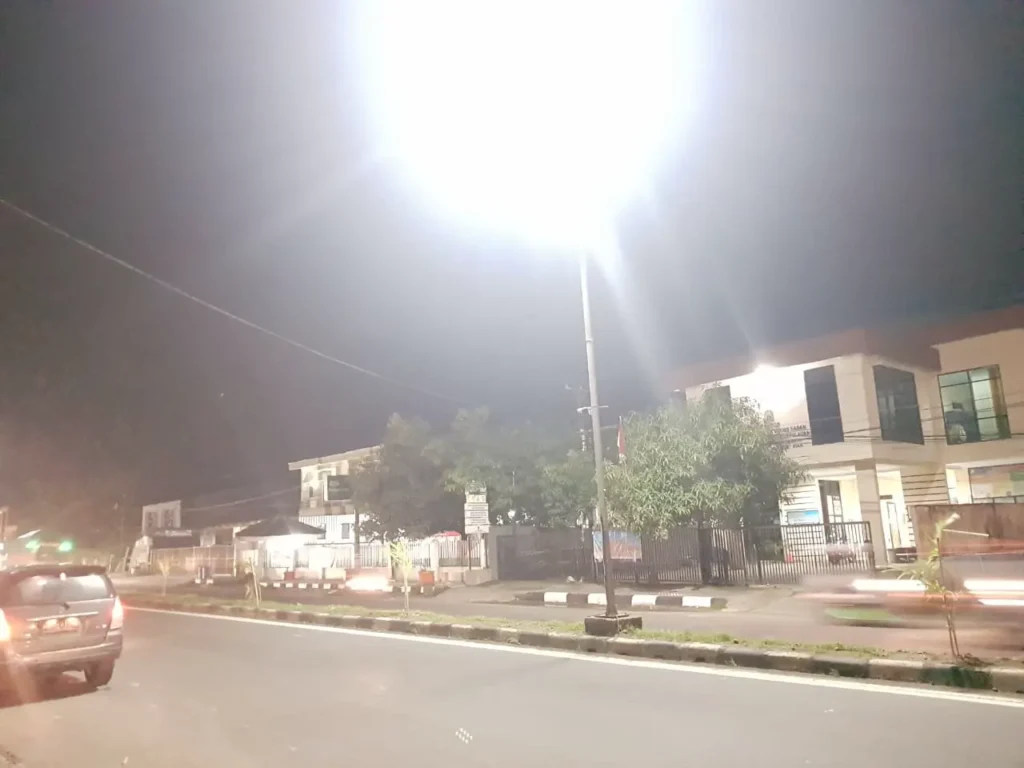
III. Project Implementation and Deployment
Project execution emphasizes efficiency and localization, avoiding the complexity of conventional grid-connected lighting systems. The Atlas Series requires no trenching or cable laying and can be rapidly mounted on light poles using integrated brackets. Installation follows a streamlined process: first, excavate a pit based on the foundation cage dimensions and secure it with C20 concrete; second, attach the bracket and luminaire with screws; finally, hoist the pole manually or mechanically, align the flange, and tighten. Overall construction time is reduced to approximately one-third of traditional methods, significantly lowering labor costs.
Even under heavy cloud cover, the monocrystalline silicon panels efficiently capture diffuse light to charge the batteries. At night, the streetlights deliver stable and consistent illumination. High-efficiency 230 lm/W LEDs improve visibility at residential-to-main-road junctions, making vehicle movement clearer and reducing accident risk. Maintenance is simplified through a modular design that allows direct replacement of components—such as batteries or LED modules—on the pole itself, minimizing operational costs.
Additionally, SRESKY provides a Super Remote Controller that supports DIY parameter configuration, enabling local teams to adjust lighting modes easily. Available settings include:
-
M1: 30% brightness with PIR until dawn
-
M2: 100% for 5 hours + 25% PIR for 5 hours + 70% until dawn
-
M3: 70% brightness until dawn
IV. Project Outcomes and Impact
The project has delivered outstanding results. From a social perspective, improved nighttime lighting has reduced traffic accidents by more than 20%, significantly enhancing public safety and quality of life. Environmentally, the Atlas Series operates entirely on solar energy, achieving zero carbon emissions. Its high-efficiency design provides strong illumination with minimal energy consumption, directly supporting Indonesia’s green transition objectives.
As a model of sustainable infrastructure development, the solution has been deployed across multiple Indonesian cities, contributing meaningfully to national carbon reduction commitments. Economic benefits are equally compelling: compared with conventional grid-powered streetlights, the system delivers annual cost savings of approximately 30% through reduced electricity consumption and lower maintenance requirements. SRESKY’s three-year warranty further minimizes investment risk. Overall, this case demonstrates how solar street lighting can elevate infrastructure standards while offering municipal clients a reliable and attractive return on investment.
V. Risks and Mitigation Strategies
Despite its success, tropical environments inherently present risks. Extreme heat can accelerate battery aging; this is mitigated through the TCS system’s real-time temperature monitoring and automatic adjustment of charging and discharging parameters. Prolonged rainy seasons pose a challenge to lighting continuity; ALS 2.2 addresses this by dynamically reducing output to prioritize operating duration, ensuring illumination for more than 10 days. Maintenance risks are minimized through remote diagnostics using the Super Remote Controller or APP/PC monitoring, allowing operators to check battery status and system performance and implement preventive maintenance.
Together, these measures ensure long-term operational stability. For projects facing similar climatic and infrastructure challenges, the SRESKY Atlas Series represents a proven and highly effective solution.
Table of Contents