
I. Project Background and Requirements Analysis
Located on the eastern Arabian Peninsula, Bahrain experiences a typical tropical desert climate, with an annual average temperature exceeding 30°C. Summer peaks frequently surpass 45°C and can approach 50°C. These extreme temperatures, coupled with frequent sandstorms and low rainfall, pose significant challenges for outdoor electronic equipment—particularly solar streetlight systems. High temperatures accelerate battery degradation, while dust accumulation on photovoltaic panels reduces charging efficiency. The arid environment may also trigger static electricity or corrosion issues. Under such climatic conditions, traditional streetlight systems often suffer from frequent maintenance needs and shortened lifespans.
This project involves a large industrial park in Bahrain, encompassing office buildings, production workshops, cooling towers, and extensive logistics corridors spanning over 100,000 square meters. As part of Bahrain’s national energy transition strategy, the park aims to achieve a zero-carbon green lighting upgrade, aligning with the United Nations Sustainable Development Goals (SDGs) and Bahrain’s Vision 2030. Park management seeks to replace conventional grid lighting with solar streetlights to reduce operational costs while enhancing the facility’s environmental credentials.
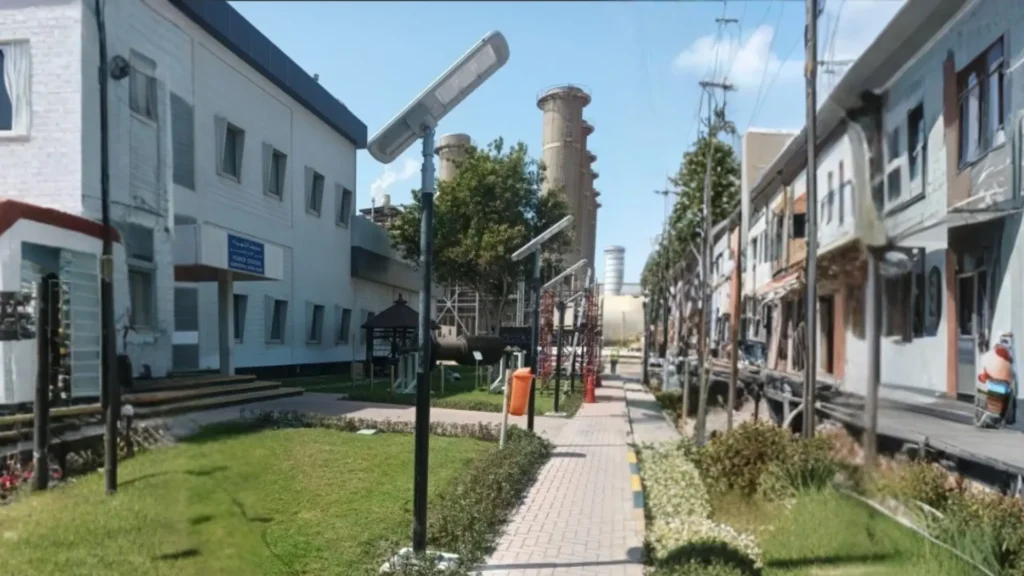
However, the project faces several significant challenges:
-
Impact of extreme heat on batteries: Conventional lithium-ion batteries overheat in temperatures above 45°C, accelerating capacity degradation and posing safety risks. The park experiences prolonged summer heat, requiring streetlights to operate reliably around the clock.
-
High maintenance costs: Frequent dust and sandstorms in industrial zones easily cover photovoltaic panels. Manual cleaning requires working at heights, incurring significant expenses (potentially tens of thousands of dollars annually) and posing safety risks, especially in factories operating three shifts.
-
Stringent safety requirements: Nighttime illumination of sidewalks, vehicle access routes, and production areas must ensure clear visibility to prevent accidents. Streetlights must incorporate intelligent sensing capabilities to adapt to foot traffic patterns and sudden weather changes.
This analysis underscores the necessity of selecting a solar streetlight system that is both heat-resistant and low-maintenance. SRESKY’s THERMOS series stands out in this context, specifically engineered for extreme environments. It integrates high-temperature protection and automated cleaning technology, making it ideally suited for Middle Eastern industrial applications.
II. Technical Solution Design
Addressing the specific requirements of the Bahrain industrial park, the SRESKY team selected the THERMOS series solar street lights and optimized deployment with 4-meter poles. This series offers brightness ranges from 4000LM to 12000LM, supports IP65 waterproofing and IK08 impact resistance, and utilizes aluminum alloy + Panlite PC materials to ensure corrosion and impact resistance in desert environments.
Core Model Selection
For the park’s pedestrian walkways and paved areas, the SSL-72A model is recommended based on the installation height requirement (approximately 4 meters to balance illumination coverage and installation convenience). This model delivers 4000LM brightness, features monocrystalline silicon solar panels and lithium-ion batteries, and provides an illumination range of up to 18 meters at a 4-meter installation height. Compared to higher-wattage models, the SSL-72A delivers uniform Type 4 light distribution at lower installation heights, preventing light pollution while maintaining high energy efficiency.
Key Technical Adaptability
THERMOS series technology directly addresses Middle Eastern high-temperature challenges, ensuring system stability and longevity:
-
Thermal Control System (TCS): This core technology automatically pauses battery charging during abnormal temperature spikes, preventing thermal runaway caused by overcharging. Specifications indicate a charging temperature range of 0–45°C and a discharging temperature range of -20°C to +60°C. Under Bahrain’s summer conditions exceeding 45°C, TCS effectively extends battery life by over 30% compared to conventional systems. Simultaneously, the system monitors battery temperature and dynamically adjusts charge/discharge logic to ensure streetlights maintain over 10 days of endurance during rainy or dusty weather.
-
Automatic Cleaning System (Solar Panel Autoclean): Features an integrated side brush design and automatic cleaning mechanism that activates daily at scheduled times to remove dust and debris. Monocrystalline silicon solar panels achieve over 23% charging efficiency, rapidly restoring full-power charging after sandstorms to prevent up to 50% efficiency loss. This functionality significantly reduces manual maintenance requirements, making it particularly suitable for high-risk industrial environments.
-
Smart Sensing & ALS 2.1 Core Technology: Equipped with a PIR passive infrared sensor (120° detection angle, maximum 8m range) for demand-based lighting—low brightness saves energy when unoccupied and instantly boosts to 100% brightness when motion is detected. The ALS 2.1 (Adaptive Lighting System) algorithm automatically adjusts brightness based on weather conditions. Even during prolonged overcast or dusty periods, it optimizes battery usage to ensure illumination lasts more than 10 days. Flexible lighting modes include M1 (30% PIR until dawn), M2 (5 hours at 100% + 5 hours at 25% PIR + 70% until dawn), and M3 (70% until dawn), customizable to factory operational routines.
-
High luminous efficacy: Utilizes OSRAM 3030 LED chips (96 pcs for SSL-72A), 4000K color temperature, and CRI >70, achieving overall luminous efficacy up to 230 lm/W. This delivers high-definition illumination while minimizing heat generation, further enhancing suitability for high-temperature environments.
III. Project Outcomes and Impact
Following implementation, the project quickly demonstrated significant results, improving lighting quality while advancing the park’s sustainable development goals.
Social Value
The streetlight system provides uniform, high-brightness illumination for nighttime workers and vehicles, substantially reducing accident risks. PIR sensors ensure dynamic lighting response, elevating factory safety management standards in compliance with international safety practices.
Sustainability Metrics
-
Ultra-low maintenance rate: Automatic cleaning and TCS technology reduce operation and maintenance costs by over 60%, lowering inspection frequency from monthly to quarterly.
-
Long-term performance: Battery lifespan is extended to over 3 years (with a 3-year warranty), delivering stable performance in high-temperature environments that far exceeds traditional products.
IV. Risks and Mitigation Strategies
Despite comprehensive project design, potential risks remain in Middle Eastern environments. SRESKY mitigates these through proactive strategies:
-
Risk 1: Battery failure due to extreme heat
Countermeasure: The TCS system automatically switches to protection mode when temperatures exceed 45°C, adjusting charging current to minimum levels to ensure cell safety. Specifications support discharge between -20°C and +60°C, with testing showing capacity degradation of less than 5% per year under high temperatures. -
Risk 2: Sandstorm coverage reducing PV efficiency
Countermeasure: The automatic cleaning function removes dust and debris daily or on schedule without manual intervention. The anti-soiling design of monocrystalline silicon panels ensures charging efficiency above 23%, restoring normal operation within 24 hours after sandstorms. -
Risk 3: Equipment durability in complex industrial environments
Countermeasure: IP65 waterproof and IK08 impact resistance protect against salt spray, vibration, and collisions. Aluminum alloy construction resists corrosion, while the Fault Alarm System (FAS) provides real-time monitoring and remote notifications to maintenance teams.
In summary, the successful deployment of the SRESKY THERMOS series in Bahrain’s industrial zone not only solves lighting challenges under extreme Middle Eastern heat but also establishes a benchmark for sustainable smart lighting.