
I. Project Background and Needs Analysis
The rural road lighting upgrade project in France arises from local governments’ urgent need for sustainable infrastructure. With the advancement of the EU Green Deal, rural areas in France are actively transitioning to low-carbon lighting solutions to reduce energy consumption and environmental impact. The project is located on a typical rural connecting road (Village Connection Road) in central France, linking several remote villages over a total length of approximately 5 kilometers. This road serves not only as a vital route for residents’ daily commutes but also supports agricultural transportation and tourism. However, the road has long lacked effective lighting, leading to frequent nighttime accidents and negatively impacting the local economy and public safety.
1. Project Location: A Village Connection Road in France
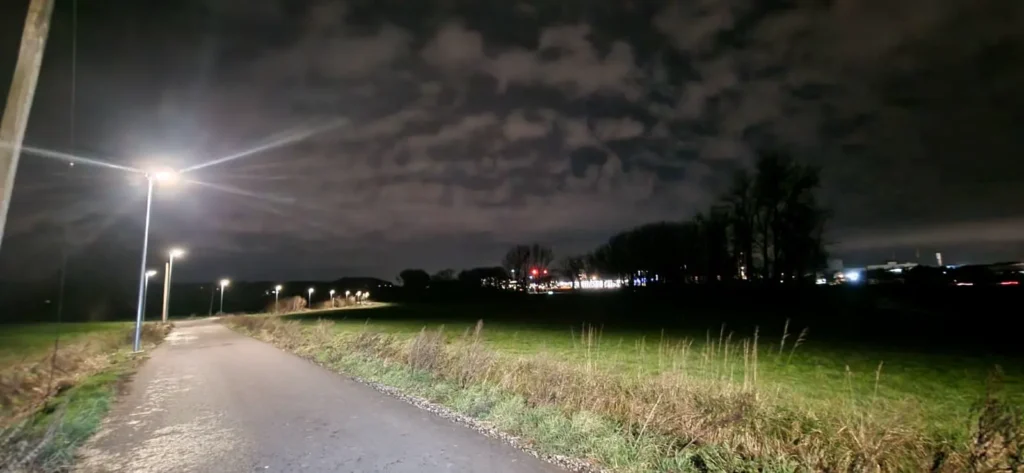
The project is situated in a rural area of central France, where the road traverses vast fields and rolling hills, far from the urban power grid. Traditional wired lighting solutions are impractical here, as trenching and cabling would be costly and environmentally disruptive. The zero-infrastructure installation feature of SRESKY’s Basalt Series solar street lights perfectly meets this need.
2. Project Environment
Geographical Features: The road is flanked by dense grasslands, scattered trees, and rolling hills. While the European rural landscape is picturesque, it presents lighting challenges: tree shadows may interfere with solar charging, and the hilly terrain requires luminaires with wide-angle light distribution to cover curved sections.
Road Conditions: The road is an unpaved gravel surface with a rough texture and low reflectivity. Nighttime visibility is extremely poor for both drivers and pedestrians, increasing the risk of vehicle skidding or falls. The light-absorbing properties of the gravel further amplify lighting requirements, necessitating a high-penetration light source for uniform illumination.
Natural Climate: Some regions of France experience long winters with heavy cloud cover, resulting in an average of only 4–5 hours of sunlight per day. Temperatures can drop below -10°C, posing severe challenges to battery performance and charging efficiency. Summers may bring high temperatures and strong winds, so the luminaires must be both wind-resistant and corrosion-resistant.
3. Core Requirements
-
Zero Infrastructure Costs: Rural roads have complex topography, and excavation and cabling would disrupt agricultural land. A fully independent solar lighting solution that requires no external power connection is essential.
-
High Reliability: The equipment must withstand cloudy, rainy, and cold weather to ensure uninterrupted lighting year-round, with the goal of providing illumination for over 10 consecutive days of overcast or rainy conditions.
-
Environmental Integration: The luminaires must feature a minimalist, modern design that harmonizes with the tranquil rural landscape. Industrial-style aesthetics should avoid disrupting the scenery while providing sufficient brightness (recommended 10,000 lm or higher) to enhance safety.
-
Safety: With an installation height of 7 meters, the luminaires must provide wide coverage and strong penetration. Luminous efficacy should reach 230 lm/W or higher to reduce glare and optimize visibility for drivers.
These requirements point directly to the SRESKY Basalt Series. Models such as the SSL-910A and SSL-912A, with luminous flux ranging from 10,000 lm to 12,000 lm, perfectly meet rural road lighting standards for a 7-meter installation height.
II. Technical Solution Design
To address the unique challenges of the French project, the SRESKY team selected the Basalt Series of solar street lights. Centered on an integrated design and patented technology, this series is tailored for harsh environments and has proven effective in numerous similar projects worldwide.
1. Selection Logic
Product Series: Based on the 7-meter installation height and road width, the SSL-910A (10,000 lm) and SSL-912A (12,000 lm) models are recommended. These luminaires are equipped with monocrystalline silicon solar panels and lithium-ion batteries, with a charging time of only 8.4–10 hours, ensuring highly efficient energy conversion.
Core Technology Applications:
-
ALS 2.2 Patented Technology: This intelligent power regulation system automatically optimizes lighting modes based on remaining battery charge, even under France’s cloudy and rainy conditions. When battery power is low, the ALS system reduces output to 30% (PIR sensor mode), ensuring the luminaire continues to function for over 10 consecutive days of rain and cloud cover.
-
TCS Temperature Control System: Designed for Europe’s cold winters, TCS technology ensures stable operation within a discharge temperature range of -20°C to +60°C. The modular lithium-ion battery prevents capacity degradation at low temperatures and extends the cycle life to over 2,000 cycles.
-
Scientific Light Distribution Design: The Basalt Series utilizes OSRAM LED chips with a color temperature of 4000K, Ra > 70, and luminous efficacy of 230 lm/W. Its Type 4 light distribution pattern is optimized for gravel surfaces, providing high-penetration beams with coverage distances of 45–54 meters, reducing visual fatigue caused by uneven road surface reflections.
2. Industrial Design Advantages
The Basalt Series features an integrated aluminum alloy frame and tempered glass, with IP65/IK08 protection ratings for corrosion and wind resistance. The frame evenly distributes stress and features high-impact resistance capable of withstanding hurricane-force winds common in open rural areas of France. The PIR sensor covers a 120° angle and 8-meter range, supporting motion-sensing mode for energy savings.
Its sleek, streamlined design blends seamlessly into the rural landscape and allows DIY remote parameter settings, enabling users to customize lighting modes (e.g., M1: 30% PIR until dawn; M2: 100% for 5 hours + 25% PIR for 5 hours + 70% until dawn).
These technologies address project pain points while enhancing overall energy efficiency, meeting EU energy standards.
III. Project Results & Impact
Upon completion, the rural roads in France were transformed, and the performance of the SRESKY Basalt Series exceeded expectations.
At night, the Basalt streetlights cast bright, even light. Even under thick cloud cover, the light penetrates the darkness, clearly outlining roadside trees and distant hills. The gravel texture shimmers in soft illumination, creating a safe yet mystical rural atmosphere. Pedestrians stroll under the warm 4000K glow, and vehicles safely navigate curves—enhancing aesthetics and reducing nighttime driving fatigue.
IV. Risks & Mitigation Strategies
Although the project was successful, potential risks were proactively assessed, and strategies were developed:
-
Challenge 1: Prolonged rainy weather causing insufficient charging
Solution: The Basalt Series’ ALS 2.2 technology predicts weather conditions and allocates power automatically. During continuous rain, the luminaires maintain low-light or motion-activated high-brightness states, ensuring uninterrupted operation. -
Challenge 2: Structural loosening due to gravel road vibrations
Mitigation: Using an integrated seismic-resistant aluminum frame and C20 concrete base, combined with IK08 protection, ensures equipment stability even under vibration. -
Challenge 3: Difficulty in post-installation maintenance
Mitigation: The FAS system provides indicator alerts and remote diagnostics, enabling maintenance personnel to quickly locate issues. SRESKY offers a 3-year warranty and remote support.
These measures ensure long-term reliability.
V. Conclusion
The successful implementation of the SRESKY Basalt Series in this French rural project validates the adaptability of solar streetlights in complex geographical and climatic conditions. It highlights the value of green lighting in promoting rural revitalization and ecological conservation. Through the power of “light,” a sustainable and safe path has been paved along the ancient cobblestone roads of France.
Table of Contents