
Brunei’s Green Opportunity for Smart Agriculture Transformation as the “Forest Nation”
Brunei Darussalam, located in northern Borneo, is covered by more than 70% tropical rainforest, earning it the title of “Forest Nation.” However, as the population grows and the economy diversifies, the Brunei government is advancing the “Wawasan Brunei 2035” initiative, emphasizing agricultural modernization to reduce reliance on petroleum. Within this context, smart agriculture is emerging—integrating precision irrigation, IoT monitoring, and optimized nighttime operations. Yet farm lighting, a basic but critical component, faces severe challenges in tropical climates: high temperatures, frequent rainfall, and persistent humidity often cause traditional lighting systems to fail, compromising safety and productivity.
Green infrastructure presents a pivotal opportunity for change. Solar street lights, with self-powered systems and low-maintenance advantages, align perfectly with Brunei’s environmental philosophy. According to the International Energy Agency (IEA), solar applications in Southeast Asia could reduce carbon emissions by more than 20%. The successful deployment of SRESKY’s SSL-06M series solar street lights in Brunei’s agricultural projects not only solves lighting challenges but also injects momentum into sustainable farming development. Optimized for tropical environments with advanced algorithms and durable materials, the series helps farms transition from traditional operations to smart management. The project details below illustrate how SRESKY has become a trusted partner for green agricultural lighting in Southeast Asia.
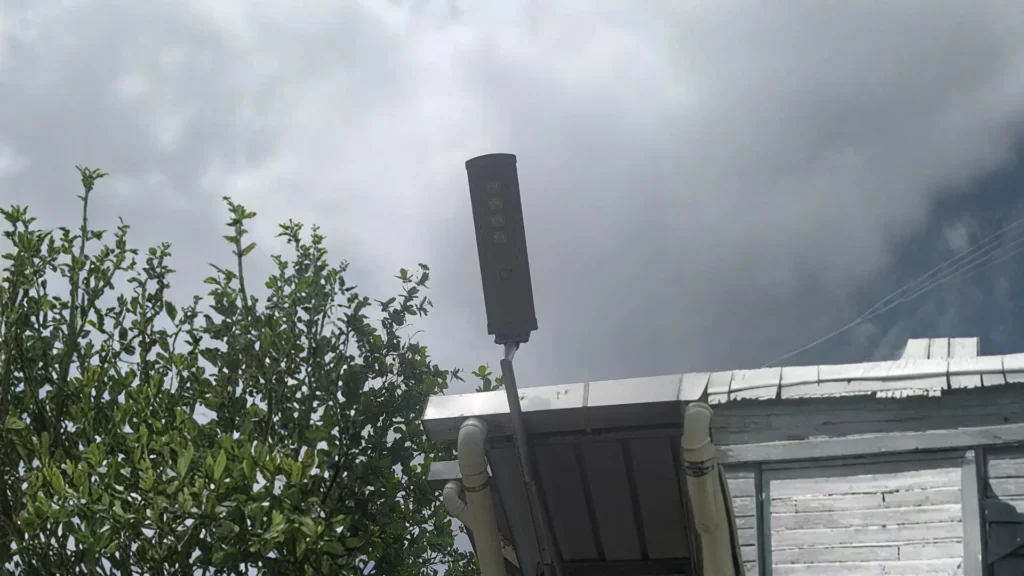
Project Background: The “Three Challenges” of Farm Lighting (Difficult Power Access, Maintenance Difficulties, Moisture Resistance)
Most farms in Brunei lie at the edges of rainforests and share similar climate characteristics: average annual temperatures of 28–32°C, humidity exceeding 80% year-round, and rainfall surpassing 2,000 mm during the rainy season. This environment intensifies the “three challenges” facing lighting systems.
First, limited power access. Farm buildings are scattered and remote. Laying power cables across dense vegetation and wetlands requires costly engineering (potentially tens of thousands of dollars per kilometer) and risks soil erosion and crop damage. Although national power supply is generally stable, frequent thunderstorms increase outage risks and disrupt nighttime operations.
Second, maintenance difficulties. Traditional outdoor fixtures require periodic circuit inspections and bulb replacements. On large, sparsely staffed farms, maintenance response times are slow. High humidity accelerates component aging, with annual maintenance costs sometimes reaching 30% of total operating expenses.
Finally, poor moisture resistance. Warm, moisture-laden rainforest air easily infiltrates poorly sealed fixtures, causing short circuits and even fire hazards. According to Brunei Meteorological Department data, more than 100 days of thunderstorms occur during the rainy season—further testing lighting durability.
This project originated from a large plantation that needed consistent illumination along approximately 500 meters of pathways serving warehouses, dormitories, and processing areas. After evaluation, the SRESKY team identified the ideal solution: wireless installation, corrosion resistance, and integrated smart control. The SSL-06M series, with its all-in-one design, became the key to addressing these three challenges.
Technical Adaptability Design: Why SSL-06M Is the Optimal Solution for Extreme Humidity?
Brunei’s extreme humidity requires lighting solutions that combine structural durability with intelligent control. The SRESKY SSL-06M solar street-light series—engineered for tropical climates—delivers precisely that. Its core strengths directly tackle local pain points: independence from the grid, easy installation, and strong corrosion resistance.
The SSL-06M integrates the solar panel, battery, and lamp head into a single compact unit, eliminating many connection failures typical of split systems. Its moderate power output supports low-to-medium intensity farm lighting, while its IP65 waterproof rating ensures reliability during the rainy season. Compared with competing products, the SSL-06M uses the ALS 2.4 system to automatically optimize power distribution according to lighting conditions, enabling 5–7 days of operation even during cloudy weather.
It is optimal because it was purpose-built for conditions like Brunei’s:
-
Wall-mounted installation adapts easily to dispersed farm buildings
-
High photovoltaic conversion efficiency (>18%) captures scattered sunlight
-
TCS temperature control prevents heat-related battery degradation
Field tests show that the SSL-06M maintains a failure rate below 1% under simulated Brunei humidity—far outperforming standard solar lights. This design reduces initial infrastructure investment by up to 50% while improving long-term reliability, shortening ROI to just 2–3 years.
Core Technology Highlights Breakdown
Flexible Wall-Mount Installation: Cost-Effective Retrofit for Existing Structures
Most farms rely on existing buildings, making new pole construction costly. The SSL-06M includes a durable metal bracket that mounts directly to walls or pillars and supports multi-angle adjustment. Installation requires only bolt anchoring and typically takes less than 30 minutes per fixture. This approach protects landscapes, avoids soil disturbance, and ensures structural stability. The bracket supports up to 20 kg and withstands winds up to Beaufort scale 8—ideal for Brunei’s frequent storms.
Matrix Circular Lamp-Head Design: Balanced Heat Dissipation and Light Distribution
The lamp head features multiple circular LED modules arranged in a matrix, each with a dedicated lens. This delivers a 120° wide-angle spread, eliminating dark zones along pathways. The circular structure increases heat dissipation area, improving convection by 30% and keeping LED chip temperatures below 60°C, extending lifespan beyond 50,000 hours. A high color-rendering index (CRI>80) enhances nighttime visibility, reducing operational mistakes. With luminous efficacy reaching 150 lm/W, the design achieves excellent energy performance.
All-Weather Stability: Endurance Algorithm for Brunei’s Rainy Climate
Frequent rainy conditions challenge solar charging. The SSL-06M integrates the ALS 2.4 adaptive lighting system, which monitors ambient light in real time and dynamically adjusts brightness—charging fully on sunny days and conserving power on cloudy days. TCS technology regulates battery temperature, preventing capacity loss from overheating. Optimized lithium batteries support up to 7 consecutive rainy days of operation. PIR motion sensing further enhances efficiency: dim when idle, bright instantly when motion is detected (response time <0.5 seconds). Altogether, the algorithm reduces unnecessary lighting by up to 80% while maintaining 24/7 security.
These strengths make the SSL-06M highly competitive across Southeast Asia’s tropical markets, and it has earned multiple international certifications such as CE and RoHS.
Conclusion: SRESKY Powers Sustainable Agricultural Development in Southeast Asia
The Brunei farm project demonstrates the strong potential of SRESKY’s SSL-06M series in tropical agriculture. It illuminates not only farm pathways—but also the broader path toward smart, sustainable agricultural transformation. As a driving force in Southeast Asia’s green transition, SRESKY continues delivering tailored lighting solutions that empower farms on their journey toward sustainable growth.