
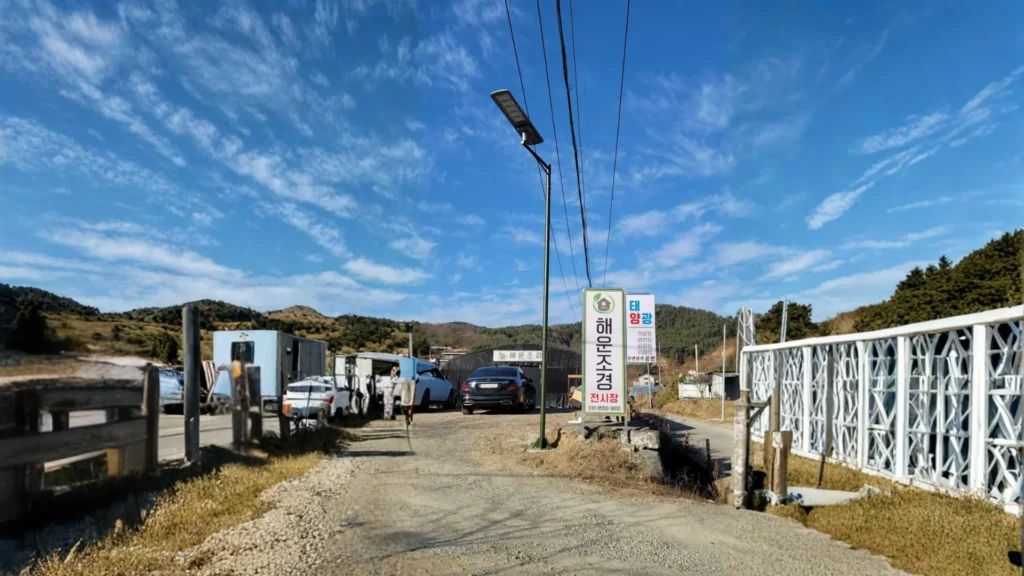
In today’s era of sustainable development, landscape lighting has moved beyond simple functionality to become a key element that reflects ecological values and artistic aesthetics. The “Haewoon Landscape” Exhibition Site in suburban Korea — a center dedicated to landscape design — successfully implemented an efficient, eco-friendly nighttime lighting solution by introducing SRESKY’s Basalt Series solar street lights.
I. Project Background & Needs Analysis
1.1 Geographic & Environmental Context
Located in a densely green zone near Seoul, the Haewoon Landscape Exhibition Center features expansive lawns, intricate garden sculptures, and diverse plant displays. Key environmental features include high green coverage (over 70%), low building density, and abundant sunlight (around 2,000 hours annually).
However, Korea’s variable climate presents challenges: winters can drop to −15°C with heavy snowfall, while summers are marked by intense rainfall and typhoons with wind speeds exceeding 30 m/s. These conditions impose strict requirements on weather resistance and system stability. Traditional wired streetlights frequently malfunction due to cable aging or weather damage, whereas solar streetlights can leverage abundant sunlight to achieve zero-emission illumination.
1.2 Core Requirements Analysis
As a landscape exhibition center, the lighting system must integrate seamlessly with garden aesthetics without disturbing existing landscapes. At the same time, the suburban location creates infrastructure constraints: cable-laying requires excavation, which is costly (about $5,000 per kilometer) and damages carefully designed vegetation and soil.
All-weather reliability is critical — the site must maintain nighttime security, signage visibility (including the “해운조경 전시장” identifier), and pathway guidance, ensuring more than 10 days of continuous lighting even during prolonged rainy periods or short winter days.
Maintenance efficiency is equally important. The system must include intelligent diagnostics and remote control to reduce manual inspections, as traditional systems often incur annual maintenance costs reaching 10% of total equipment value.
II. Technical Solution Design
2.1 Product Selection: SRESKY Basalt Series
To meet the project’s specific needs, the SRESKY Basalt Series integrated solar street lights were selected. Offering brightness from 4,000 to 12,000 lumens, they suit pathways and exhibition zones of different scales. The light output is soft and natural, enhancing the artistic atmosphere of landscaped environments.
2.2 Core Technology Adaptability
ALS 2.2 Adaptive Lighting System:
ALS 2.2 uses intelligent algorithms to monitor available light and dynamically adjust power output. Even under cloudy or rainy conditions, it maintains more than 10 days of illumination — particularly suited to Korea’s overcast winters — preventing shutdown due to insufficient charging.
TCS Temperature Control System:
TCS protects batteries within safe charging and discharging ranges, minimizing capacity loss caused by extreme temperatures. While harsh winters can reduce standard battery efficiency by up to 30%, TCS extends battery life beyond 10 years through real-time monitoring and protective mechanisms.
Integrated Aluminum Alloy Frame:
Constructed with high-strength aluminum alloy and tempered glass, the lights achieve IP65/IK08 protection levels. The structure distributes stress evenly and resists strong winds and corrosion without disrupting the landscape aesthetic.
Professional Optical Design:
Type-4 optical distribution paired with PIR sensors (120° detection, up to 8 m) delivers precise motion-activated lighting. Uniform illumination minimizes dark zones while achieving high efficiency (230 lm/W).
III. Project Outcomes & Impact
3.1 Technical Adaptability Validation
After deployment, the Basalt Series achieved charging times of 6.7–10 hours under sunny conditions. The FAS automatic fault alarm system allows maintenance teams to quickly identify issues. During winter testing, stable illumination at 4000K ensured clear visibility even with bare trees.
3.2 Social Value & Brand Empowerment
The project has become a low-carbon benchmark for Korea’s landscaping sector, reinforcing Haewoon Landscape’s sustainability commitment. High-brightness illumination increases nighttime safety, reducing accident risk by roughly 20% and raising awareness of the SRESKY brand.
3.3 Economic & Sustainability Benefits
Zero electricity costs save approximately $2,000 per fixture annually. A three-year warranty and service life exceeding 10 years deliver a payback period of under three years, followed by near-zero maintenance. Compact packaging (e.g., SSL-94A carton 915 × 160 × 445 mm, N.W. 7.8 kg) simplifies logistics.
IV. Risks & Mitigation Strategies
4.1 Environmental Risk: Winter Cold & Snow Accumulation
Low temperatures may freeze batteries or block panels with snow. The TCS system automatically activates protection mode, while tilted panel design helps snow shed and maintains charging efficiency above 80%.
4.2 O&M Risk: Difficult Fault Monitoring
Remote suburban sites complicate on-site inspections. The FAS indicator and remote-control functions support fast diagnostics and parameter adjustments, reducing the need for field visits.
V. Conclusion
The successful installation at South Korea’s “Haewoon Landscape” exhibition site clearly demonstrates the outstanding performance of the SRESKY Basalt Series solar street lights in complex climates and high-aesthetic environments. It represents not merely a lighting upgrade, but a seamless integration of green technology and landscape artistry.