
I. Project Background and Needs Analysis
As a member of the European Union, Spain is actively promoting the “Green Deal” and smart city development. This road lighting upgrade project aims to enhance safety and sustainability in suburban areas and on mountainous and hilly connecting roads. The project covers multiple road sections, from the suburbs surrounding Madrid to the mountainous regions of Andalusia, with a total length of approximately 20 kilometers. These routes serve not only as daily transportation arteries but also connect tourist attractions and agricultural areas. Previously, insufficient nighttime lighting led to frequent accidents. The introduction of the SRESKY Basalt Series is specifically designed to address the high costs and environmental impact associated with traditional lighting.
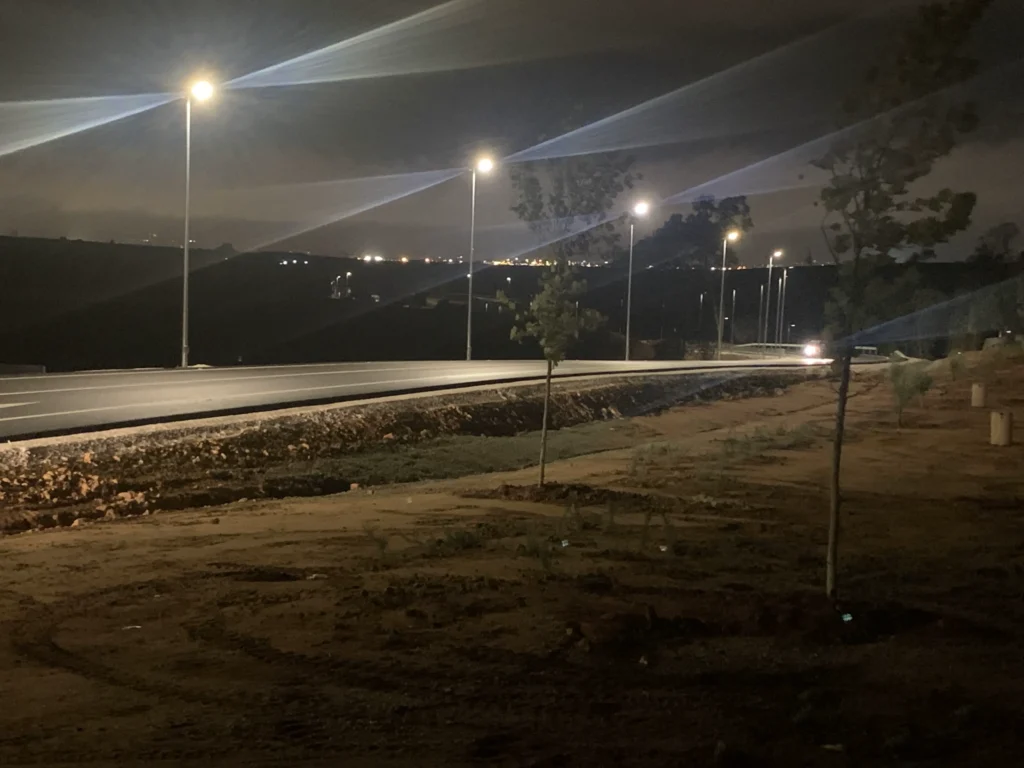
1. Project Location: Spain (covering suburban and mountainous/hilly connecting sections)
The project focuses on the south-central region of Spain, where roads extend from flat suburban areas into rugged mountainous terrain, far from the main power grid. This requires a self-sufficient lighting solution that does not rely on extensive cabling. The solar-powered, integrated design of the Basalt series makes it an ideal choice, enabling rapid deployment without disrupting existing infrastructure.
2. Project Environment
- Geographical Features:
The roads traverse typical European hilly terrain, consisting of winding, steeply sloped paths bordered by unpaved edges prone to wind and sand erosion. This terrain complicates lighting coverage and requires luminaires with a wide beam angle to illuminate blind spots on curves. - Traffic Conditions:
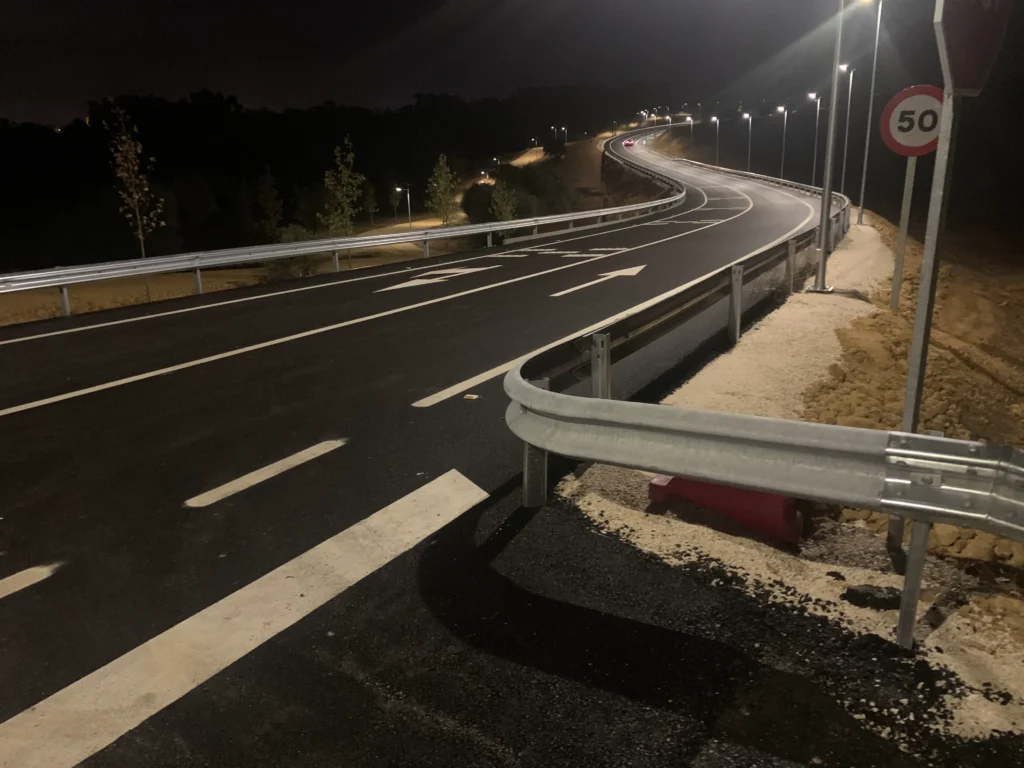
Road conditions are complex, including curves, steep slopes, and long straight sections, with a typical speed limit of 50 km/h. At night, drivers must clearly identify lane markings and guardrails. However, unpaved road edges can generate dust, reducing visibility. This places higher demands on lighting penetration and uniformity. - Climate Challenges:
Spain enjoys abundant sunshine, with an average annual sunshine duration exceeding 2,500 hours. However, summer temperatures can exceed 40°C, while winters occasionally bring rain and strong winds. High temperatures accelerate battery degradation, and rainy conditions reduce solar charging efficiency. Therefore, the equipment must offer excellent weather resistance and operational stability.
3. Core Requirements
- Traffic Safety Assurance:
High-intensity, uniform lighting is required—especially on curves—to ensure drivers can clearly identify lane markings, guardrails, and speed limit signs. The target illuminance is 20–30 lux on average, with glare control to improve nighttime driving comfort. - Reduced Infrastructure Costs:
By eliminating complex underground cabling and using solar-powered plug-and-play installation, the system is well suited for remote mountainous areas and helps reduce municipal investment. - Weather Resistance and Stability:
The system must withstand high temperatures, strong winds, and rain, while ensuring continuous illumination for more than 10 days and supporting remote monitoring for maintenance.
These requirements align closely with the capabilities of the SRESKY Basalt Series, particularly the SSL-912A model, which stands out with its 12,000-lumen output and intelligent control systems.
II. Technical Solution Design
Considering Spain’s diverse terrain and climate, the project team selected the SRESKY Basalt Series solar street lights, with a focus on the SSL-912A model. This model delivers 12,000 LM and integrates high-efficiency monocrystalline silicon solar panels and lithium-ion batteries, achieving a full charge in approximately 10 hours.
1. Application of Core Patented Technologies
- ALS 2.4 Smart Lighting Technology:
During extended periods of rain or dust, the ALS 2.4 system intelligently adjusts power output and optimizes lighting modes based on remaining battery capacity (e.g., M1: 30% brightness with PIR until dawn). It ensures continuous illumination for over 10 days, preventing outages during Spain’s rainy winter periods. - TCS Temperature Control System:
Designed for high-temperature environments, TCS maintains battery operation within a charging range of 0°C to 45°C and a discharge range of -20°C to +60°C, preventing overheating damage. The modular lithium-ion battery supports over 2,000 cycles, significantly extending service life. - FAS Fault Alarm System:
This system automatically detects component failures and signals issues via indicator lights. In remote mountainous regions, it enables fast fault identification and reduces maintenance costs.
2. Industrial-Grade Structural Design
- Integrated Aluminum Frame:
Built with aluminum alloy and tempered glass, the structure features IP65 waterproof and IK08 impact resistance ratings. It distributes stress evenly and provides excellent resistance to wind and external impact, making it suitable for harsh environments. - Scientific Light Distribution Design:
The SSL-912A uses OSRAM LEDs with a 4000K color temperature, Ra > 70, and a luminous efficacy of up to 230 lm/W. Its Type IV light distribution ensures wide coverage—up to 54 meters at a 12-meter installation height—while maintaining strong light penetration and uniform illumination across both curves and straight sections.
These features enhance durability while optimizing energy efficiency, fully complying with Spain’s energy-saving standards.
III. Project Results and Impact
After implementation, the road lighting system demonstrated significant improvements, with the Basalt series exceeding expectations.
1. Visual and Safety Performance
- Improved Curve Visibility:
On roads with a 50 km/h speed limit, the lighting provides clear guidance, making lane markings and guardrails highly visible. This reduces the risk of nighttime accidents and improves driving safety. - Uniform Illumination Across the Route:
From winding mountain roads to long straight sections, the system ensures consistent brightness and uniform road surface lighting, significantly lowering accident rates.
2. Social and Environmental Value
- Energy Self-Sufficiency:
By utilizing Spain’s abundant solar resources, the system operates entirely on renewable energy, saving approximately €100,000 in annual electricity costs and reducing carbon emissions by around 300 tons. - Sustainability Impact:
With high efficiency and long service life, the SRESKY Basalt Series serves as a benchmark for smart city development in Spain, supporting low-carbon infrastructure and rural modernization.
IV. Risks & Mitigation
Despite the project’s success, potential risks were identified and addressed:
- Challenge: Battery degradation due to high temperatures
Mitigation: The TCS system maintains safe operating temperatures, ensuring stable performance even above 40°C and extending battery lifespan by approximately 20%. - Challenge: Maintenance difficulties in remote mountainous areas
Mitigation: The FAS alarm system, combined with remote diagnostics, allows maintenance teams to monitor and troubleshoot systems efficiently, reducing inspection time by 50%. - Challenge: Light interference from complex road surface reflections
Mitigation: Advanced optical lens design enhances light penetration, minimizes glare, and ensures clear visibility on uneven surfaces.
These strategies ensure long-term system reliability and performance.
V. Conclusion
By deploying the SRESKY Basalt Series solar street lights in this Spanish road project, the team successfully overcame the challenges posed by complex terrain and harsh environmental conditions. At the same time, the project achieves an optimal balance between traffic safety and carbon reduction goals.
This is not just a successful lighting upgrade—it represents a forward-looking model for integrating smart transportation with renewable energy.
Table of Contents