
I. Project Background & Needs Analysis
1.1 Project Background
Israel is globally renowned for its high-tech industries and serves as a benchmark for renewable energy adoption. According to data from the Israeli Ministry of Energy, the country aims to generate 30% of its electricity from renewable sources by 2030, with solar energy playing a pivotal role.
Israel’s climate presents unique conditions: annual sunshine exceeds 3,000 hours, while summer temperatures can surpass 40°C (104°F). In contrast, winter seasons occasionally bring extended overcast and rainy periods. These conditions make Israel an ideal market for solar lighting systems, while simultaneously imposing stringent requirements on product durability and weather resistance.
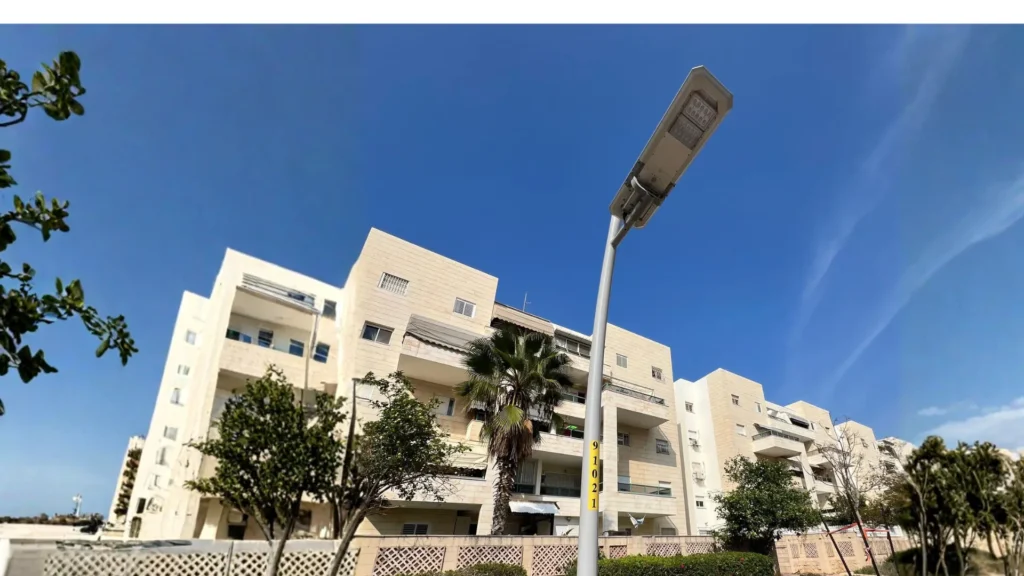
This project is located in a high-end residential community in central Israel, covering approximately 50 hectares. The development includes multi-story apartments, high-rise residences, and expansive landscaped green spaces. The community features modern architectural styles accented by palm trees, manicured hedges, and lawns dotted with yellow flowers, creating a vibrant and livable urban oasis.
During an assessment of the existing lighting infrastructure, property management identified several issues with traditional grid-connected streetlights, including high energy consumption, frequent maintenance needs, and installation methods that disrupted the landscape. In response to the national “Green Israel” initiative, the community decided to upgrade to a solar street lighting system to reduce its carbon footprint while improving residents’ quality of life.
The project involves the installation of approximately 200 solar street lights across internal roads, walkways, and public activity areas, with the goal of building a “zero-carbon” smart community.
1.2 Core Requirements
Project requirements are shaped by Israel’s climate characteristics and the community’s functional and aesthetic expectations, with a strong emphasis on sustainability, intelligence, and long-term reliability. Key requirements include:
-
Low-Carbon Sustainability
The system must operate on 100% solar energy to eliminate fossil fuel dependence, in line with Israel’s renewable energy subsidy policies. High solar conversion efficiency is required to minimize energy loss. -
High-Temperature Tolerance
Extreme summer heat exceeding 45°C demands stable battery and component performance under high temperatures, preventing thermal runaway and performance degradation. -
All-Weather Stability
Although Israel enjoys abundant sunshine, winter conditions may include prolonged rainy periods. The lighting system must provide uninterrupted illumination for at least 10 consecutive rainy days, ensuring year-round reliability with zero outages. -
Installation Simplicity & Aesthetics
Existing landscaped environments restrict large-scale excavation for cabling. Luminaire designs must be minimalist and modern, blending harmoniously with light-colored buildings, palm trees, and green spaces. -
Precision Management
Remote monitoring and parameter adjustment capabilities are required to support fault diagnosis and reduce maintenance costs. Smart sensing features, such as PIR motion detection, are preferred to enable demand-based lighting and further energy savings.
These requirements prioritize not only technical performance but also long-term ROI (Return on Investment), making the solution replicable for similar residential and municipal projects.
II. Technical Solution Design
In response to the project’s requirements, SRESKY recommended the ATLAS Series integrated solar street lights. With brightness options ranging from 2,000 lm to 10,000 lm, the SRESKY ATLAS Series has been deployed in over 3,500 global tender projects, demonstrating proven reliability in diverse and demanding environments.
The solution design focuses on core technology integration and hardware optimization to ensure stable operation under Israel’s high temperatures and intense solar irradiation.
2.1 Core Technology Adaptation
The ATLAS Series integrates multiple patented technologies developed by SRESKY, specifically optimized for high-temperature and high-irradiance environments:
-
TCS Temperature Control System
Designed to address extreme summer heat, TCS continuously monitors battery temperature, supporting charging within a range of 0°C to 45°C and operation from –20°C to 60°C. Intelligent algorithms automatically regulate charging and discharging rates under high temperatures to prevent overheating and battery damage. Field testing shows that TCS extends battery lifespan by more than 30%, significantly exceeding the typical 1,500-cycle lifespan of standard lithium batteries. -
ALS 2.2 Core Technology
During overcast or rainy conditions, ALS 2.2 dynamically adjusts output power to maintain consistent illumination. The system supports more than 10 days of continuous lighting during extended cloudy periods without compromising luminous efficacy. Advanced algorithms intelligently allocate stored energy, prioritizing essential lighting needs—an ideal solution for Israel’s occasional winter cloud cover. -
BMS Battery Management System
The BMS improves charging efficiency by up to 30% and works in conjunction with high-performance lithium batteries to ensure efficient energy storage. It includes overcharge and overdischarge protection, as well as multi-level balanced charging, to maintain long-term battery health. -
Smart Sensing & Operating Modes
An integrated PIR motion sensor (120° detection angle, maximum 8 m range) supports three preset lighting modes:-
M1: 30% brightness with automatic boost upon motion detection until dawn, suitable for low-traffic areas.
-
M2: 100% brightness for the first 5 hours, followed by 25% brightness with PIR activation for the next 5 hours, then 70% brightness until dawn—balancing safety and energy efficiency.
-
M3: Constant 70% brightness throughout the night for high-traffic roads.
In addition, the Super Remote Control allows property managers to customize parameters remotely, enabling seasonal or scenario-based optimization.
-
These technologies collectively enhance system adaptability, reduce energy consumption, and ensure compliance with EU and Israeli energy efficiency standards.
2.2 Hardware Specifications
Hardware configurations are flexibly selected based on road width and lighting requirements, supporting installation heights from 3 m to 10 m and illumination distances from 15 m to 32 m:
-
Luminous Flux & LEDs: 2,000 lm–10,000 lm, 5700 K color temperature, CRI Ra >70, with luminous efficiency up to 230 lm/W. Type II light distribution ensures uniform road illumination.
-
Solar Panel: High-efficiency monocrystalline silicon panels (>23% conversion efficiency) with strong UV resistance, optimized for Israel’s abundant sunlight.
-
Battery: High-performance lithium battery with a charging time of 6.7 to 10 hours. LED indicators display charging and discharging status (red/orange/green flashing).
-
Structure & Protection: Aluminum alloy and PC construction, IP65 waterproof and IK08 impact resistance, with corrosion-resistant design suitable for salt spray environments. Integrated construction minimizes assembly complexity.
-
Additional Features: Ray sensor for automatic on/off control and a 3-year warranty ensuring long-term operational stability.
These specifications are derived from SRESKY’s extensive global project experience. Detailed technical parameters are available in the official downloadable specification sheet.
III. Project Implementation
The integrated design of the ATLAS Series enables rapid installation without cable routing. Only foundation anchoring is required, following these steps:
-
Excavate a foundation pit according to the cage dimensions and secure the cage using C20 concrete.
-
Attach the mounting bracket to the luminaire using the supplied screws.
-
Mount the luminaire onto the pole.
-
Lift the pole manually or mechanically, align it with the foundation cage, and fasten it securely with bolts.
This process avoids road surface damage and preserves the integrity of the community’s green spaces. Overall installation time was reduced to one week, achieving approximately 50% cost savings compared to traditional grid-powered street lighting systems.
IV. Risk & Mitigation
Potential risks and corresponding mitigation strategies provided by the SRESKY ATLAS Solution include:
-
Dust and Salt Spray Corrosion
High-grade aluminum alloy and sealed PC housing with IP65 protection, combined with ALS system battery health feedback. -
Thermal Runaway Risk
TCS continuously monitors temperature and automatically limits charging and discharging under extreme heat to protect battery cells. -
Prolonged Winter Rainy Periods
ALS 2.2 dynamically allocates energy to ensure more than 10 days of continuous illumination. -
Inconvenient Parameter Adjustment
Super Remote Control enables DIY parameter settings for seasonal and operational optimization.
All strategies are validated through rigorous testing, ensuring up to 99.9% system uptime.
V. Conclusion
The successful implementation of this Israeli residential solar street lighting project highlights the exceptional adaptability of the SRESKY ATLAS Series in high-temperature and high-irradiance environments. Powered by patented technologies such as ALS 2.2, TCS, and BMS, the series has evolved from a “reliable lighting solution” into an “intelligent and long-lasting” system.
Whether for residential property upgrades or large-scale government tenders, ATLAS Series solar street lights provide a proven pathway toward zero-carbon goals and sustainable urban development worldwide.
Table of Contents