
Amid the global wave of green energy transformation, Iraq—the ancient cradle of Mesopotamian civilization—faces both significant opportunities and challenges in rebuilding its infrastructure. Power shortages, extreme weather conditions, and accelerated urbanization have made the upgrade of municipal road lighting systems an urgent priority.
This article provides a detailed analysis of Iraq’s municipal solar street lighting project, demonstrating how the SRESKY THERMOS Series solar street lights deliver efficient and sustainable lighting solutions. More than a technical case study, this project represents a scalable model for green infrastructure development across the Middle East.
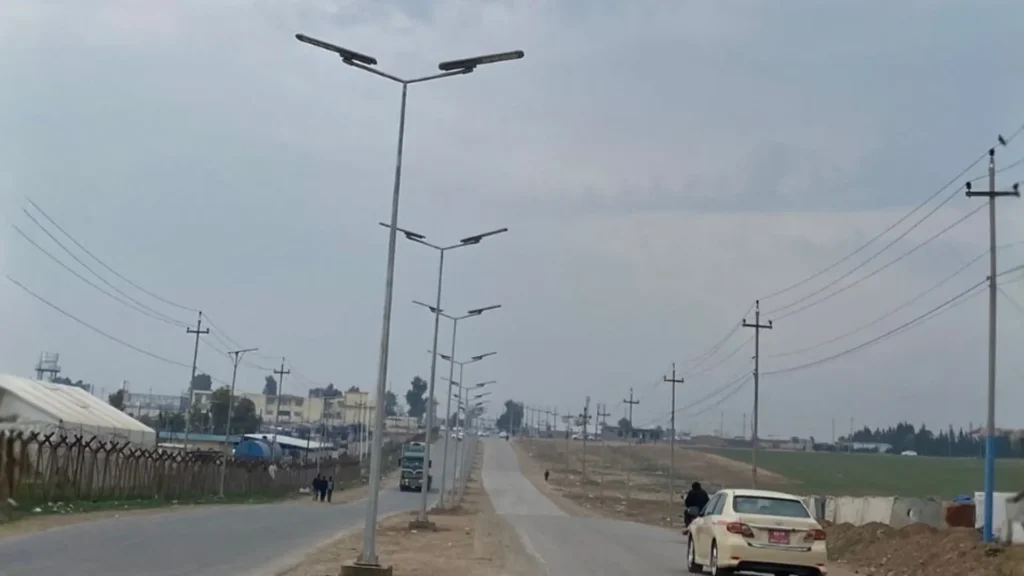
Project Background and Needs Analysis
Following years of conflict and ongoing reconstruction, Iraq’s power infrastructure remains under severe strain. According to World Bank data, national electricity coverage remains below 80%, particularly in remote rural areas and newly developed urban zones. Traditional grid expansion is costly, time-consuming, and often unreliable. Insufficient nighttime lighting not only increases traffic accident risks but also restricts nighttime economic activity and weakens public security.
The project’s requirements focus on several region-specific challenges:
Extreme Heat Challenges:
Summer temperatures in Iraq frequently exceed 50°C (122°F), placing extreme stress on batteries and electronic components. Conventional lithium batteries are prone to thermal runaway under such conditions, resulting in shortened lifespans and potential safety hazards.
Sand and Dust Accumulation:
As a desert region prone to frequent sandstorms, solar panels experience rapid dust accumulation, which can reduce charging efficiency by 20–30% in a short time. This necessitates lighting systems with self-cleaning functionality to reduce reliance on manual maintenance.
Power Constraints and Multi-Scenario Adaptability:
The project must support a wide range of environments, including urban commercial zones, residential districts, rural roads, and major arterial routes. Required luminance levels range from 4,000 lm to 12,000 lm, while maintaining aesthetic consistency and enabling fast installation without complex wiring.
Public Safety Assurance:
High-quality lighting is essential for reducing nighttime accident rates and revitalizing urban activity. Pre-upgrade studies showed nighttime accident rates as high as 15%, with significant reductions expected following the lighting upgrade.
These requirements clearly expose the limitations of traditional lighting systems, making the transition to solar street lighting unavoidable. As a global leader in solar lighting manufacturing, SRESKY, with its THERMOS Series renowned for extreme-environment adaptability, emerged as the optimal solution for this project.
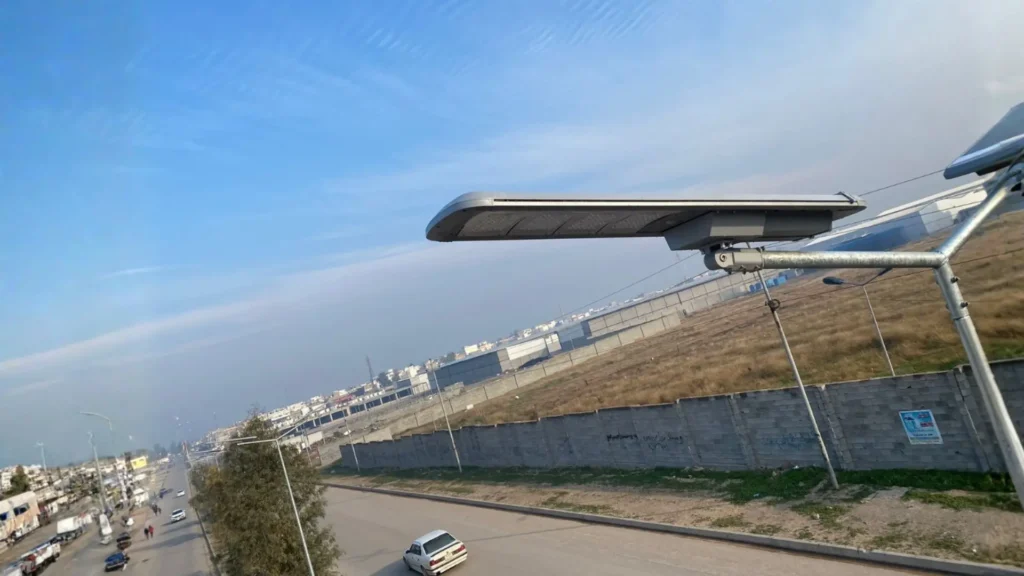
Technical Solution Design: Why Choose the SRESKY THERMOS Series?
Among numerous solar streetlight solutions, the SRESKY THERMOS Series stands out for its performance and reliability. Designed specifically for municipal and urban arterial road lighting, it offers lumen outputs ranging from 4,000 lm to 12,000 lm. Equipped with OSRAM LED chips, the system achieves luminous efficacy of up to 230 lm/W with a color temperature of 4000K (Ra > 70), providing comfortable and natural illumination.
Its suitability for Iraq’s environment lies in the following core technologies:
Solar Panel Autoclean Technology
To combat frequent sandstorms, the THERMOS Series integrates an automatic solar panel cleaning system. Side brushes and programmed vibration cycles regularly remove accumulated dust, maintaining optimal charging efficiency. Combined with monocrystalline silicon panels exceeding 23% conversion efficiency, the system rapidly recovers performance after sandstorms, significantly reducing maintenance frequency and labor costs—an essential advantage in regions with limited manpower.
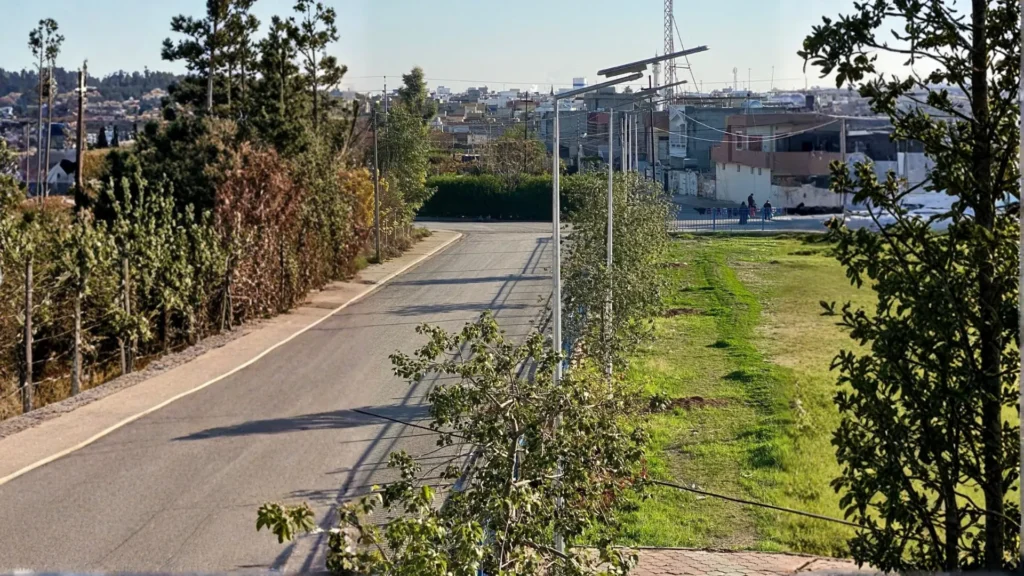
Dual Temperature Control System (TCS & Automatic Heating Function)
Thermal Cut-off System (TCS):
The integrated Temperature Control System automatically suspends battery charging under extreme heat conditions, preventing thermal damage. Compared with standard LiFePO₄ batteries, TCS extends battery lifespan to over 2,000 cycles. Even at ambient temperatures above 50°C, capacity degradation is controlled within 5%.
Automatic Heating Function:
While Iraq is known for high temperatures, winter nights in northern regions can drop to −20°C. The automatic heating system ensures stable battery operation in cold conditions, supporting charging between 0°C and 45°C and discharging between −20°C and +60°C. This guarantees reliable year-round performance across diverse climates.
Intelligent Management System (ALS & PIR)
The THERMOS Series incorporates patented ALS 2.1 technology, enabling continuous operation for more than 10 days during extended rainy periods. Intelligent algorithms dynamically adjust brightness to optimize energy usage. Integrated PIR motion sensors (120° detection angle, 8 m range) reduce brightness to 30% when no movement is detected and increase output to 100% upon activity. The Super Remote Controller allows DIY parameter configuration, including custom lighting modes such as M1 (PIR mode until dawn) and M2 (5 hours at 100% + PIR + 70% until dawn).
High-Specification Durability
The luminaires feature IP65 waterproof and IK08 impact-resistance ratings. An aluminum alloy housing combined with Panlite PC material ensures resistance to UV aging and harsh outdoor conditions. Lithium-ion battery capacity ranges from 269.36 Wh to 769.6 Wh, with charging times between 8 and 9.6 hours. Installation heights range from 4 to 12 meters, with pole spacing from 18 to 54 meters, compatible with Φ60 mm poles. The integrated FAS (Fault Alarm System) provides real-time monitoring for rapid maintenance response.
These technologies are fully integrated into a unified system, delivering zero electricity costs and low-maintenance operation. Compared with traditional grid-connected streetlights, the THERMOS Series requires no trenching or wiring, reducing installation costs by more than 30%.
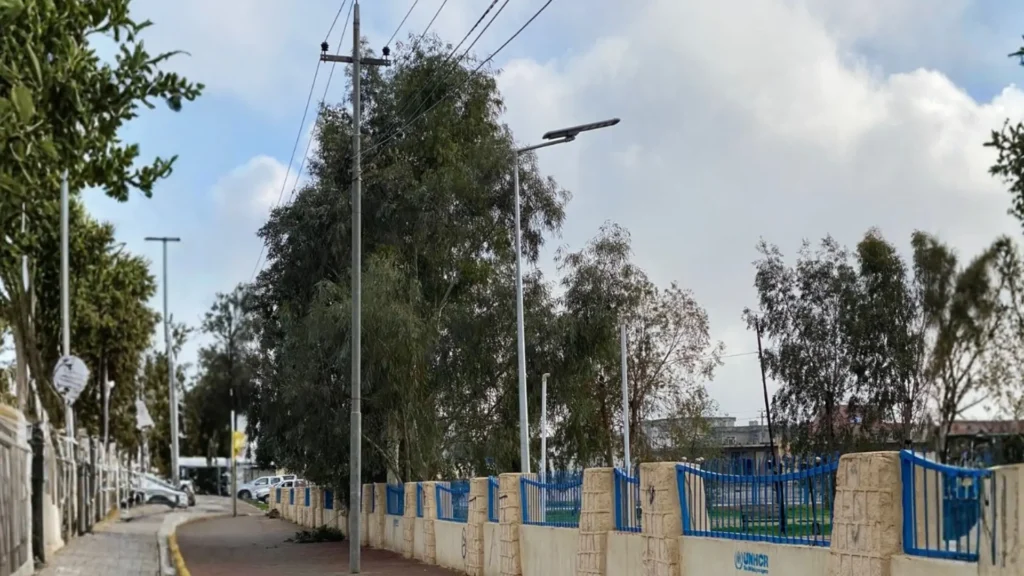
Project Implementation and Deployment
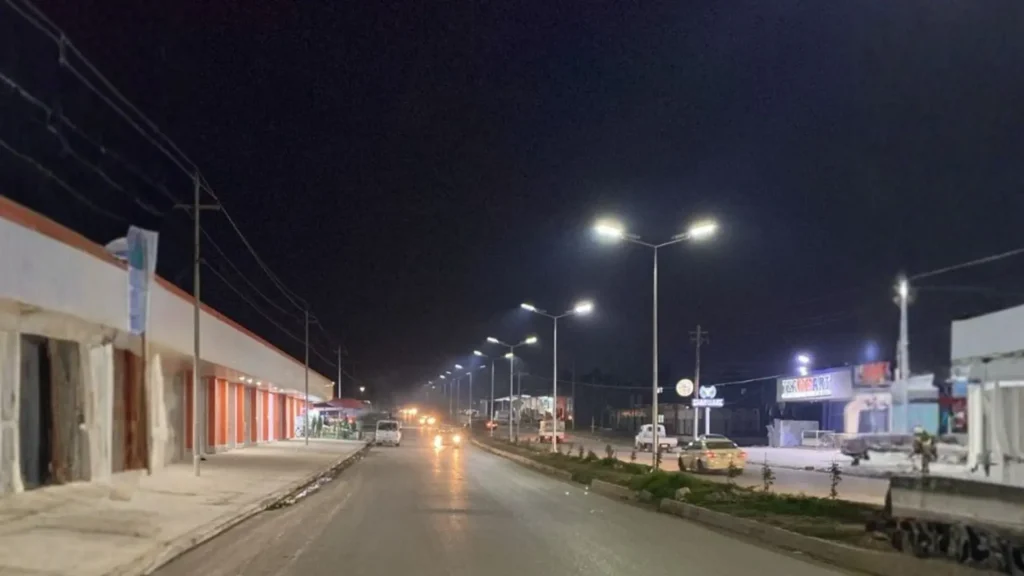
The project adopted a modular deployment strategy across multiple provinces and cities in Iraq, with total installations exceeding 5,000 units. The installation process was straightforward and well suited to local conditions. Foundation pits were excavated to secure foundation cages with C20 concrete, followed by mounting the brackets and luminaires. Lamp posts were then hoisted and fixed in place. No specialized equipment was required, enabling efficient local implementation.
Project Outcomes and Impact
Following commissioning, the project delivered substantial benefits:
Social Value – Safety and Urban Vitality:
Nighttime traffic accident rates decreased by more than 20%. Residents reported improved safety during nighttime travel, while commercial districts experienced a 15% increase in evening foot traffic, revitalizing the urban night economy.
Economic Value – Zero Electricity Costs and Low Maintenance:
Solar-powered operation eliminates electricity expenses, saving millions annually. The self-cleaning system and long-life batteries reduce maintenance costs by approximately 60%, while SRESKY’s three-year warranty further lowers operational risk.
Sustainability – A Green Reconstruction Benchmark:
Annual CO₂ emissions were reduced by thousands of tons, aligning with the United Nations Sustainable Development Goals. The project now serves as a benchmark for green infrastructure development in the Middle East, supporting Iraq’s clean energy transition.
The impact of this project extends beyond Iraq, offering valuable reference value for other developing countries facing similar challenges.
Conclusion
The Iraqi Municipal Road Lighting Upgrade Project demonstrates that the SRESKY THERMOS Series solar street lights are an ideal solution for infrastructure development in emerging economies. By addressing electricity shortages, extreme climate conditions, and sustainability goals simultaneously, the project not only improves public safety but also drives socioeconomic recovery and long-term environmental value.
Table of Contents