
I. Project Background and Needs Analysis: Addressing Lighting Challenges in High-Latitude Climates
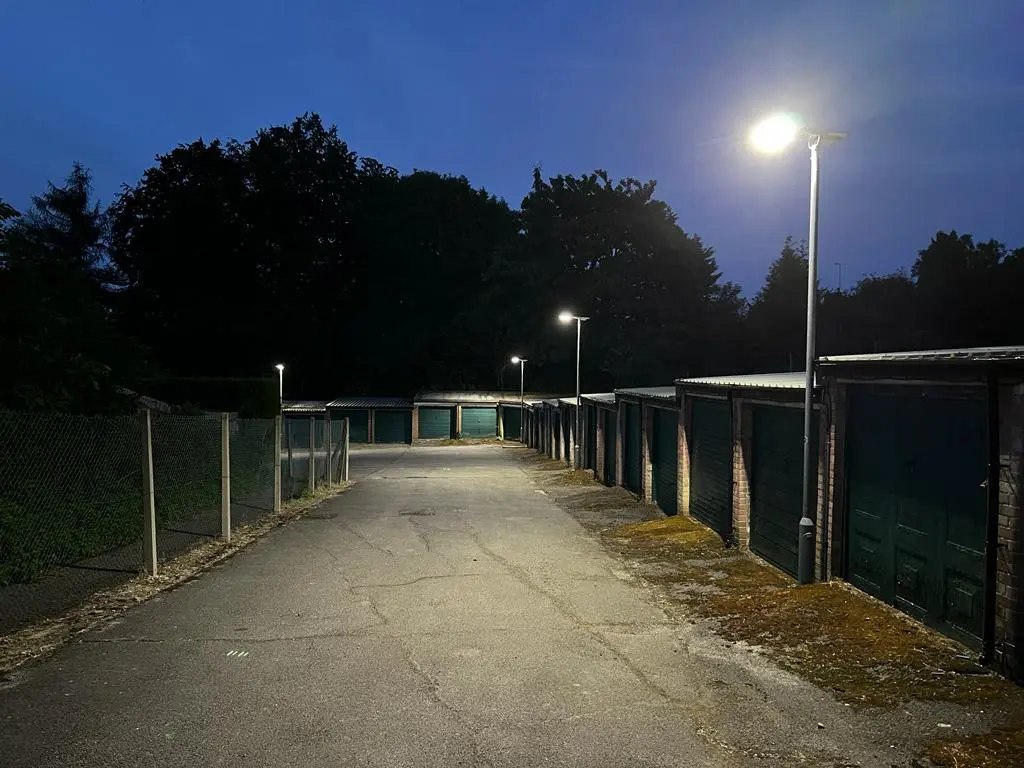
Located between 50°N and 60°N latitude, the UK experiences a typical temperate maritime climate characterized by year-round rainfall, frequent cloud cover, and short winter daylight hours (averaging just 7–8 hours) with low solar intensity. This makes traditional solar street lights prone to performance degradation due to insufficient energy during winter, sometimes even causing “blackouts.” Situated in a typical UK residential area, this project covers streets, parking lots, and green belts, presenting unique lighting challenges.
Project Geographic Context
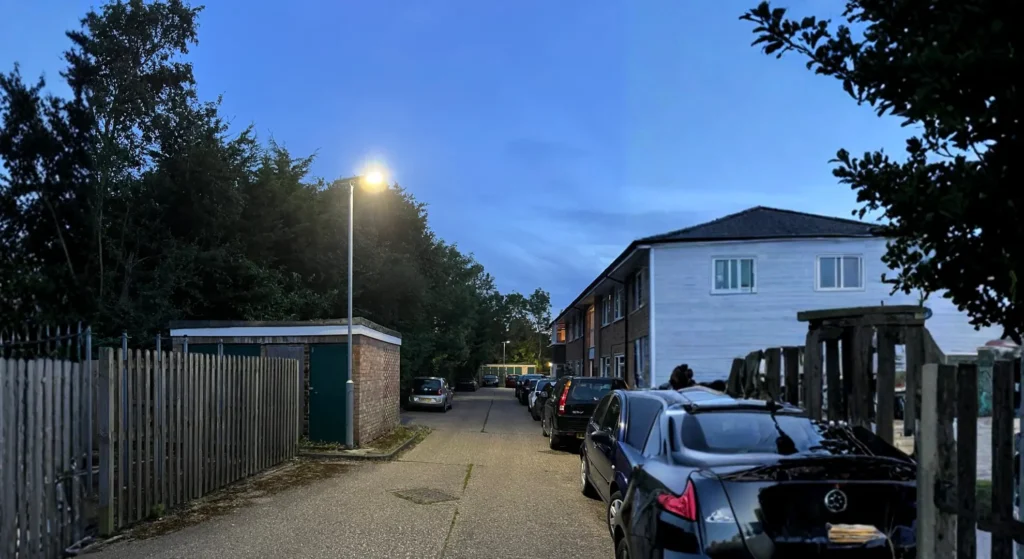
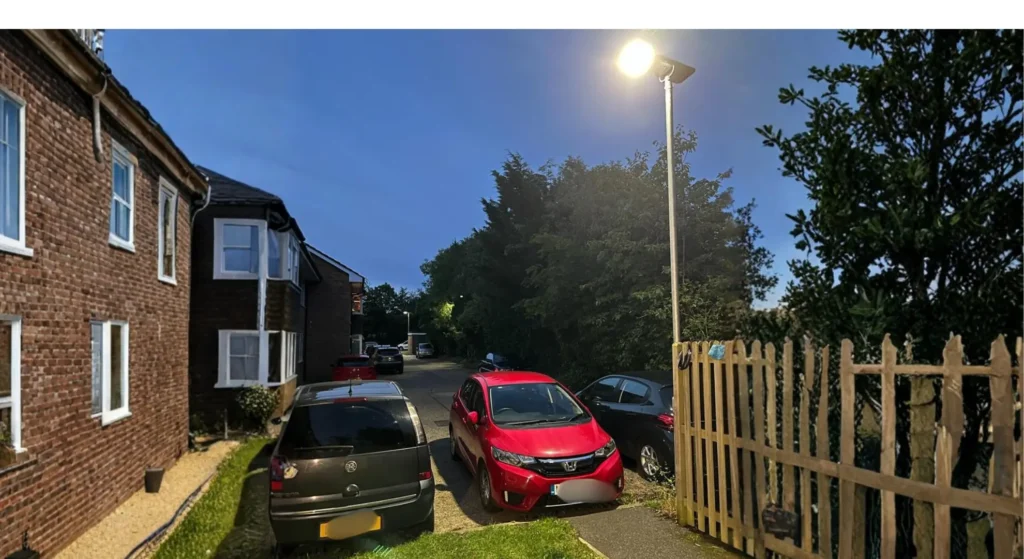
Key features of the project area include dense residential buildings, green vegetation lining both sides of the streets, and diverse parking scenarios (e.g., black SUVs, red compact cars, and other private vehicles). Winter smog and inclement weather further amplify lighting demands: slippery surfaces and reduced visibility increase the risk of pedestrian slips and vehicle collisions. According to UK government data, annual solar radiation averages only 800–1000 kWh/m² in high-latitude regions—significantly lower than the 2000 kWh/m² typical of tropical areas—imposing stringent stability requirements on solar street lights.
Core Community Needs
Residents and administrators conducted detailed needs assessments during the project’s initial phase and identified key pain points:
-
Safety and Security: Nighttime streets and parking lots require sufficient brightness (minimum 2000LM) to ensure pedestrian safety and protect vehicles and property. The parking areas accommodate diverse vehicle types, necessitating the elimination of shadowed blind spots to prevent theft or accidents.
-
Zero-Carbon Transition: Aligning with the UK’s Net Zero by 2050 policy, the community sought renewable energy lighting to reduce public electricity costs (traditional streetlights incur thousands of pounds annually) and lower its carbon footprint. The SRESKY ATLAS series, exemplifying cold-resistant solar street lights, operates entirely on solar power, eliminating fossil fuel dependency.
-
Low-Disruption Installation: Traditional streetlights require cable laying and excavation, which may damage vegetation and disrupt residents’ daily lives. The community demanded a wireless solution for rapid installation and simplified maintenance.
These requirements reflect a widespread trend in UK community lighting upgrades: transitioning from high-energy-consumption sodium lamps to efficient solar systems. The SRESKY ATLAS series is precisely tailored for such challenges, having secured over 3,500 tender projects globally.
II. Technical Solution Design: Core Adaptability of the SRESKY ATLAS Series
To address the UK’s rainy and cold climate challenges, the project selected SRESKY ATLAS series smart solar street lights (SSL-32A~310A). This series integrates multiple core technologies to ensure reliable, all-weather illumination under extreme conditions.
All-Weather Lighting Assurance — ALS 2.2 Technology
The ATLAS series features ALS 2.2 core technology, maintaining over 10 days of illumination during continuous overcast or rainy periods. This technology dynamically adjusts power output via intelligent algorithms: charging efficiently during sunlight and optimizing energy distribution under low-light conditions to prevent battery over-discharge. Compared to traditional solar street lights, ALS 2.2 extends illumination duration by over 30%, effectively addressing the challenge of insufficient daylight during the UK winter. For example, the SSL-32A model can provide continuous lighting for more than 10 days during rainy periods, ensuring uninterrupted illumination on community streets.
Extreme Temperature Protection — TCS Temperature Control System
UK winter temperatures frequently drop below -5°C (23°F). At such temperatures, standard lithium batteries suffer from freezing effects, resulting in reduced charging efficiency and shortened lifespan. The ATLAS series incorporates the TCS system, supporting charging temperatures from 0°C to 45°C (32°F to 113°F) and discharging temperatures from -20°C to 60°C (-4°F to 140°F). This system continuously monitors battery temperature, preventing overheating or freezing and ensuring stable operation in frigid conditions. Combined with an aluminum alloy housing (IP65 waterproof, IK08 impact-resistant), the product withstands the corrosive effects of the British island climate.
High-Efficiency Energy Conversion — BMS and Monocrystalline Panels
The BMS battery management system improves charging efficiency by over 30%. Combined with monocrystalline silicon solar panels with conversion efficiency exceeding 23%, the system effectively captures energy even under low sunlight conditions. This ensures streetlight brightness ranging from 2000LM to 10000LM under the UK’s low-irradiance environment, with LED efficiency reaching 230lm/W (OSRAM 3030 LED, 5700K color temperature, Ra>70).
Smart Sensing and Dimming
A built-in PIR motion sensor (120° wide angle, up to 8m range) supports multiple lighting modes:
-
M1: 30% brightness (rising to 100% upon PIR activation) until dawn
-
M2: 100% brightness for the first 5 hours + 25% (PIR) for the next 5 hours + 70% until dawn
-
M3: 70% brightness until dawn
The Super Remote enables DIY parameter adjustments to adapt to seasonal changes. In areas such as parking lots, default low brightness conserves energy while instantly boosting brightness upon detecting pedestrians or vehicles—balancing energy efficiency and safety.
Additionally, the ATLAS series supports hybrid mode (customizable) and smart lighting control via APP/PC, allowing monitoring of battery and solar panel status, scheduling, and CCT adjustments.
III. Project Outcomes and Impact: A Win-Win for Social Value and Sustainability
Post-implementation results demonstrate significant benefits:
-
Social Value: High-quality lighting reduced nighttime crime risks by over 20%, with residents reporting greater comfort during evening activities. Parking lot blind spots were eliminated, improving vehicle safety.
-
Environmental Contribution: Achieved zero-emission lighting. Using the SSL-310A as an example, its 10,000LM brightness replaces traditional sodium lamps, generating annual carbon savings equivalent to planting hundreds of trees.
-
Economic Benefits: Zero electricity costs and simplified maintenance (thanks to IP65/IK08 protection) enable the community to recover its investment within three years. The BMS system extends battery life to over 1,500 cycles, reducing replacement expenses.
This UK case study has become a benchmark for energy-efficient community lighting, with the SRESKY ATLAS series demonstrating proven reliability in high-latitude regions.
IV. Risks and Mitigation Strategies: Technology Ensures Long-Term Operation
Despite its advanced design, the project proactively addresses potential risks:
-
Risk 1: Extreme Winter Light Deficiency
Mitigation: Remote-controlled mode adjustment (e.g., prioritizing M1 with PIR) ensures over 10 days of illumination through ALS 2.2. Hybrid mode enables AC auxiliary charging, automatically activating when battery capacity falls below set thresholds. -
Risk 2: Structural Erosion from High Winds and Severe Weather
Response: Dual rust-proof brackets combined with IP65 protection resist wind and rain penetration. IK08 impact protection safeguards the equipment from accidental damage.
These strategies ensure long-term stable operation, with full technical support provided by SRESKY.