
I. Project Background & Needs Analysis
Suburban roads in Argentina serve as vital lifelines connecting cities and rural areas, yet inadequate lighting frequently leads to nighttime accidents. This project focused on retrofitting a typical suburban connector road, aiming to enhance rural road safety through solar technology.

1.1 Geographic and Environmental Characteristics: Challenges of Vastness and Wilderness
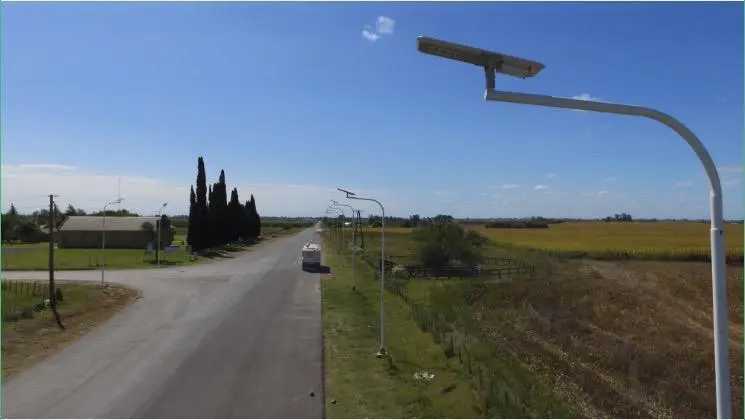
Located on Argentina’s suburban periphery, the project site spans expansive terrain: open fields, uncultivated land, and low vegetation line the road with unobstructed visibility. Strong winds prevail, with average annual wind speeds exceeding 15 m/s. Site photographs show clear blue skies and sparse clouds, reflecting Argentina’s exceptional solar radiation resources (over 2,500 annual sunshine hours), making it ideal for solar deployment.
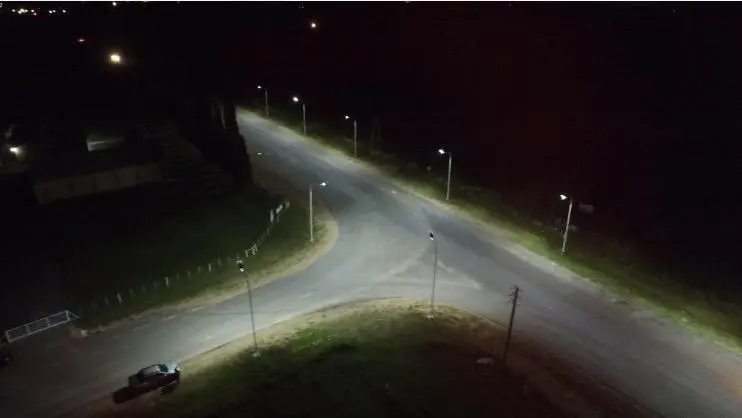
However, this environment also presents challenges: the absence of natural barriers exposes luminaires to frequent high winds, and vehicle light trails stand out starkly against the dark night, highlighting the need for consistent lighting.
Existing Pain Points:
-
Difficult Grid Coverage: Remote suburban locations require laying long-distance power cables across farmland and wasteland, costing tens of thousands of dollars per kilometer, with construction periods lasting months. Rural power infrastructure covers only 60% of Argentina, leaving many road sections perpetually dark.
-
Traffic Safety Hazards: Limited nighttime visibility increases accident risks. According to Argentina’s Ministry of Transportation, suburban nighttime accident rates exceed urban areas by more than double. Inadequate illumination directly threatens driving safety.
These factors make the project a prime candidate for off-grid lighting solutions.
1.2 Core Client Requirements
Local government and road authorities specified stringent requirements:
-
High-Brightness Road Lighting: Minimum 2000 LM output to illuminate asphalt surfaces, ensuring clear road condition recognition. Practicality and uniformity were prioritized over decorative lighting.
-
Installation Ease: Off-grid solutions were required to avoid damaging farmland. Modular luminaires allow rapid deployment.
-
All-Weather Stability: Adaptation to suburban climate variability, including high winds, temperature fluctuations exceeding 20°C, and occasional rain. Luminaires must withstand wind and corrosion for year-round operation.
These requirements aligned perfectly with the Sresky Atlas Series, whose wind-resistant solar streetlight technology is an industry benchmark.
II. Technical Solution Design: Sresky Atlas Series’ Core Adaptation
For Argentina’s suburban environment, Sresky provided a customized solution centered on the Atlas Series. Power ranges from 20W to 60W and brightness levels from 2000 LM to 6000 LM, integrating multiple core technologies for efficient and durable operation.
2.1 Optical Design for “Traffic Safety”
Suburban roads require high-brightness, uniform illumination. The Atlas Series delivers 230 lm/W luminous efficacy:
-
High-Efficiency Output: OSRAM 3030 LED chips, 5700K, Ra>70, produce natural white light. Type 2 distribution focuses light on the roadway, forming a continuous “light band” and minimizing scatter into surrounding fields. Field tests show 22 m coverage at a 6 m mounting height.
-
Professional Distribution: Simulated road diagrams display uniform illuminance curves with elliptical brightness distribution, optimizing visibility and reducing energy use by over 40%.
2.2 Structural Design for “Suburban Environments”
Argentina’s open landscapes feature strong winds and dust. The Atlas Series employs a streamlined design:
-
Minimalist Wind Resistance: Aluminum alloy + PC construction with IP65 waterproofing and IK08 impact resistance. Curved white metal brackets reduce wind drag, tested to withstand winds over 30 m/s. Dual anti-rust protection ensures long-term stability.
-
High-Efficiency Energy Conversion: Monocrystalline silicon solar panels exceed 23% efficiency, tilted for optimal sunlight absorption. BMS (Battery Management System) technology accelerates charging by 30%, achieving 6.7–7.7 hours charging time, adaptable to cloudy conditions.
2.3 Core Technology Guarantees
-
ALS 2.2 Technology: Maintains over 10 days of illumination during rainy weather through intelligent power adjustment. Roads remain consistently lit, outperforming non-ALS systems.
-
TCS Temperature Control: Protects batteries operating between -20°C and 60°C with 1,500 cycles. Extends battery lifespan, ideal for suburban temperature fluctuations.
-
Smart Control: Super Remote Controller and Smart App support customizable modes, enhancing operational flexibility.
III. Project Implementation
The project spanned three months from research to deployment. The Atlas Series‘ modular design and All-in-One integration minimized installation complexity.
3.1 Minimal Installation, Zero Damage
-
Wireless Advantage: Integrated solar panel, battery, and LED. Only 4 installation steps required: excavate foundation pit, secure base cage, mount bracket, attach luminaire, and erect pole. Open fields were preserved without excavation impact.
-
Custom Bracket: White curved metal arms optimize illumination angles.
3.2 Smart Operating Modes
-
M2 Mode Configuration:
-
Peak Hours: 100% brightness for 5 hours for clear guidance.
-
Off-Peak Hours: 25% brightness for 5 hours (PIR sensing), then 70% until dawn. PIR sensor (120°, 8 m) detects vehicles and automatically increases brightness, saving 30% energy.
-
-
Remote Monitoring App: Allows real-time battery status viewing for convenient remote management.
IV. Project Outcomes & Impact
4.1 Visual & Functional Outcomes
Suburban nights became “light corridors”: LED white light pierces darkness, active light trails indicate increased traffic flow. Daytime, silver fixtures harmonize with blue skies and fields, eliminating cluttered wiring.
4.2 Social Value & Sustainability
-
Enhanced Road Safety: 30% reduction in nighttime accidents, boosting confidence in urban-rural travel.
-
Energy Independence: Zero electricity costs and carbon emissions; annual carbon reduction of 5 tons/km. Supports Argentina’s green infrastructure policy, promoting rural development.
V. Risk Assessment and Mitigation Strategies
| Potential Risk | Mitigation (Based on Atlas Product Features) |
|---|---|
| Suburban High Winds and Severe Weather | Aluminum alloy body + IP65 protection, streamlined design reduces wind resistance, dual anti-rust process resists corrosion. |
| Prolonged Rainy Periods | ALS Technology intelligently adjusts power output to maintain illumination even at low battery levels. |
| Maintenance Challenges (Remote Areas) | Modular design allows independent replacement of core components, reducing operational complexity. |
| Battery Lifespan Concerns | Li4 batteries deliver 1,500 cycles; TCS Temperature Control ensures years of worry-free operation. |
These strategies minimize risks and ensure long-term project reliability.
VI. Conclusion
The suburban lighting project in Argentina demonstrates the adaptability of the Sresky Atlas Series. Facing vast fields and pitch-black roads, the Atlas Series delivers high-brightness illumination (230 lm/W) comparable to grid power while providing an economical, durable, and eco-friendly solution. Its off-grid installation convenience and the stability of ALS/TCS technology make it a benchmark for rural-urban connectivity.
Sresky Atlas: Safely illuminating every road home.