
Under the shade of olive trees on the Apennine Peninsula, Italian urban parks are quietly undergoing a sustainable lighting revolution. The Sresky HONOR Series SLL-31 solar street lights, featuring advanced 360-degree lighting technology and an intelligent control system, have been successfully deployed in a lighting renovation project at a modern Italian park. This Italian solar streetlight project has not only improved the lighting quality of the park’s walkways but also advanced municipal landscape enhancement and the implementation of sustainable development solutions.
If you are a municipal planner, landscape architect, or green energy procurer, this article provides professional insights through detailed background analysis, technical explanations, and outcome evaluations to help you assess the feasibility of similar park lighting projects.
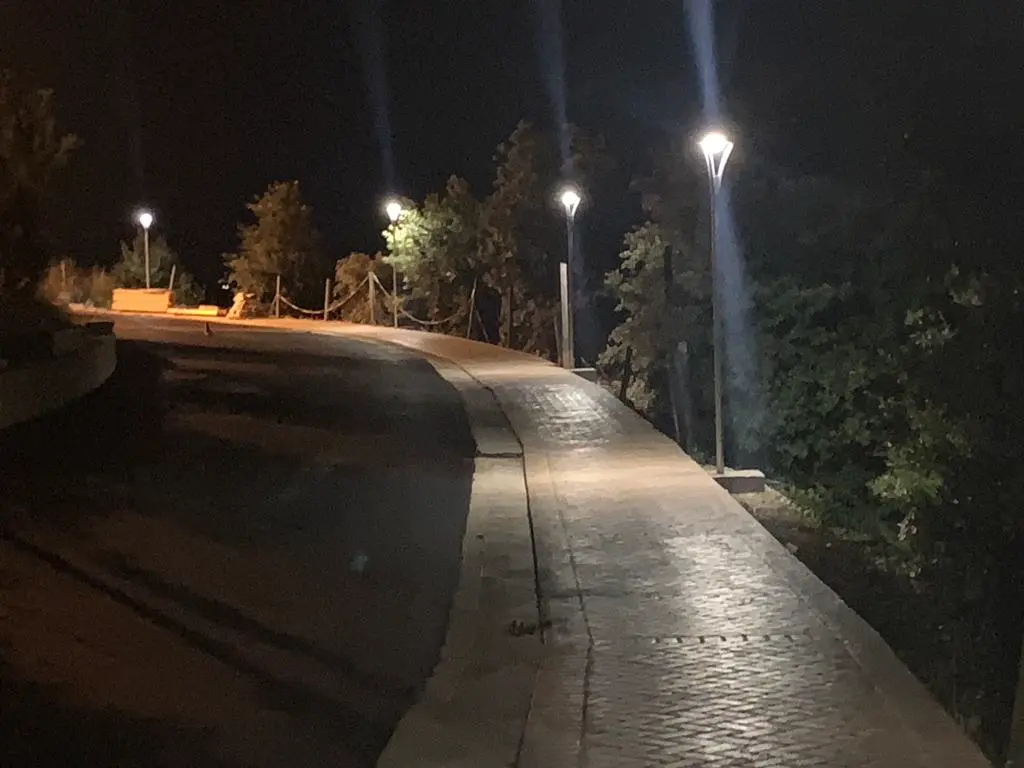
I. Project Background and Needs Analysis
As a crossroads of European culture and natural landscapes, Italy’s urban parks often blend historical landmarks with modern recreational functions. This project is located in a modern park in Italy, situated in a Mediterranean climate zone where summer temperatures can exceed 35°C, while winters are rainy, with temperatures dropping below 0°C.
The park environment features lush greenery, stone-paved walkways, and asphalt roads, attracting large numbers of residents for evening strolls, jogging, and family outings. However, the limitations of traditional lighting systems have become increasingly apparent, creating an urgent need for innovative solutions.
The core pain points stem primarily from real-world usage scenarios:
- Nighttime safety is the primary concern. Blind spots exist at intersections of park paths and asphalt roads, increasing the likelihood of collisions between pedestrians and slow-moving vehicles (such as bicycles), especially during cloudy or rainy weather when visibility is poor.
- Energy consumption and sustainability pressures are significant. In response to the EU’s “Fit for 55” carbon reduction policy, the Italian government requires municipal facilities to reduce emissions and adopt lighting solutions with zero electricity costs and zero emissions. Traditional grid-connected streetlights consume large amounts of electricity and incur high maintenance costs.
- Installation complexity cannot be overlooked. Cable laying damages existing landscapes, such as stone paths and surrounding vegetation, disrupting ecological balance.
- Aesthetic compatibility is essential. Lighting fixtures must blend seamlessly with the park’s modern, minimalist style, avoiding visual disruption.
These challenges highlight a key question for municipal lighting upgrades: how to balance functionality, sustainability, and aesthetics? The introduction of the Sresky HONOR Series provides a precise answer.
II. Technical Solution Design
After multiple rounds of evaluation, the project team selected the Sresky HONOR Series SLL-31 solar landscape streetlight. This product features an integrated design that combines the solar panel, lithium battery, and LED light source into a single unit, eliminating the need for traditional wiring.
Why choose the HONOR SLL-31?
The key lies in its innovative, environment-specific technology, ensuring efficient and reliable lighting performance.
The primary advantage is its 360° all-around illumination. The SLL-31 features a large lens design that delivers circular light distribution, effectively covering sidewalks and roadside green belts while eliminating shadow zones typical of conventional fixtures. Optical simulations show a uniform illuminance gradient within a 12-meter range, ensuring no visual blind spots on curved or straight paths.
With a high output of 3,000 lumens, an efficiency of 230 lm/W, a color temperature of 4,000K, and a color rendering index (Ra) >70, the system provides clear and natural visibility, fully compliant with the European urban lighting standard EN 13201.
Core Technological Advantages
- Adaptive Lighting System (ALS):
Ensures continuous operation for over 10 days during rainy or overcast conditions. Intelligent algorithms monitor solar input and automatically adjust brightness modes:- M1: 15% until dawn + PIR 30s
- M2: 30% (first 5 hours) + 15% PIR 30s
- M3: 35% until dawn
- Temperature Control System (TCS):
Designed for extreme conditions (-10°C to 60°C), protecting the lithium-ion battery (14.8V, 115.44Wh) from thermal stress and extending lifespan to 3–5 years. - High-efficiency solar panel:
Monocrystalline silicon (16.2V/18.75W) with a charging time of only 6.7 hours (charging: 0°C–45°C; discharging: -45°C–60°C). - Dark Sky technology:
Minimizes light pollution while preserving nighttime visibility and environmental harmony.
Additionally, dual PIR motion sensors (120° × 2° detection, up to 8 meters) enable intelligent lighting behavior: lights brighten when people approach and dim when they leave. This feature can reduce energy consumption by up to 70% during low-traffic periods.
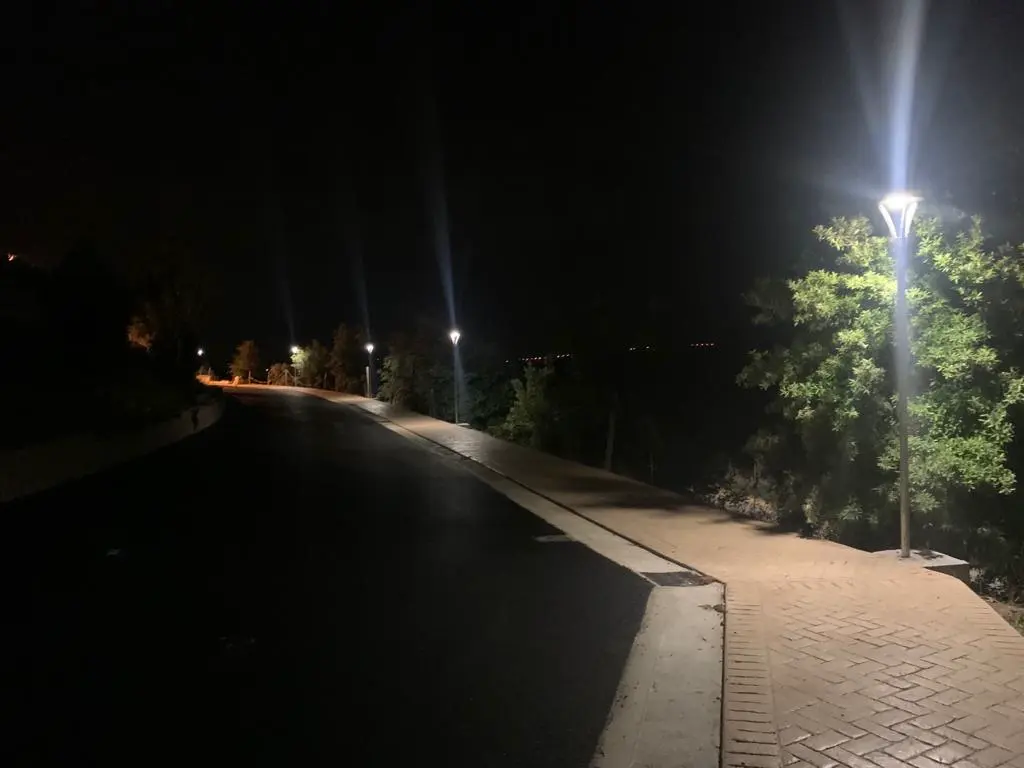
III. Project Outcomes and Impact
Since implementation, the project has delivered results that exceed expectations, particularly in visual quality and environmental impact.
Soft lighting enhances the appearance of damp stone pathways and surrounding trees, creating a calm and harmonious nighttime atmosphere. Meanwhile, consistent illumination along asphalt paths provides clear navigation for runners and pedestrians, eliminating dark zones and significantly improving safety.
According to user feedback, nighttime park usage has increased by over 20%.
Socio-economic Benefits
- Improved public safety: Reduced risks of falls and collisions
- Enhanced community value: Modern lighting design has become a visual highlight
- Replicable model: Serves as a benchmark for sustainable urban lighting projects across Italy and Europe
Overall, the project demonstrates how solar street lighting can play a central role in urban green transformation.
IV. Risks and Mitigation Strategies
While the project has been successful, outdoor environmental risks must be considered.
- Extreme weather conditions:
Heatwaves may cause battery overheating. The TCS system ensures stable operation within -10°C to 60°C through real-time temperature regulation. - Maintenance and durability:
The IP65 waterproof rating protects against rain and moisture, while the modular design allows quick component replacement, reducing maintenance costs. - Theft and structural risks:
Reinforced mounting structures and high-strength aluminum alloy/PC materials ensure durability in public environments. - Battery management:
The ALS system optimizes energy usage during low-sunlight conditions, enabling up to 10 days of runtime.
The Sresky system is supported by a 3-year warranty and optional remote monitoring, ensuring long-term reliability.
Through this Italian solar streetlight project, we see how the Sresky HONOR Series seamlessly integrates advanced technology with real-world application needs. In the context of EU carbon reduction policies, this case provides valuable, scalable insights for municipalities worldwide seeking sustainable lighting solutions.