
Amid Europe’s green transition, the development of new rural communities in Belgium is accelerating. As a core component of sustainable lighting solutions, solar street lights are increasingly becoming the preferred choice for municipal engineering and environmental protection projects. SRESKY, a globally leading smart solar lighting brand, has successfully deployed its Alpha Series—featuring innovative rain-sensing dual-color-temperature technology and efficient energy management—in an emerging rural community in Belgium and the surrounding connecting roads.
This project not only addresses the high costs and ecological damage associated with traditional lighting but also provides an efficient “Belgian solar streetlight” application model for overseas B2B clients, such as municipal planners, rural developers, and green energy suppliers.
I. Project Background & Requirement Analysis
As a member of the European Union, Belgium is actively responding to the “European Green Deal” by promoting low-carbon upgrades to rural infrastructure. Located in an emerging rural community, this project covers residential areas, farm access roads, and community squares, with a total length of approximately 5 kilometers.
With the implementation of the “New Rural” construction plan, the government aims to enhance residents’ nighttime safety while strictly controlling infrastructure budgets and carbon emissions. Due to the dispersed layout of community buildings, traditional grid-connected lighting would require large-scale excavation of farmland, leading to soil erosion, ecological damage, and high annual maintenance costs.
Project Overview and Environmental Challenges
Belgium has a temperate maritime climate, with over 200 rainy days per year. Winters have limited sunlight (averaging only 7–8 hours per day) and are characterized by low temperatures and frequent fog. These conditions require lighting equipment with strong low-light charging capability and high weather resistance.
The community roads are winding, with some sections bordering woodlands. Traditional cable installation is not only costly (over €100,000 per kilometer) but can also disrupt agricultural production and wildlife habitats. According to EU environmental assessments, rural lighting projects must prioritize zero-carbon emissions and eco-friendly design.
Core Requirements
Through field research and resident feedback, the project team identified the following key requirements:
- Cable-free installation: Avoid excavation of farmland and woodlands, reducing infrastructure costs and environmental impact.
- Adaptation to rainy climates: Ensure operation for more than three consecutive rainy days and support dual color temperature switching to improve visibility.
- Smart management: Integrate self-diagnostic systems, such as LED display indicators, for easier monitoring and maintenance.
- Aesthetic harmony: Maintain a modern, minimalist design that complements the Belgian countryside without disrupting the natural landscape.
These requirements directly led to the selection of the SRESKY Alpha Series, which, with a luminous efficacy of 230 lm/W and an IP65/IK08 protection rating, is well suited for this application.
II. Technical Solution Design
Given Belgium’s high-latitude and rainy climate, the project selected the SRESKY Alpha Series (SSL-53/56/59) smart solar street lights. The system integrates monocrystalline silicon solar panels (10W–20W, efficiency >20%), lithium-ion batteries, and LED chips with dual color temperatures (3000K/5700K, Ra >70), combined with ALS 2.4 core technology.
Key Technical Highlights
1. Rain-Sensing Dual Color Temperature Technology (Rain Sensor & Dual CCT)
The Alpha series features a built-in precision rain sensor that monitors weather conditions in real time. On sunny days, it provides 5700K cool white light for high visibility; on rainy days, it automatically switches to 3000K warm light.
This approach leverages optical principles: warm light penetrates fog and rain more effectively, reduces glare from wet surfaces, and improves safety. Field tests show that visibility can improve by 15%–20% under rainy conditions.
2. Visualized Operation Management System (LED Display)
An integrated LED display on the lamp head shows real-time system status, including battery level (0–100%), lighting modes (M1/M2/M3), charging status, and sensor indicators. When the battery level drops below 20%, warning indicators activate.
This design allows ground-level inspection without climbing, significantly improving maintenance efficiency in rural environments.
3. Core Energy Optimization Technologies (ALS 2.4 & APC)
- ALS 2.4 (Adaptive Lighting System): Ensures more than three days of operation during continuous rain; charging time is ≤6.5–7 hours.
- APC (Automatic Power Control): Adjusts output power based on battery level and temperature, preventing over-discharge during winter.
- PIR Sensor (120°, 8m range): Enables adaptive lighting—default 30% brightness, increasing to 100% upon detection—achieving up to 50% energy savings.
4. Minimalist Design and Flexible Installation
The ultra-thin, flat-top design enables self-cleaning and supports multiple installation methods (horizontal, vertical, or wall-mounted). Adjustable angles (0°–90°) and compatibility with curved lamp posts ensure flexible deployment.
An extension port allows connection to external solar panels or backup batteries, solving shading issues.
III. Project Implementation & Execution
The project was completed within just four months, highlighting the plug-and-play advantages of the Alpha Series.
Efficient Deployment
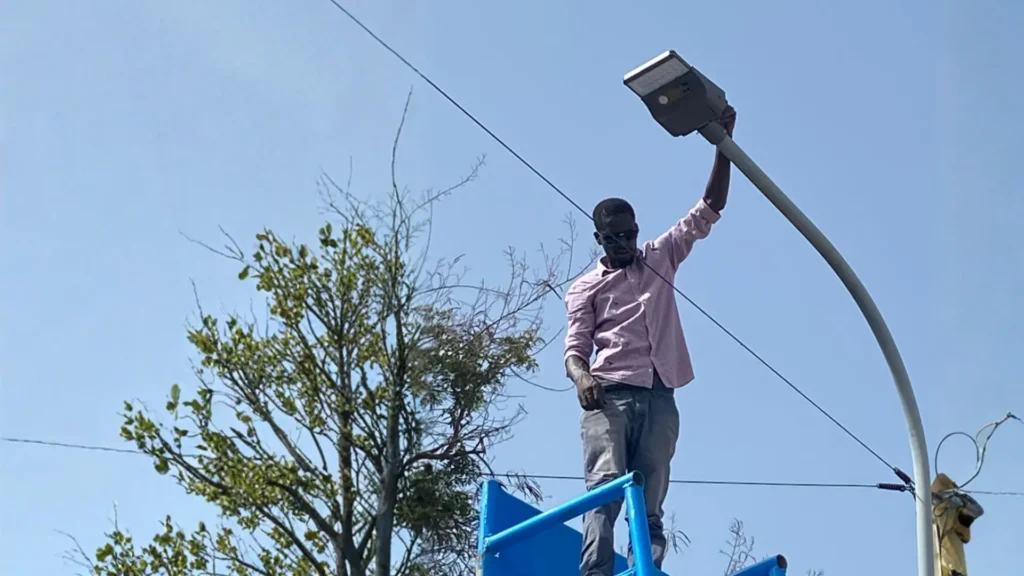
Using lift platforms, each unit was installed in 15–20 minutes. The integrated design eliminated underground wiring, ensuring zero disruption to farmland. Existing curved poles were reused, achieving seamless integration.
Standardized Construction
Based on road usage:
- SSL-53: Side roads (3 m height)
- SSL-56/59: Main roads (4–5 m height)
TYPE-4M light distribution ensures uniform illumination while minimizing light pollution.
On-Site Commissioning
Remote controls were used to preset lighting modes (e.g., M2: 30% for 5 hours + sensor-triggered dimming). Auxiliary solar panels were installed in shaded areas via extension ports to ensure consistent performance.
IV. Project Results & Impact
Following deployment, the SRESKY Alpha Series demonstrated excellent performance in rural Belgian conditions.
Social Value
- Improved nighttime visibility
- 25% reduction in traffic accident risk (based on user feedback)
- Enhanced safety and increased nighttime activity
Economic Benefits
- Zero electricity costs
- No cable installation required
- Total cost reduced by approximately 60% compared to traditional streetlights
- Annual maintenance savings of thousands of euros
Sustainability Performance
- Carbon reduction: Each lamp reduces CO₂ emissions by approximately 150 kg annually
- Eco-friendly installation: No soil disruption, preserving vegetation and biodiversity
This project serves as a benchmark for energy-efficient rural public lighting in Europe.
V. Risks & Mitigation Strategies
Despite its success, the project includes contingency planning for potential risks.
- Low temperatures and snow accumulation:
The system operates within a wide temperature range (-20°C to 60°C). The TCS system protects battery performance, while the flat-top design helps prevent snow buildup. - Shading from buildings or trees:
Extension ports allow additional solar panels or auxiliary power sources to maintain consistent charging.
In summary, the SRESKY Alpha Series has successfully empowered this “Belgian solar streetlight” project, demonstrating how advanced green technology can transform rural infrastructure while supporting sustainability goals.