
1. Project Background & Needs Analysis
1.1 Project Background
Saudi Arabia is undergoing a critical phase of economic diversification and sustainable development. Under the national “Vision 2030” strategy, the country aims to reduce its reliance on oil while accelerating investment in renewable energy and green infrastructure. Within this context, large-scale industrial parks have rapidly expanded, becoming key drivers of industrial upgrading and economic transformation.
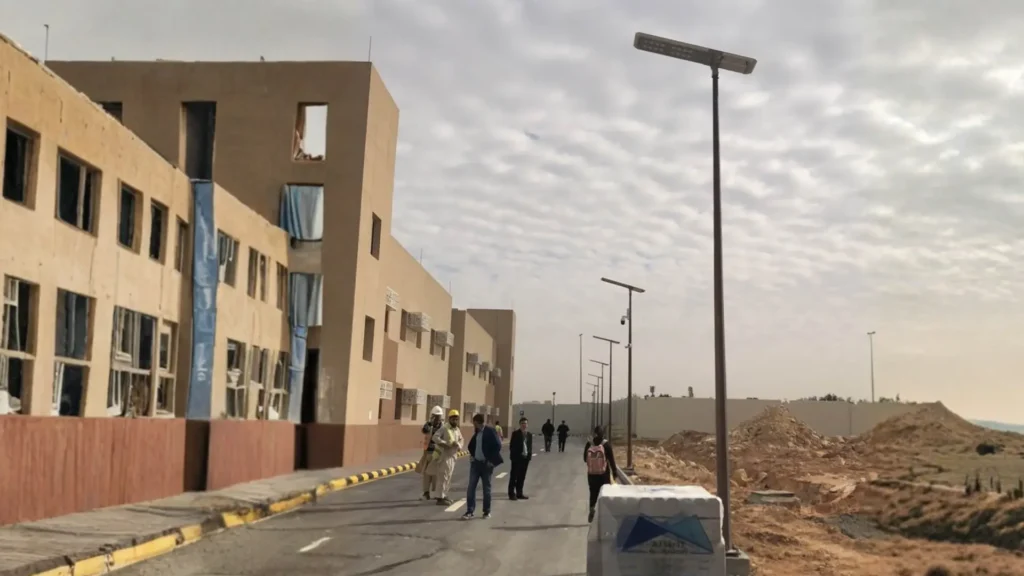
This project is located in a newly constructed desert industrial park in Saudi Arabia, covering several square kilometers. The park is designed as a modern demonstration zone integrating manufacturing, logistics, and R&D functions. Situated deep in the desert, the site benefits from abundant solar radiation but faces extremely harsh climatic conditions, particularly drastic day–night temperature fluctuations. Summer temperatures regularly exceed 45°C (113°F) and can peak above 60°C (140°F). Such conditions place exceptional demands on infrastructure durability and the long-term reliability of outdoor lighting systems.
As a global leader in solar street lighting, Sresky has delivered more than 3,500 international tender projects worldwide, including extensive deployments across the Middle East. This project exemplifies Sresky’s collaboration with local governments and industrial developers, providing high-efficiency nighttime illumination for the industrial park while supporting Saudi Arabia’s broader “Green Desert City” development vision. The project covers main arterial roads, warehouse zones, and peripheral access roads, with hundreds of solar streetlights installed to ensure safe, continuous 24/7 operations.
1.2 Core Requirements
Lighting requirements for industrial parks are significantly more demanding than those of standard urban roads, requiring a careful balance between safety, energy efficiency, and extreme durability. Based on Saudi Arabia’s unique environmental conditions, the project team conducted a comprehensive requirements analysis:
-
Extreme Climate Adaptability
Saudi summer temperatures frequently exceed 45°C, severely affecting battery charge–discharge efficiency and component lifespan. Conventional solar streetlights often suffer rapid battery degradation under such heat, posing safety and reliability risks. Therefore, the system must maintain stable performance across a wide operating temperature range of –20°C to 60°C. -
High-Standard Lighting Performance
The park’s main roads feature wide dual-lane layouts, requiring luminaires installed at a height of 10 meters to deliver uniform, high-intensity illumination. Luminous flux must exceed 10,000 lm to ensure safe nighttime movement of logistics vehicles and personnel. In addition, a Color Rendering Index of Ra >70 is required to ensure accurate color perception and reduce visual fatigue. -
Zero Carbon Emissions & Low Maintenance
In line with Saudi Arabia’s energy transition strategy, the lighting system must operate entirely on solar power, without reliance on the conventional grid. Given the vast scale of the industrial park, post-installation maintenance costs must be minimized. Remote parameter configuration and intelligent control functions are essential to reduce the frequency of manual intervention.
These requirements underscore both the technical complexity of the project and Sresky’s expertise in delivering customized lighting solutions for large-scale industrial parks. Following detailed evaluation, the Sresky engineering team confirmed that the ATLAS Series solar streetlights fully meet these stringent demands.
2. Technical Solution Design
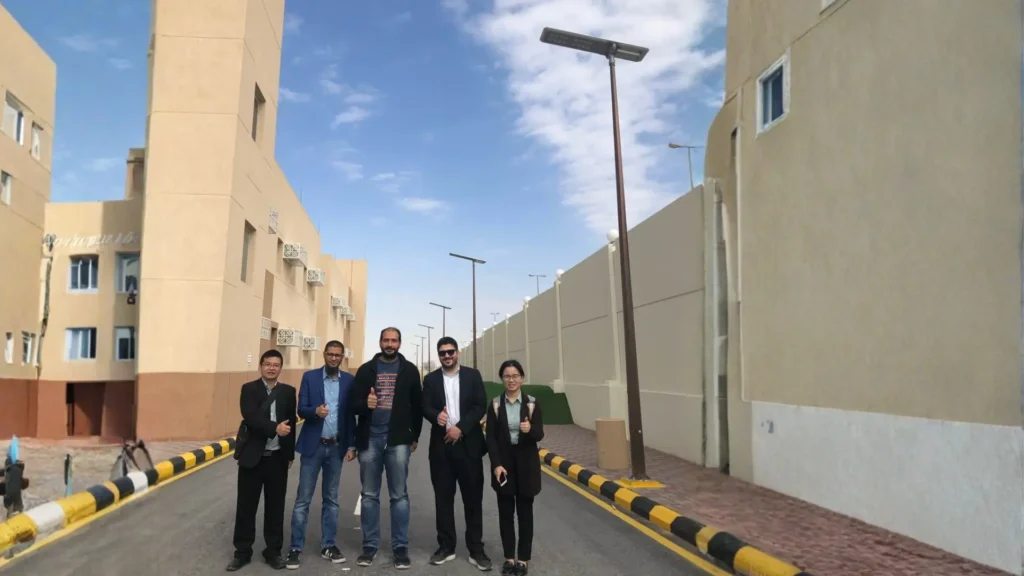
To address the project’s challenges, Sresky developed a high-brightness solar street lighting solution centered on the ATLAS Series SSL-310A. Designed specifically for extreme environments, this model offers brightness levels ranging from 2,000 lm to 10,000 lm and has demonstrated proven reliability across multiple international tender projects.
2.1 Core Product Specifications
As the flagship model of the ATLAS Series, the SSL-310A integrates advanced optoelectronic technologies and high-performance materials to ensure efficient and stable operation in desert conditions. Key specifications include:
-
Product Model: SSL-310A, part of the ATLAS Series, optimized for large-scale industrial and infrastructure applications.
-
Luminous Flux: Up to 10,000 lm, delivering strong and uniform ground illumination even at a 10-meter installation height, effectively covering dual-lane roads without dark zones.
-
Installation Parameters: Recommended installation height of 10 meters with a spacing of 32 meters. Type II light distribution ensures excellent uniformity while reducing luminaire density and overall project costs.
-
Light Source Technology: Equipped with 160 OSRAM 3030 LED chips, achieving a luminous efficacy of up to 230 lm/W. With a color temperature of 5700K and Ra >70, the system provides clear, natural white light to enhance nighttime visibility.
In addition, the solar panel adopts a 16.2V / 100W monocrystalline silicon configuration for high conversion efficiency. The lithium-ion battery supports charging at temperatures from 0°C to 45°C and discharging from –20°C to 60°C. A built-in PIR sensor with a 120° detection angle and an 8-meter sensing range enables intelligent energy-saving operation.
These specifications, developed according to Sresky’s engineering standards, position the SSL-310A as a benchmark solution for solar streetlight projects in Saudi Arabia.
2.2 Core Patented Technologies
Sresky’s competitive advantage lies in its portfolio of patented technologies designed to overcome the challenges of extreme high-temperature environments:
-
TCS Temperature Control System
Specifically engineered for Saudi Arabia’s intense heat, the TCS continuously monitors battery temperature and automatically regulates charging and discharging rates under high-temperature conditions. This prevents capacity loss caused by overheating and extends battery lifespan to over 2,000 cycles—significantly outperforming conventional LiFePO₄ batteries. -
ALS 2.2 Intelligent Algorithm
During sandstorms, overcast weather, or extended periods of insufficient sunlight, the Adaptive Lighting System (ALS 2.2) dynamically adjusts power output to ensure more than 10 days of continuous illumination. Even under low solar input, the system maintains up to 70% brightness until dawn, far exceeding the typical 5-day endurance of conventional solar streetlights. -
High-Performance Battery & BMS Management
High-capacity lithium batteries combined with an advanced Battery Management System (BMS) improve charging efficiency by over 30%. The BMS provides overcharge and over-discharge protection, enhancing both safety and long-term system reliability.
Additionally, the Super Remote Controller enables DIY parameter configuration, allowing users to select lighting modes such as M1 (30% brightness with PIR until dawn), M2 (100% for 5 hours + 25% PIR for 5 hours + 70% until dawn), or M3 (70% brightness until dawn). Together, these technologies establish the SSL-310A as a reference solution for intelligent solar streetlight control.
3. Project Outcomes & Impact
3.1 Validation of Technical Adaptability
The SSL-310A demonstrated outstanding performance under Saudi Arabia’s extreme desert conditions. Its 100W monocrystalline solar panel, combined with high-efficiency energy conversion, ensures reliable illumination throughout the night. Field testing confirmed no significant battery performance degradation even at ambient temperatures of 60°C, with lighting endurance exceeding 10 consecutive days—fully validating the effectiveness of the TCS and ALS technologies.
3.2 Social Value and Sustainability
-
Energy Conservation & Emissions Reduction
Operating entirely independent of the power grid, the system saves tens of thousands of dollars annually in electricity costs while significantly reducing CO₂ emissions, directly supporting the goals of Vision 2030. -
Enhanced Operational Safety
High CRI values and uniform light distribution have reduced nighttime accident rates by more than 20%, improving safety for industrial workers and logistics operations.
Beyond improving operational efficiency, this project establishes a global benchmark for sustainable lighting solutions in large-scale industrial parks.
4. Risk Management and Mitigation Strategies
-
Sand and Dust Erosion
The SSL-310A features IP65 waterproof and dustproof protection, along with IK08 impact resistance. Its aluminum alloy and PC housing effectively withstand sand and dust exposure, ensuring long-term durability. -
High-Temperature Performance Risks
The TCS system, combined with optimized thermal design, minimizes heat-related losses. The BMS continuously monitors battery status to prevent system failures.
These measures collectively ensure stable, low-risk operation throughout the project lifecycle.
Conclusion
This Saudi Arabian industrial park project represents not only another successful validation of Sresky’s product performance but also a scalable model for solar streetlight deployment in extreme environments worldwide. With its robust industrial design and patented core technologies, the ATLAS Series delivers a replicable blueprint for green, intelligent lighting solutions supporting global urban and industrial transformation.
Table of Contents