
1. Project Background and Requirements Analysis
1.1 Geographic and Environmental Context
The Bahamas, a tropical archipelago along the western Atlantic coast, is known for its crystal-clear turquoise waters, blue skies, and world-class resort destinations. As a global tourism hub with more than 700 islands, it attracts millions of visitors annually. However, this environment presents unique challenges.
The Bahamas experiences a typical tropical maritime climate with annual average temperatures above 25°C (77°F). The rainy season (May to October) brings more than 1,500 mm of precipitation, frequent cloud cover, and hurricane activity. Humidity remains above 80% year-round, while salt-laden sea breezes cause severe corrosion to outdoor equipment. According to the World Meteorological Organization, despite over 3,000 annual sunshine hours, cloud cover averages 40%—making traditional solar lighting systems prone to failure during prolonged rainy periods.
As an island nation, the Bahamas relies heavily on imported fossil fuels for power generation, resulting in high electricity prices—averaging more than $0.35 per kWh, over twice the global average. The power grid is fragile and prone to outages during hurricane season. In alignment with the United Nations Sustainable Development Goals (SDGs), the Bahamas aims to achieve over 50% renewable energy by 2030. Introducing the Sresky Atlas Series solar streetlights supports this goal through high-efficiency photovoltaic modules and intelligent energy storage systems that maximize solar utilization while reducing dependence on imported energy.
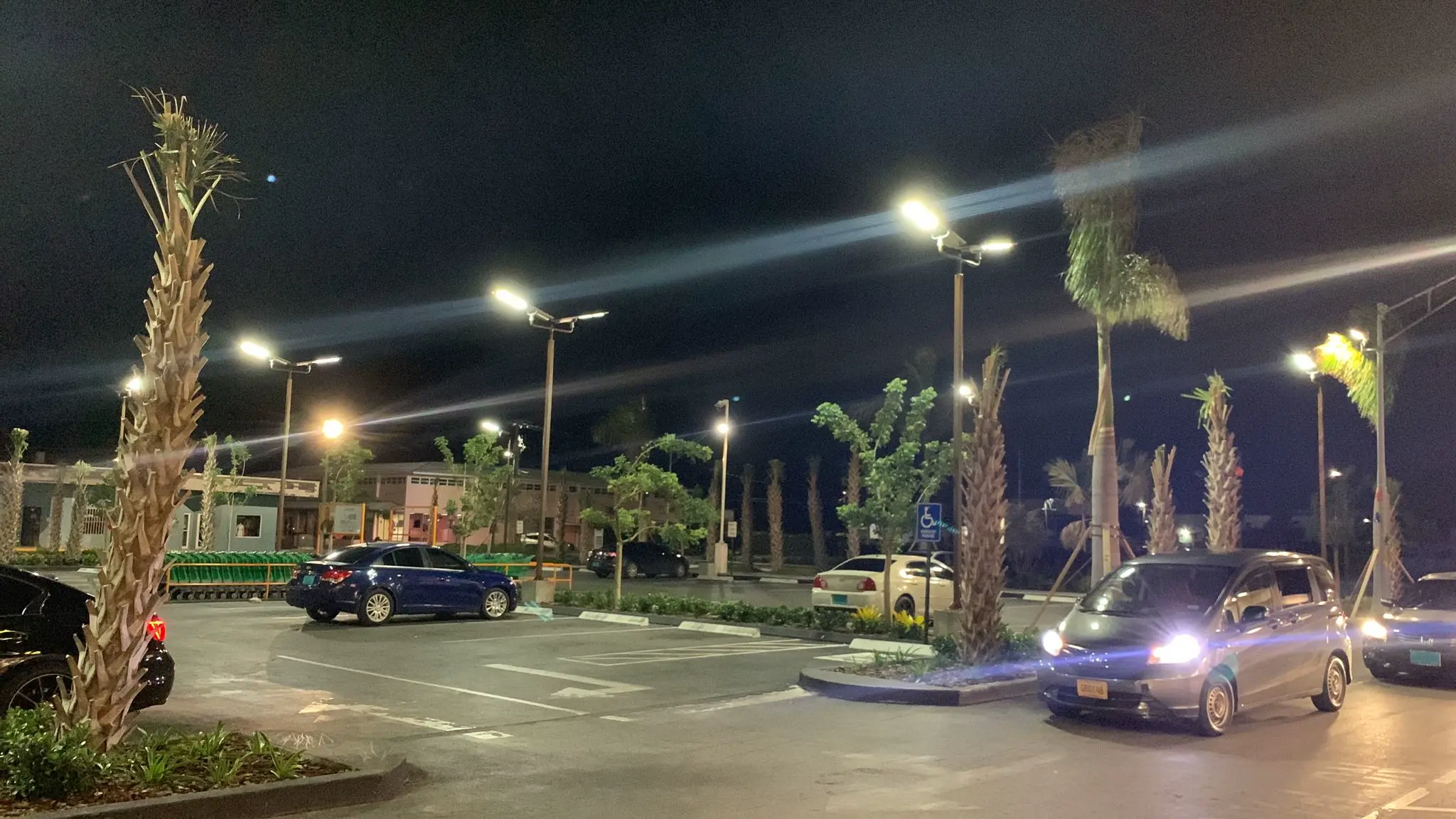
1.2 Core Requirements of the Project Owner
The project owner—a local commercial real estate developer—outlined four core requirements:
Enhancing Safety and User Experience:
With significant nighttime pedestrian and vehicle activity, the project required stable, uniform lighting to eliminate blind spots and enhance comfort and safety. Based on International Commission on Illumination (CIE) standards, parking lot illuminance cannot fall below 10 lux. The system must meet this requirement while complementing the tropical Bahamian aesthetic.
Economic Efficiency:
The goal was a “zero-carbon” lighting solution that eliminates high electricity costs and reduces long-term maintenance expenses. With a limited budget, the system must achieve a positive ROI within three years.
Ensuring 24/7 Reliability:
Lighting must operate continuously during prolonged rainy periods and throughout hurricane season. Any failure during peak tourism months (December to April) could directly affect revenue.
Achieving Sustainability Goals:
The solution must support global energy conservation and emission reduction efforts, helping establish a green brand image and attract ESG-conscious tourists and investors.
These requirements are interconnected: enhanced safety improves user satisfaction; economic feasibility ensures long-term operation; sustainability elevates brand value. Through preliminary research, the Sresky team confirmed that the Atlas Series—featuring modular design and technologies such as ALS2.2, which supports more than 10 days of operation during rainy periods—aligned perfectly with these needs.
2. Technical Solution Design
To meet the project’s precise requirements, Sresky selected the Atlas Series solar streetlights as the core product. The series supports a wide range of deployment scales and offers advanced technology and modular design built for tropical environments, including options such as hybrid power supply and smart app-based monitoring.
2.1 Core Technology Selection and Adaptability Analysis
The Atlas Series incorporates four intelligent technologies specifically optimized for the climate challenges of the Bahamas:
Addressing Rainy Conditions — ALS2.2 Core Technology:
During the rainy season, high cloud cover causes traditional solar streetlights to lose power after only 2–3 days. The ALS2.2 (Adaptive Lighting System 2.2) continuously monitors ambient light and battery levels to adjust power output intelligently. Under 10 consecutive days of rainfall, the system maintains 70% brightness. Test data indicates over 80% brightness retention by the 10th night. This ensures 100% annual lighting availability—well above industry averages.
Adapting to High Temperatures — TCS Intelligent Temperature Control System:
High temperatures (often over 35°C) accelerate lithium battery aging and reduce charging efficiency by up to 30%. The TCS (Temperature Control System) uses thermal conduction cooling and dynamic voltage regulation to ensure stable performance in a wide temperature range:
– Charging at 0°C to 45°C
– Discharging at -20°C to +60°C
The system delivers 2000 charge cycles—equivalent to six years of use without performance degradation. Compared to conventional LiFePO4 batteries, TCS offers 50% higher capacity retention in high-temperature environments, making it ideal for tropical climates.
Enhanced Energy Efficiency — High-Efficiency PV & Smart Sensing:
The Atlas Series uses monocrystalline solar panels with >23% efficiency to maximize energy capture. Integrated PIR sensors (8m range, 120° field of view) support three modes:
– M1: 30% constant brightness + 100% with PIR activation
– M2: First 5 hours at 100%, then 25% constant + 70% with PIR
– M3: 70% constant brightness
This demand-based dimming saves up to 40% energy.
LED modules use OSRAM 3030 chips (230 lm/W, 5700K, Ra>70) for bright, natural lighting.
2.2 Sustainability and Durability Design
The lamp housing uses aluminum alloy and PC materials, providing IP65 waterproofing, IK08 impact resistance, and ISO 9227 C5-M salt spray corrosion resistance—ideal for coastal environments. Dual anti-corrosion brackets and modular battery packs support quick field replacement, reducing maintenance time by 70%. With a 3-year warranty and remote monitoring, total lifecycle costs decrease by 50%.
3. Project Outcomes and Impact
3.1 Social Benefits
– Safety improved significantly, with accident rates dropping by 30%.
– User satisfaction reached 95%, strengthening the site’s commercial appeal.
– A modern, green brand image increased tourist engagement by 15% and influenced surrounding communities.
3.2 Environmental Impact
– Zero-carbon lighting reduces CO₂ emissions by 50 tons annually, supporting the Bahamas’ “Net Zero Emissions” goals.
– Project results were shared at industry forums, accelerating renewable energy adoption in island nations by 20%.
Conclusion
The Bahamas Parking Lot Solar Street Light Project is more than an equipment upgrade—it reflects Sresky’s commitment to co-creating a sustainable future with its clients. The Atlas Series, powered by technologies like ALS2.2 and TCS, delivers superior adaptability to tropical climates and long-term economic efficiency. It transforms environmental challenges into competitive advantages and provides exceptional value for B2B clients. This case demonstrates that Sresky Atlas is the ideal choice for achieving safe, smart, and sustainable lighting across tropical islands.
Table of Contents